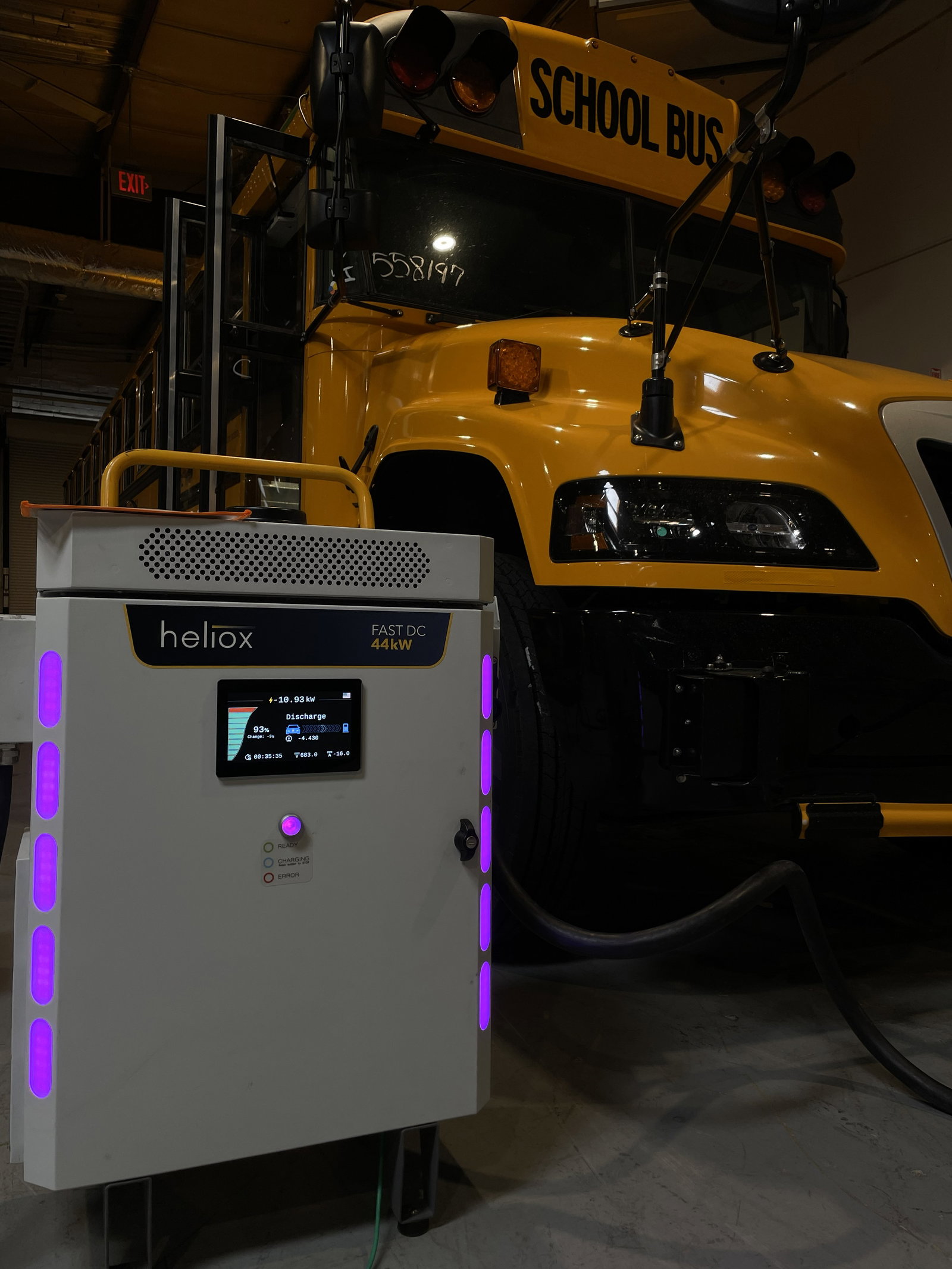
The unmistakable yellow of a school bus paired with the purple glow of a Heliox bidirectional charger, this V2G system highlights the next generation of fleet innovation and clean‑energy leadership
A Sustainable, Economic Solution for School Districts and Electric Utilities
By: Marlene Biehl, Product Management Lead, Heliox, A Siemens Business
The iconic yellow school bus is undergoing a high-tech transformation. Beyond providing healthier transportation for students and cleaner air for the environment, fleets of electric buses are being reimagined as mobile battery storage systems capable of feeding power back into the grid.
It's a win-win for utilities and school bus operators. When parked, these vehicles can help stabilize the power grid, reduce peak demand, and provide emergency backup power.
For school districts and the transportation providers that serve them, this transition is not just about environmental sustainability, it's also a smart financial strategy. By participating in Vehicle-to-Grid (V2G) programs, school bus operators can unlock new revenue streams and lower long-term operating costs.
From Early Success to Mainstream Adoption
The proof is already in the numbers. In Oakland, California, a fleet of 74 electric school buses provides 2.1 gigawatt-hours of energy back to the grid annually—enough energy to power about 190 U.S. homes for an entire month or fully charge about 35,000 Tesla Model 3 cars. A McKinsey analysis projects that school buses in Southern California Edison’s service area will generate $7,000 to $12,000 in annual revenue per vehicle.
But despite these early successes, the industry faces a common challenge for many breakthrough technologies: moving from early adoption to mainstream deployment. To borrow from Geoffrey Moore’s Crossing the Chasm, the bridge to mass adoption lies in simplicity. This involves shifting from standalone components to a fully integrated solution that works seamlessly from the start. This approach removes the need for clunky workarounds or extra effort, addressing the customer's needs completely.
And the foundation of that simplicity? Rigorous, universally adopted standards like ISO 15118-20 and its V2G features. These standards are the invisible glue that binds vehicles, chargers, and the grid into a seamless ecosystem, allowing school districts and transportation providers to focus on their primary mission—educating and transporting students—rather than managing the complexities of moving electrons.
The Economics of V2G: Why It Makes Sense
The story of V2G is fundamentally a story about grid economics. As renewable energy sources like wind and solar grow, the grid needs more storage to balance supply and demand. Stationary battery storage is booming, but it is expensive to build from scratch.
The Value Proposition for Utilities
This is where electric school buses (ESB) come in. Every ESB is essentially a large battery on wheels. When these assets are aggregated, they offer tremendous value to utilities. They can provide grid stabilization services or inject power during peak-demand periods, reducing the need for utilities to fire up emission‑intensive peaker plants or build expensive new power generation capacity. Additionally, V2G systems can support frequency regulation, a critical function for maintaining grid stability.
Financial Incentives for School Districts
Because these services save utilities money, that value flows back to the asset owners. For school bus transportation providers, this translates to new revenue streams. Long-term, the income generated from V2G programs can significantly offset the upfront cost of ESBs, making the transition to zero-emission fleets more financially viable for cash-strapped districts.
A 2023 study by the Canadian Electric School Bus Alliance found that V2G revenue significantly shortens the payback period for ESBs compared to diesel, by 3.6 years for Type C classic large school bus and by 4.6 years for Type D flat-front large school bus.
Benefiting from Time-of-Use Pricing, school bus transportation providers can buy low during non-peak hours to charge the buses and sell high back to the grid during peak times.
In addition, operators can generate revenue through demand response programs by choosing not to charge during peak-demand periods or in response to signals from their electricity provider, and by receiving compensation for helping to stabilize the grid.
Why School Buses Are Ideal for V2G Technology
In public perception, V2G technology is often associated with personal cars and trucks, but in many ways, it is better suited to commercial and public transportation fleets. School buses are a prime example, their predictable schedules make them ideal for supporting the energy grid, providing a more practical solution than private vehicles.
Predictable Patterns
Unlike private vehicles with irregular schedules, school buses operate on fixed, predictable timetables. They run for a few hours in the morning and mid-afternoon, with occasional exceptions such as field trips or after-school activities. For much of the day, and crucially, about half the days of the year school buses are idle. This downtime naturally aligns with peak energy demand, particularly between 5–9 PM and during the summer months, when air conditioning use is at its highest and schools are typically not in session.
Enormous, Concentrated Capacity
A school bus battery stores far more power than a residential solar system or a typical personal electric vehicle. A fleet of 50 to 100 buses parked at a single depot isn’t just a group of vehicles, it’s a concentrated energy source. This high energy density simplifies management and delivers a significant power boost, making grid integration a worthwhile investment.
Resilience on Wheels
Beyond economics, school buses offer a unique humanitarian benefit. Because they are mobile, they can serve as portable power sources during emergencies. After hurricanes, wildfires, or other disasters that sever power lines, buses can provide power to the grid or buildings where they are parked. With these distinct advantages, the momentum is growing. According to the Electric School Bus Initiative, the number of V2G school bus programs in the United States more than doubled between 2023 and 2025, expanding from 11 utilities in five states to 26 utilities across 19 states.
The Complexity Problem
If the benefits are so clear, why isn’t every school district doing this already? The answer lies in complexity. We are operating in a new, fast-developing world. A V2G implementation involves several puzzle pieces that must fit together perfectly: the bus manufacturer (OEM), the charging hardware provider, the software management platform, the utility company, and the school bus fleet operator.
For V2G to work, these components must coordinate in real-time. The utility needs to signal its need for power; the charger needs to relay that request to the bus; the bus needs to verify its state of charge and authorize the discharge; and the software controls the charging/discharging and provides monitoring and tracking.
Beyond operational complexity, security is another major concern. Connecting high-voltage batteries to the public grid introduces significant risks, so robust security protocols are essential to prevent accidents and malicious attacks that could damage vehicles or trigger dangerous local grid failures.
The Critical Role of Standards
This is where industry standards play a pivotal role in the creation of a scalable, viable V2G ecosystem. Standardization ensures interoperability, security, and long-term reliability.
ISO 15118-20: Driving the Future of V2G
Heliox, A Siemens Business, partnering with Hubject, Accelera by Cummins, and Blue Bird, recently achieved a major milestone: the first commercial deployment of a V2G solution compliant with the ISO 15118-20 international standard. This is more than a technical achievement; it's a blueprint for scaling the industry. Heliox provides V2G-capable DC fast chargers meeting ISO 15118-20 standards, while Hubject ensures secure Plug&Charge functionality. Accelera by Cummins offers integrated electric powertrains that support V2G, and Blue Bird delivers electric school buses capable of exporting energy to the grid, creating new revenue opportunities and improving grid resilience.
ISO 15118-20 is the successor to ISO 15118-2. It provides a common language that allows different buses, chargers, and backend software systems to "speak" to each other, regardless of their manufacturer. Here is why ISO 15118-20 is critical for V2G applications:
● Native Bidirectional Support: Unlike its predecessor, ISO 15118-20 has V2G capabilities built directly into its DNA. It doesn't rely on workarounds to feed energy back into the grid.
● Enhanced Security: It mandates TLS 1.3, a rigorous security protocol that is significantly stronger than the older TLS 1.2. This ensures that the communication between the vehicle and the grid is encrypted and secure.
● Improved Plug & Charge: It streamlines authentication, making it easier to manage multiple contracts and varying charging profiles.
Why Standards Matter Specifically for School Buses
For transportation providers, adherence to these standards isn’t just about technical compliance—it’s about protecting their investment and ensuring operational stability.
Interoperability Across Fleets
School transportation operators rarely purchase their entire fleet at once. Fleets often consist of a mix of bus types and model years, incorporating differing hardware and software even from the same manufacturer, as well as vehicles from multiple manufacturers. Without a unifying standard like ISO 15118-20, managing a mixed fleet becomes an integration nightmare. Standards ensure that a charger bought today will work with a bus bought five years from now, regardless of the brand.
Grid Stability and Security
When you connect a gigawatt of battery capacity to the grid, the stakes for cyber and operational security skyrocket. We cannot afford to have a hacker take control of a fleet of buses or coordinate a massive charging or discharging event that destabilizes the local power network. ISO 15118-20’s use of certificate-based authentication and TLS encryption prevents unauthorized access. It ensures that when a command to charge or discharge energy is sent, it comes from a trusted source.
Smarter Energy Management
ISO 15118-20 makes V2G "intelligent" rather than just a binary on/off switch. It allows the vehicle to share critical data with the charger and back office, such as:
● Minimum and maximum power limits
● State of Charge (SOC) windows
● Scheduled departure times
With this data, the system can optimize charging and discharging. It enables sophisticated strategies such as Time-of-Use (TOU) arbitrage (buying low, selling high) and peak shaving, while ensuring the buses are fully charged and ready for their routes the next morning.
Conclusion: The Path Forward
Vehicle-to-Grid (V2G) technology for school buses is transforming these vehicles from depreciating assets into revenue-generating, resilience-building resources for their communities. By turning fleets into mobile energy storage, school districts can advance sustainability goals, reduce operating costs, and support local grid stability.
However, like other transformative technologies, V2G cannot reach its full potential in a fragmented ecosystem. The real value emerges when buses, chargers, software platforms, and utilities interoperate seamlessly, underpinned by robust, widely adopted standards. Standards such as ISO 15118-20 provide the common language, security, and flexibility required to move from isolated pilots to dependable, scalable programs that districts can trust for the long term.
Working with its bus manufacturing and digital infrastructure partners, Heliox has proven this future is not just theoretical—it's commercially operational today. With the right standards and partners in place, school districts can focus on their primary mission, supporting the next generation, while their buses quietly power a more resilient, sustainable energy system in the background.

Parul Dubey
Video: New Roundabout Under Construction at McIver and Old Florence Roads in Darlington County
Promenade at The Point

June Issue 2026
.jpg?width=225)