In this section, Informed Infrastructure compiles infographics from trusted sources that reveal insight on infrastructure spending. We also compile some of the top infrastructure stories that shouldn’t be missed. For ongoing news coverage, turn to Informed Infrastructure online (www.informedinfrastructure.com), our Twitter feed (@IInfrastructure) and our weekly e-newsletter.
New USGS AI Tool Forecasts Drought 90 Days Ahead Nationwide
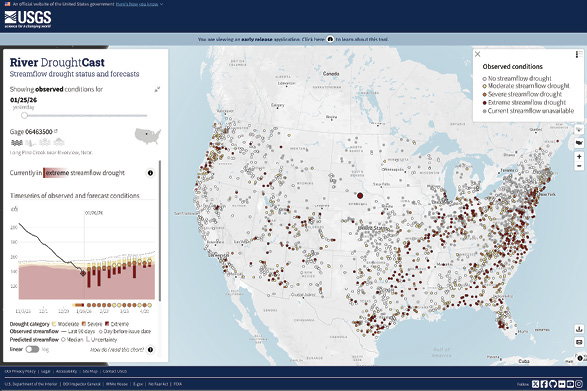
The U.S. Geological Survey released River DroughtCast in late March 2026—a machine-learning tool that forecasts streamflow drought up to 90 days ahead at more than 3,000 streamgage locations across the lower 48 states. The tool fills a recognized gap between short-term weather forecasts and seasonal water-supply outlooks, giving water utilities, irrigation districts and emergency managers significantly more lead time to respond before shortages arrive.
River DroughtCast targets streamflow drought specifically when rivers and streams drop below normal levels for extended periods—which is distinct from rainfall-based drought and harder to predict because soil moisture, snowpack and groundwater all influence when dry conditions translate into reduced river flows. Models were trained on up to 100-plus years of continuous records per gauge. Forecast reliability runs about 75 percent for the first week of severe or extreme drought conditions and drops to approximately 55 percent at week 13. All outputs include confidence estimates. Practical applications span irrigation scheduling, municipal conservation protocols and recreation management.
ICC Launches Effort to Standardize Data Center Design and Code Application
Data centers have become central infrastructure, but building officials and project teams are navigating inconsistent approaches to occupancy classification, design standards and code application, creating uncertainty and delays in permitting and construction. The International Code Council (ICC) is moving to close that gap with a new dedicated guideline.
Launched in April 2026, the G12 Data Center Guideline process is now underway. ICC is convening regulators, designers, builders, operators and other stakeholders to address key safety considerations and align existing best practices. Topics expected to be covered include physical security, occupancy classification, fire protection, structural design, electrical systems and environmental impacts. Stakeholders from the United States, Canada and internationally are invited to join the committee or participate as interested parties. Progress updates are available at iccsafe.org/committees/g12.
ASCE Building Cross-Disciplinary Wildfire Resilience Resources
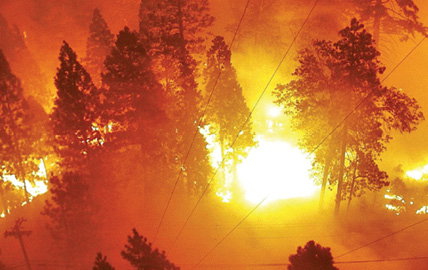
The American Society of Civil Engineers (ASCE) Structural Engineering Institute (SEI) Fire Protection Committee launched a dedicated wildfire subcommittee to position structural engineers more centrally in wildfire resilience. The initiative focuses on research at the fire-structure interface, technical guidance for wildfire-resilient design and interdisciplinary coordination across engineering, fire safety and related fields—addressing gaps the committee identifies in current standardization and professional education.
Most building codes rely on prescriptive approaches that fall short for complex structural systems and evolving fire behavior. The SEI group is also contributing to development of a performance-based fire design prestandard. ASCE’s “2025 Report Card for America’s Infrastructure” cited wildfire risk alongside flooding and heat as key pressure factors on long-term asset performance—with nearly 39 percent of homes at severe or extreme risk located in California, representing $1.8 trillion in property value.
Data Centers Are Carrying Nonresidential Construction Planning
Construction planning for nonresidential buildings grew 1.8 percent in March 2026 to reach 250.5 on the Dodge Momentum Index (DMI), but the headline number obscures a striking divergence underneath it. Commercial planning rose 7 percent for the month while institutional planning fell 8.8 percent, and within commercial, nearly all the growth came from a single building type: data centers. Planning momentum slowed across every other commercial sector.
The DMI, published by Dodge Construction Network, tracks nonresidential projects entering the planning stage and leads actual construction spending by 12 to 18 months. The March data extend a pattern that has defined the index for more than a year: data center demand is propping up overall planning numbers while most other sectors contend with macroeconomic uncertainty and tightening budgets.
Institutional planning weakness was broad-based in March, with only education and public buildings posting modest gains. The findings suggest that outside of digital infrastructure, owners and developers are increasingly cautious about committing new projects to the pipeline—a signal that construction activity in non-data-center categories could soften into late 2026 and 2027.
Most Infrastructure Capital Projects Introduce Cybersecurity Too Late
Adversaries are increasingly targeting the operational technology and industrial control systems that keep power flowing, water running and industrial processes moving—yet 72 percent of industrial capital projects introduce cybersecurity too late in development, or not at all, according to a new global report from Black & Veatch and Takepoint Research. The report, “Secure by Design: A Market-Informed Guide to Cybersecurity for New Critical Infrastructure,” surveyed more than 450 owners, operators, engineering leaders and EPC stakeholders worldwide.
The most consequential cybersecurity decisions—which systems are connected, how access is structured, what monitoring is embedded—are made at project inception. Retrofitting security after a facility is built is more expensive and less effective. As regulations evolve, the report argues compliance alone no longer ensures defensibility; cybersecurity must be defined in project scope from the start, alongside structural and mechanical requirements.
Download the report at iimag.link/Wkgua.
TOP Stories
The following are the top stories from the last few months (in terms of traffic) on the Informed Infrastructure website. This also reflects key coverage areas that are regularly refreshed online and via our weekly e-newsletter.
Simply search key words on Informed Infrastructure online to find the full story.
Buildings
Roofing Alliance Releases Impactful Sustainability and Resiliency Study
“Green” on Paper, Underperforming in Reality: Why Buildings Still Miss Sustainability Targets
New Guide Simplifies LEED v5 Certification for Designers Using Structural Steel
Structural Steel’s Embodied Carbon Down More Than 10% Since 2021 Industry-Wide EPDs
From Complexity to Confidence: Evolving Approaches to Seismic Bracing
Transportation
STV Selected to Lead Major I-81 Reconstruction in Luzerne County
Monon Corridor Extends Chicago Train Service to Northwest Indiana Communities
Water
City of Kyle Advances $250 Million Wastewater Expansion with STV’s Accelerated Design
New Workforce Initiative Provides Skilled Job Training for the Water Sector
Tools and Technology

Todd Danielson
Todd Danielson has been in trade technology media for more than 20 years, now the editorial director for V1 Media and all of its publications: Informed Infrastructure, Earth Imaging Journal, Sensors & Systems and Asian Surveying & Mapping.
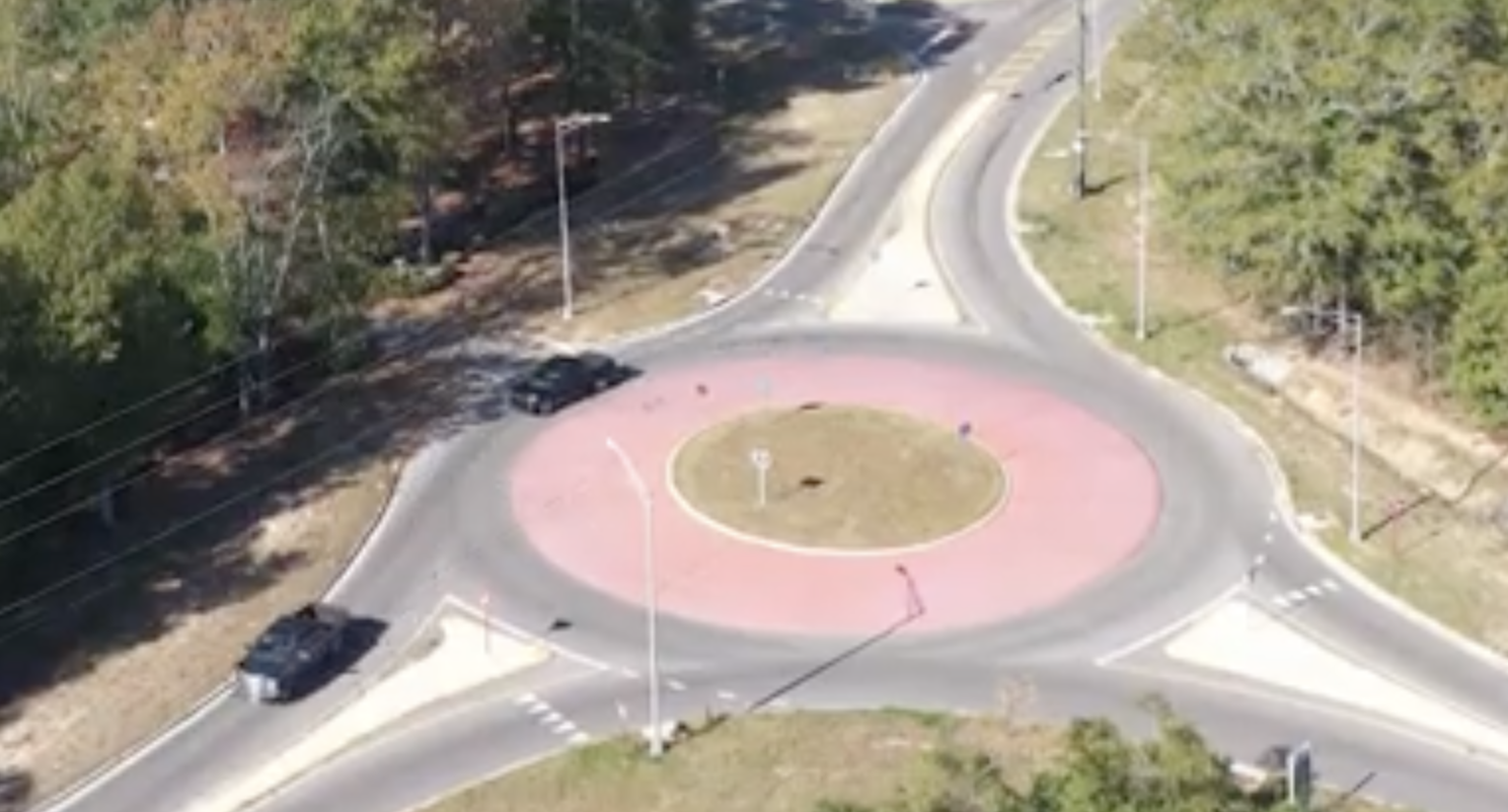
Video: New Roundabout Under Construction at McIver and Old Florence Roads in Darlington County
Promenade at The Point
June Issue 2026
.jpg?width=225)