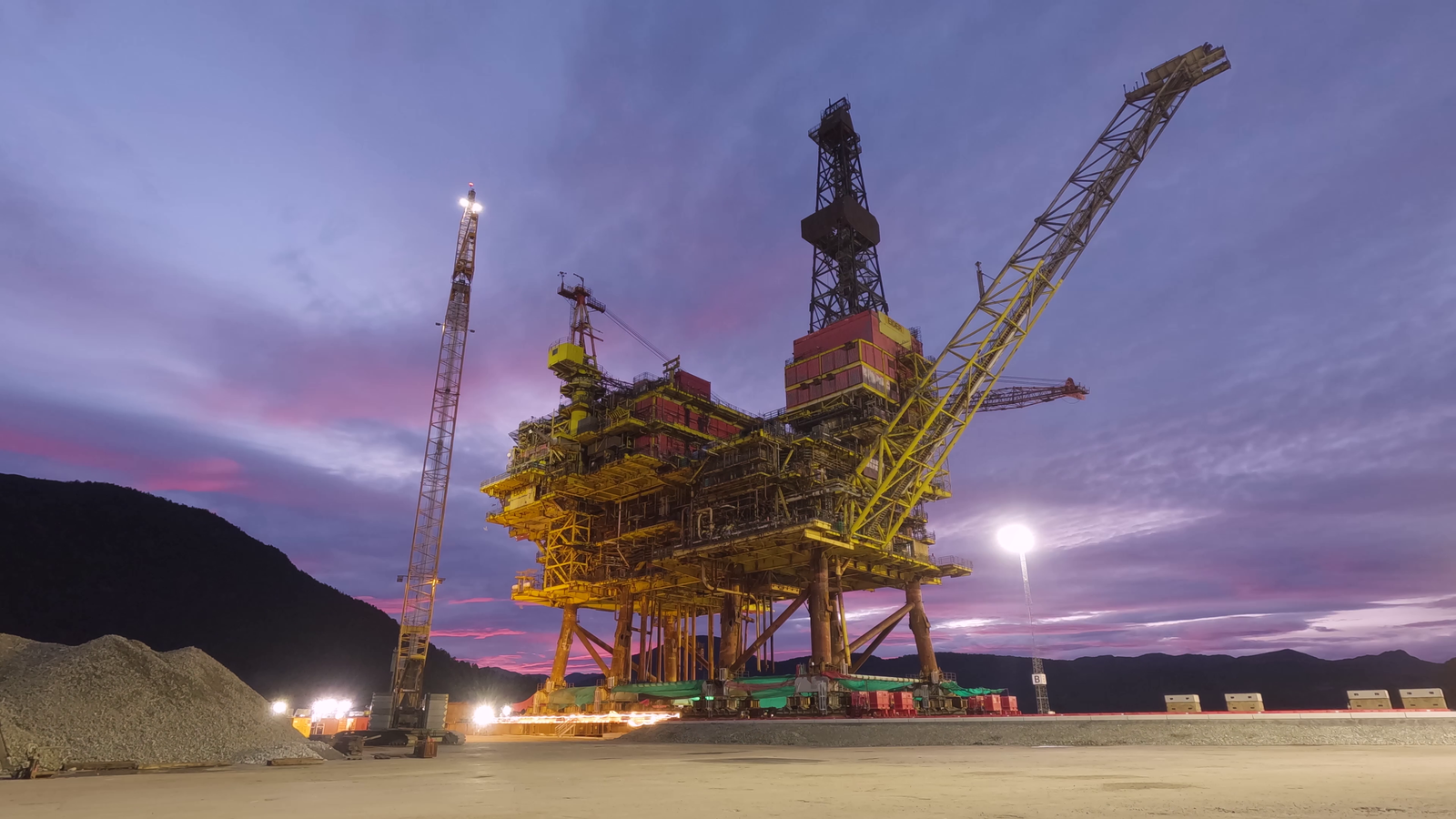
Load-ins for the Heather Alpha and Eider Alpha topsides were integrated to save time
Oil and gas topsides are colossal offshore structures that can weigh tens of thousands of tonnes, so their safe removal requires specialist equipment and careful planning.
Mammoet has been proudly working with Allseas for many years, supporting it to offload some of the world’s biggest topsides from its specialist vessels onto quaysides for disposal.
Previously, Mammoet assisted Allseas with the load-in to shore of the Brent, Bravo, Charlie and Delta topsides. In 2025, it managed the skidding of the 15,300-t Heather Alpha and 11,640-t Eider Alpha topsides for decommissioning.
These latest projects presented additional challenges – Mammoet had to ensure its skidding tracks could accommodate Allseas’ skid shoes. It was also crucial that the topsides be offloaded quickly to minimize risk during the load-in operations.
As the topsides were being removed one after the other, it presented a unique opportunity during the planning stage – Mammoet could prepare the deck of Allseas’ purpose-built cargo barge, Iron Lady, for both topsides simultaneously, saving considerable time and cost.
Helping Iron Lady deliver twins
While the decommissioning of Heather Alpha was completed in August, and Eider Alpha in October, the extraction and load-in methodology was the same for both platforms.
Allseas deployed its motion-compensated heavy lift vessel Pioneering Spirit to remove each structure from the UK North Sea in a single lift.
Pioneering Spirit features a catamaran-style design with powerful lifting beams that interface with the underside of a topside, raising it clear of its jacket foundations and suspending it securely between the vessel’s twin bows.
Following removal, the topsides were transported to shallower waters, where they were transferred to Iron lady for load-in to the disposal yard.
The topside’s legs rested on skid shoes slotted inside Mammoet’s skid tracks. On top of these shoes sat the grillage and interfacing equipment.
Mammoet’s scope was to outfit Iron Lady with all this equipment – as well as the inner skid beams that would later be used for transporting Eider Alpha – in Rotterdam.
The inner beams were used to spread the load from the skid tracks onto the barge, as well as match the height level of the skid tracks on the barge with those on the quayside.
Executing both topside’s removals within a single summer campaign enabled Mammoet to optimise the configuration of Iron Lady to accommodate the two structures simultaneously.
Once safely transferred onto Iron Lady, Heather Alpha was shipped to Frederikshavn in Denmark and Eider Alpha to Vats in Norway for decommissioning.
In addition to preparing the barge, Mammoet managed all engineering for the load-in operations.
Both load-ins were floating operations, meaning Iron Lady wasn’t grounded in front of the quay but floating in the water when the cargos were offloaded.
This presented additional challenges during ballasting, especially when the topsides were partially on the quay and partially on the barge - which is why timing was of the essence.
“The clients wanted us to achieve the load-ins in 24 hours, but we managed it in half of that; a single shift,” explains Leo de Vette, Project Manager at Mammoet.
“To achieve this required a lot of planning and preparation, with us working closely with Allseas to time the installation of our equipment with their skid shoes and ensure everything aligned and went smoothly”.
Pushing and pulling in the same direction
Using a total of 40 push/pull units (36 for Eider Alpha and 40 for Heather Alpha), a combined push capacity of 3,652 tonnes moved the topsides 15 meters per hour over 180 meters.
Mammoet provided hydraulic cylinders for the stabilizer beams for the quaysides, creating makeshift concrete moorings for the Iron Lady to dock inside and stay secure during ballasting.
“This has now become a standard operation for Mammoet,” adds de Vette. “We know the optimum time and steps to set up our equipment on the barge and on the quay.
Naturally, supporting Allseas with the Brent topsides helped us, because it was a very similar process. This meant Allseas had full confidence in our method and equipment”.
Mammoet’s ability to integrate its tools, teams and equipment with those of its clients is a huge benefit in projects like these, where close cooperation and communication at every stage is essential for safety and success.
Mammoet
Mammoet helps clients with Smarter, Safer and Stronger solutions to any heavy lifting or transport challenge. We aim to develop long term relationships in order to understand their businesses and challenges best, so we can realize the most efficient and cost-effective approaches. We have a unique global network and an unparalleled fleet of equipment. Through deep and longstanding engineering expertise and the highest quality and safety standards in execution we bring an intelligent and flexible approach to projects across a wide breadth of industry sectors. Clients trust us to help them achieve feats that were once considered impossible, and we have often broken records in doing so.
For more information, visit www.mammoet.com

Parul Dubey
Video: New Roundabout Under Construction at McIver and Old Florence Roads in Darlington County
Promenade at The Point

June Issue 2026
.jpg?width=225)