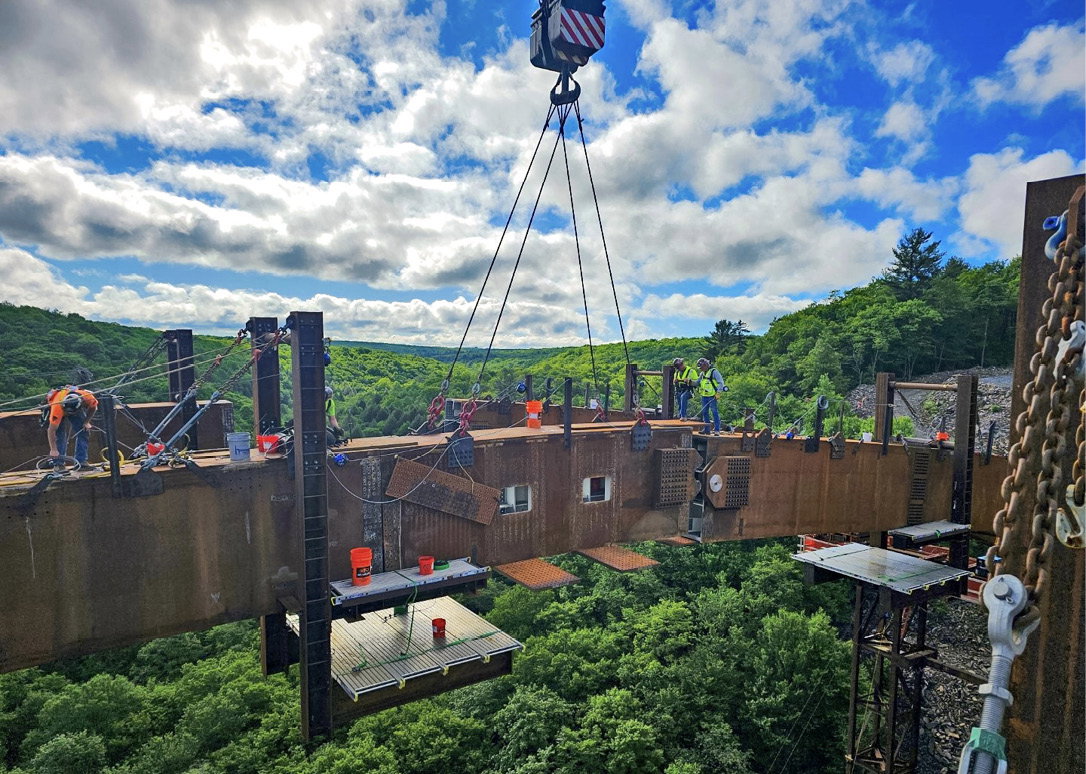
Two halves of the first completely assembled arch about to joined at the large-diameter ASTM A709 50CR hinge pin.
The Pennsylvania Turnpike Commission (PA Turnpike) initiated the Hawk Falls Bridge Replacement to resolve serious deficiencies in a 1950s continuous deck truss—limited lane widths and shoulders, extensive deterioration and an end-of-life structure spanning a deep gorge within a heavily used state park. “The Hawk Falls Bridge Project is critical to enhancing safety and mobility along our roadway,” says Walter Wimer, bridge engineering manager of the PA Turnpike. “As the Pennsylvania Turnpike continues to improve its infrastructure to meet present and future traffic volumes, we are excited to highlight innovations in bridge design and add improvements that strengthen regional connectivity.”
Modjeski and Masters (M&M) Senior Engineer Frank A. Artmont, PhD, P.E., speaks fondly of the project. “I started working on the replacement bridge on my first day … and here I am, 10 years later, and it’s nearly completed,” he recalls. “I worked on basically everything that was reinforced concrete, and I stayed on that through construction.” Artmont’s long initial career arc parallels a broader professional triumph for the M&M team that conceived, detailed and built a structure that’s beautiful, durable and—perhaps most importantly—perfectly suited to its site and purpose.
As Senior Vice President Thomas Murphy sees it, bridge engineers “… have a responsibility to not make the world uglier,” and Hawk Falls became an opportunity to demonstrate that conviction in a difficult setting. He describes a bridge design constrained by the steep, forested banks of Mud Run Gorge, depending on a shallow steel deck arch and buried rock-founded skewbacks to minimize permanent disturbance while delivering a full-modern PA Turnpike cross-section. And, not least, it’s an award-winning beauty.
Project Highlights
• Pennsylvania Turnpike Commission is replacing a deteriorated 1950s deck-truss bridge over Mud Run Gorge in Hickory Run State Park.
• Modjeski & Masters served as prime consultant for the new steel deck-arch, leading overall bridge design and team coordination, in conjunction with the PA Turnpike’s engineering team.
• Key partners included Benesch (roadway and drainage), AGES (geotechnical) and environmental consultants working closely with the Pennsylvania Department of Conservation and Natural Resources, which manages the park.
• Trumbull Corporation was the general contractor, with High Steel Structures fabricating the steel superstructure, Genesis Structures providing erection engineering services, and STV providing construction engineering and inspection support.
• The project delivers full-width lanes and shoulders, improves safety and operations, and dramatically enhances the visual and environmental fit of the Turnpike crossing.
Site and Alignment
Mud Run is a pristine, high-quality cold-water stream in Hickory Run State Park, with popular hiking, sightseeing and fishing at and around Hawk Falls. The existing truss sat nearly 200 feet above the stream, and the gorge’s steep slopes, sensitive habitats, wetlands and popular hiking access meant any new solution had to control earthwork, limit scars on the landscape and preserve a high-value recreational resource—ideally with no traffic disruption.
For Murphy, the touchstone for bridge design wasn’t structurally beautiful arches or trusses, nor strictly cost-effective utility, but a bit of both inspired by the gorge itself. “The main challenge here was the steep slopes,” he says. “We wanted our design to minimize disruption to the state park, and, when we were done, we intended that the park’s recreational and aesthetic resources would be maintained … or even enhanced.”
Geotechnical conditions turned out to be an asset to M&M designers. Rock was very close to the surface on both sides of the gorge, enabling large spread footings founded directly on competent rock, after removing thin soil and fractured rock. That made an arch not just conceptually attractive, but structurally efficient, because the foundations could directly take the shallow arch thrust without piles or deep rock sockets and could be buried and revegetated so only small pedestals would remain visible.
Benesch led an alignment study that considered three main alternatives: a west shift, an east shift and a split alignment with each direction on opposite sides of the existing bridge. The east alignment emerged as the best option because it tied smoothly back into the existing Turnpike in both directions, minimized earthwork in a large rock cut on the south side, and made it easier to manage waste-vs.-fill balances and truck-hauling impacts, all while setting up a favorable geometry for an arch crossing.
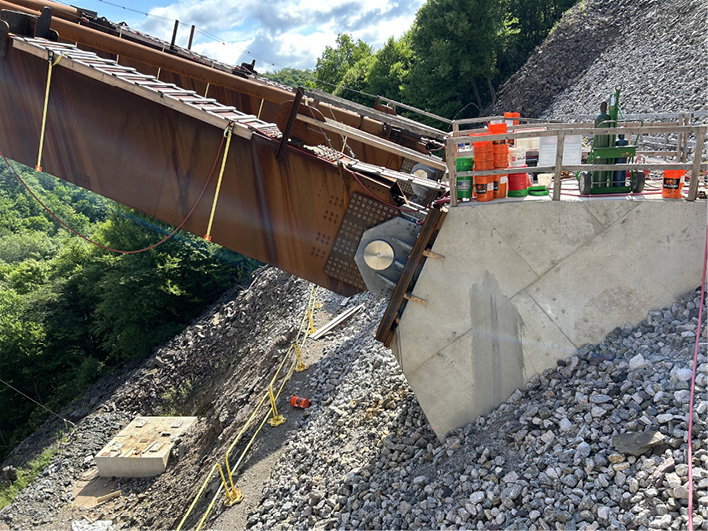
Skewbacks set on “large spread footings founded directly on competent rock” support large-diameter corrosion resistant hinge pins.
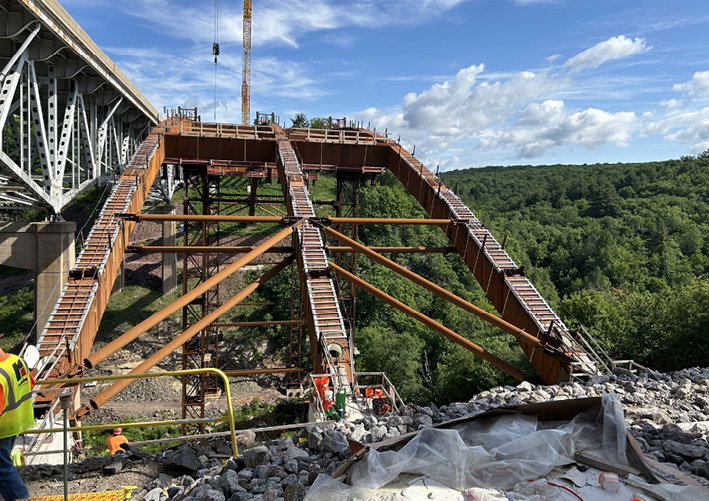
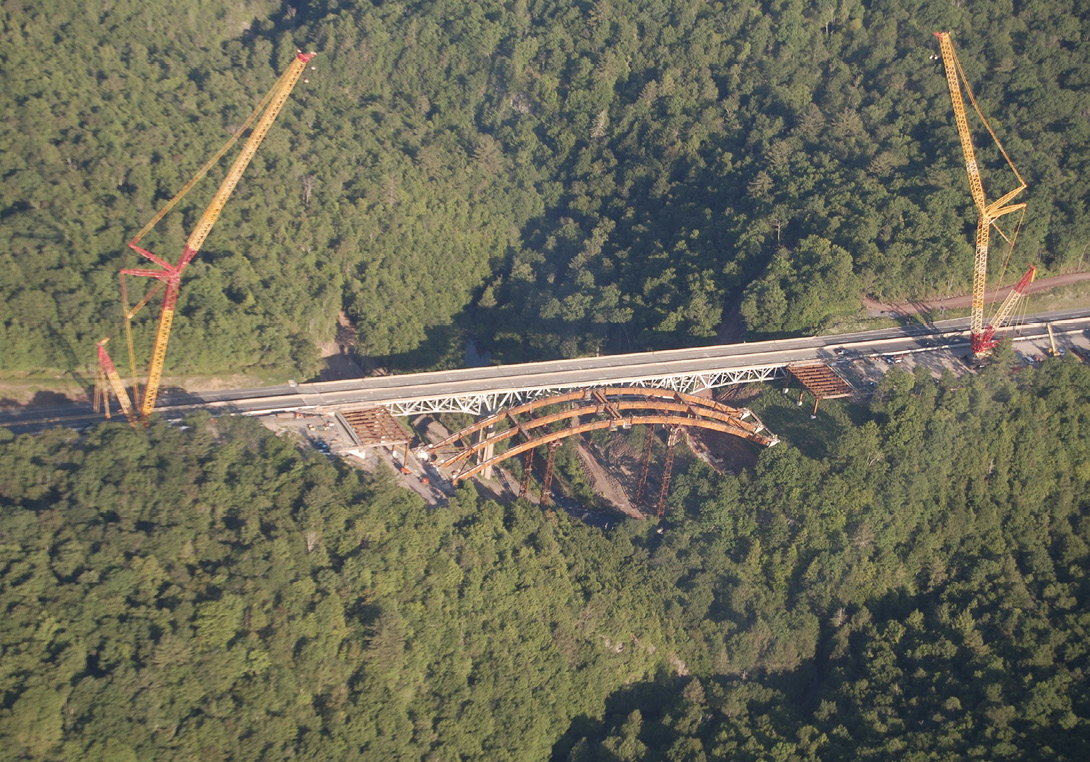
Visible here are the falsework towers that supported crane assembly of arch segments.
Key Design Decisions
From early on, M&M considered this a replacement project, not a bridge repair or rehabilitation. “Rehabilitation was not going to be cost effective because of the amount of deterioration,” explains Murphy. Steel and concrete options were evaluated as well as various girder schemes, but the access realities of a deep gorge favored steel and an arch form. “An arch was cost competitive in this situation, because the nature of constructing an arch lent itself well to this site.”
The final structure is a 720-foot steel deck arch bridge with a main 480-foot two-hinged arch span, flanked by four 60-foot steel girder approach spans. Three welded steel box arch ribs, roughly 4 feet 3 inches wide by 7 feet 6 inches tall, carry a multi-girder deck superstructure designed so the bridge can be widened in the future to add a lane in each direction while maintaining generous shoulders.
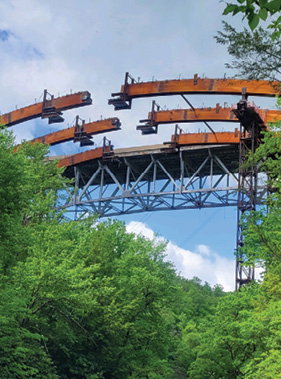
Prominently shown here are the custom work platforms that were moved along the arches as prefabricated segments were assembled by twin cranes.
Why were the arch ribs conceived as boxes, rather than open shapes?
“The vertical loads were high, and the arch rib is relatively shallow,” notes Murphy, meaning that because the arch doesn’t rise very much over its 480-foot span, the geometry forces larger horizontal thrusts at the supports, which, in turn, means the compressive axial forces in the ribs are quite high. “We could have made an open shape work, but we’d be pushing the limits there, so we went with a box.”
To facilitate inspection, M&M sized the ribs so an inspector with a hardhat can stand upright inside a fully illuminated, ventilated box served by access hatches and a dedicated fan system. “We have a full lighting and ventilation system in there,” says Artmont. “It helps with confined space, and it’s something we like to do to give owners more value. It doesn’t cost a whole lot to add, and the inspector is going to be happier when doing their job.”
Facilitating inspection also is one of the strategies the M&M team used to achieve a 100-year service life. “That was the goal,” says Artmont, “even though AASHTO’s typical minimum is 75 years.”
Other strategies that extended service life include:
• The arch and spandrels are mainly uncoated steel intended to weather usefully—and beautifully. “Uncoated steel starts out kind of orangey colored, but, over time, it ends up being more of a deep, almost purplish-brown that looks great in natural environments,” says Artmont.
• The superstructure is continuous abutment-to-abutment, with just two expansion joints, one at each end. “Joints always leak,” explains Murphy, so the team carried the deck continuously over the backwalls and moved the joints away from bearings. The detailing here is interesting: a large-movement neoprene strip seal over a drainage trough, “So if and when it leaks, it’s not causing a problem. Water goes into a drainage trough and drains out the sides to dedicated drainpipes.”
• At the skewbacks, where each arch rib bears on a large pin, engineers leaned hard into corrosion-resistant materials. “There’s a large pin-bearing there—a 17-inch-diameter pin,” notes Artmont. “We used stainless steel and ASTM A709 50CR, which performs like stainless steel, to mitigate the need to coat areas where you really can’t paint in the future.” Murphy elaborates: “The hinge bearings are designed to never need replacing throughout the life of the bridge. We used innovative materials here. The CR steel, for example, is a highly corrosion-resistant material we used in very specific locations where long-term access might be impeded.”
Considered in isolation, not one of these design decisions is particularly remarkable. But this many innovative strategies, deployed in one bridge, enters boldly into progressive engineering territory. Combining a relatively shallow-rise, two-hinged deck arch with high span-to-rise ratio and three large box ribs, detailed for internal access and equipped with corrosion-resistant bearings, inserts Hawk Falls Bridge into the conversation about the “renaissance” of tied-arch and other arch forms across North America—particularly when aesthetics are considered.
Aesthetics and Context
For all the attention to load paths and steel grades, the team never lost sight of how visible this bridge would be—off the PA Turnpike, from the park’s trails and by fishermen from down at Mud Run. In addition to his aforementioned concerns about not making the world uglier, Murphy says “we should be designing and building structures that everyone involved can be proud of. We also need to be very cognizant of funding and being economical and efficient in our designs. So that’s always a balance engineers work toward.” In this case, the gorge itself helped achieve this balance. “This shapely shallow arch was just right for several reasons.”
“The decision on whether or not you can call this a ‘signature’ bridge doesn’t depend on the span length,” says Artmont. “Hawk Falls might not be the longest span, but look at what it actually accomplishes, especially considering it’s a major feature of a state park. Something big and flashy wouldn’t be appropriate—our team wanted to design and build a graceful, durable and cost-effective bridge that enhanced the beauty of Mud Run Gorge. And that’s what we did.”
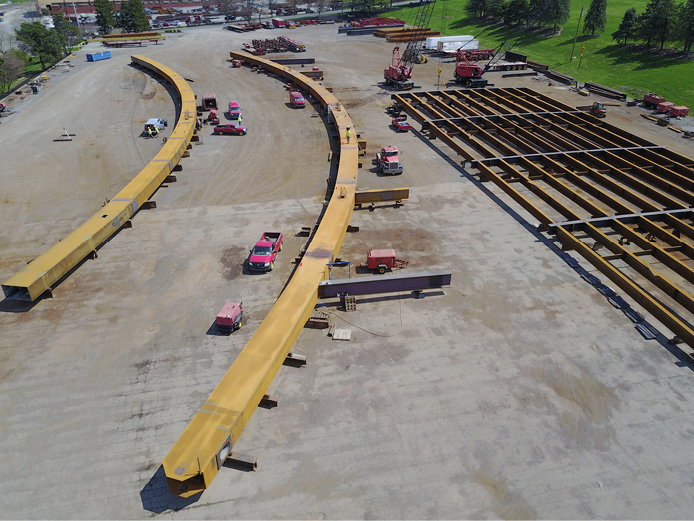
High Steel Structures did a full lay-down assembly of the ribs in its yard in Lancaster, Pa., and then disassembled segments for transport.
Construction and Staging
It’s one thing to design a great bridge; quite another to actually see it built. “Part of design is to anticipate a feasible way to erect the bridge,” says Senior Project Manager Daniel McCaffrey. “And then we need to be flexible when we coordinate with the contractor doing the actual construction.”
For Hawk Falls, general contractor Trumbull opted for two extremely large cranes—basically twins—one behind each abutment. “It took upwards of 50 semi-truck deliveries just to get each crane onsite,” adds Artmont. Those cranes lifted steel rib segments, supporting each pick on temporary falsework towers equipped with jacks so the erection engineer could adjust geometry. Segments were longer and heavier near the skewbacks—where crane radii were shorter—and shorter as the ribs extended toward midspan, balancing weight and reach.
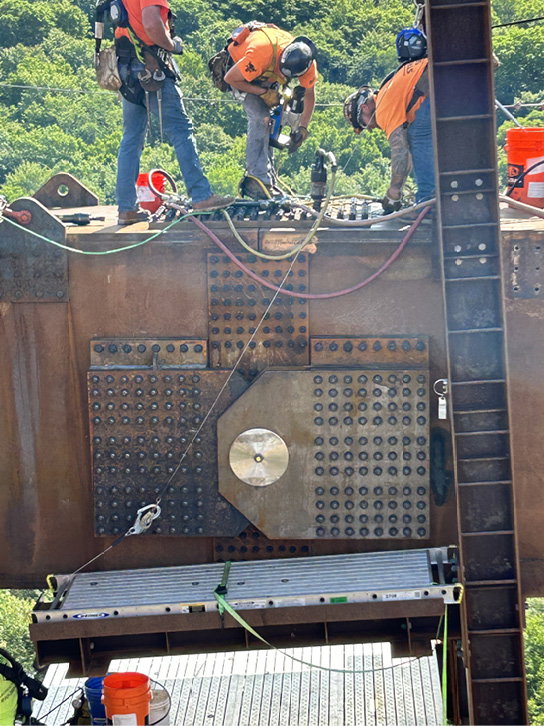
The hollow arches were equipped with interior lighting and ventilation, and were large enough for inspectors to walk in comfortably.
Survey control was critical. “The contractors had surveyors out there for pre-dawn surveys before sunlight and heat affected measurements,” explains Artmont. Targets and prisms were mounted at the ends of each new segment, and data came back to the design and erection teams to ensure that “when you get to the middle and you’re trying to put that crown piece in, everything lines up,” he adds. At the crown, a temporary erection pin helped manage risk. And, when the day came, everything did line up.
Field access solutions were clever and simple. Artmont describes custom work platforms that could be clamped to the leading edge of a rib segment, chained back and rotated to stay level: “They sat on kind of a hinge that was up above on the arch rib. They’d put that platform on the end of the segment that was most-recently erected, and, when they flew the next segment in, they’d be able to stand right there and put the bolts in. Then they’d move the platform up to the end of the segment they just put in and repeat that process all the way up.”
Prefabrication underpinned much of this. High Steel Structures did a full lay-down assembly of the ribs in its yard in Lancaster, Pa., to ensure that every splice and plate aligned before shipping, then broke the assembly into transportable pieces. Some spandrel frames and floor systems were preassembled in staging areas near the abutments and hoisted into place as larger units, taking advantage of the giant cranes and reducing time working over the gorge.
Collaboration, Digital Tools and Project Management
Hawk Falls Bridge showcases M&M’s approach to collaborative, digitally informed practice. The firm, founded in 1893 and known for its work on major crossings, including numerous Mississippi River spans, has long specialized in complex bridges, giving it both the institutional depth and procedural expertise needed for demanding projects such as this.
The M&M team used the LUSAS finite-element program as its primary 3D analysis tool to study the bridge’s overall behavior and check stresses and deflections during staged construction. Trumbull’s erection engineer, Genesis Structures, built an independent model for the erection sequence, then the teams compared step-by-step stresses and deformations, particularly during partial erection conditions when temporary supports and crane loads can govern. This dual-model approach—design model vs. erection model—provided a form of digital checks-and-balances that helped de-risk the closure operation and verified that construction stresses stayed within limits.
Real-time webcam coverage, updated every few minutes, allowed the design team to monitor segment picks, falsework adjustments and closure operations without constant site presence. It also serves as a time-lapse record for future training and outreach.
The combination of detailed analytical models, fabrication fit-up in the shop, careful survey data collection and construction webcams formed a pragmatic, project-specific digital strategy. M&M’s work here shows that high-end modeling and targeted digital tools can be deployed precisely where they add value—erection engineering, geometry control and inspection planning—without overcomplicating the project.
A Bridge of Its Time, Ahead of Its Time
Aspects of Hawk Falls Bridge seem likely to resonate with bridge designers. For one thing, it’s a textbook example of choosing an arch because it fits the site—not as an aesthetic flourish, but because the valley geometry, shallow rock and environmental constraints all pointed naturally to a deck arch solution that minimized permanent footprint while maximizing aesthetic appeal.
And the project demonstrates how to design for a 100-year lifespan in a harsh environment without resorting to exotic forms or untested systems. Thoughtful use of uncoated weathering steel, targeted deployment of corrosion-resistant alloys such as Grade 50CR and stainless at critical details, elimination of interior expansion joints, and integral detailing for inspection access together create a durable system that emphasizes maintainability as much as initial strength.
In the current arc of U.S. bridge work—characterized by aging mid-century structures, rising expectations for resilience, and renewed interest in arches and other visually expressive forms—Hawk Falls Bridge is right on time. It replaces a fracture-critical 1950s truss that had become difficult to maintain with a structure that’s more redundant, easier to inspect and better matched to the site’s environmental and aesthetic demands.
For Modjeski & Masters, it’s also a statement piece. The firm’s history is deeply intertwined with American arch and long-span bridge design, and Hawk Falls adds a contemporary chapter: a high-performance, corrosion-resistant deck arch that quietly showcases the firm’s expertise in structural analysis, detailing, constructability and collaboration.
Standing on the gorge floor, looking up at the three weathering-steel ribs framing the sky and the waterfall, it’s easy to imagine future engineers pointing to Hawk Falls Bridge as a model of how to balance form, function and stewardship in 21st-century bridge design.

Angus Stocking
Angus Stocking is a former licensed land surveyor who has been writing about infrastructure since 2002 and is the producer and host of “Everything is Somewhere,” a podcast covering geospatial topics. Articles have appeared in most major industry trade journals, including CE News, The American Surveyor, Public Works, Roads & Bridges, US Water News, and several dozen more.
Video: New Roundabout Under Construction at McIver and Old Florence Roads in Darlington County
Promenade at The Point

June Issue 2026
.jpg?width=225)