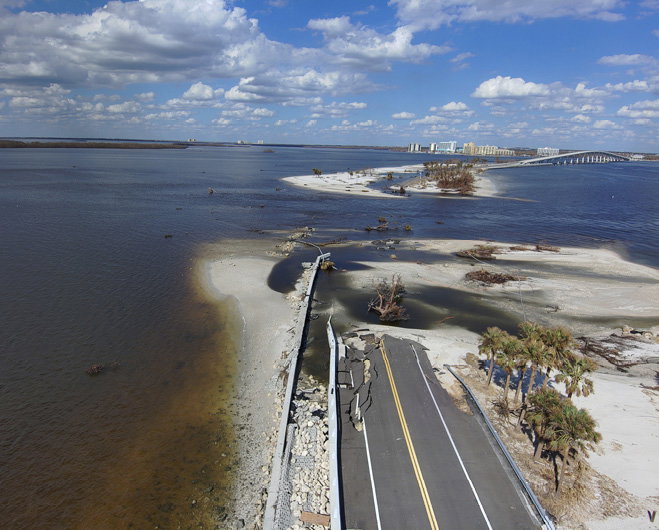
(Superior Construction)
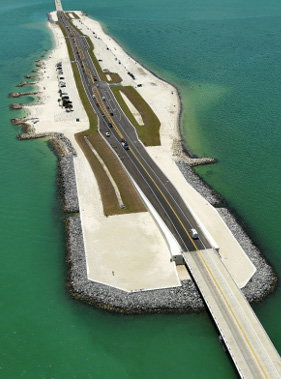
(Kisinger Campo & Associates)
Hurricane Ian’s damage was catastrophic, but engineers and contractors worked together to rebuild and reconstruct the Sanibel Causeway in Lee County, Fla.
On Sept. 28, 2022, Hurricane Ian cut off the Sanibel Causeway, the only vehicular transportation link between Florida’s Gulf Coast and Sanibel and Captiva barrier islands, home to 6,500 residents. Within 24 hours, Superior Construction and The de Moya Group formed a joint-venture team that restored emergency access to Sanibel Island in a week and then completed the permanent reconstruction two years ahead of schedule at a cost of $328 million.
The joint-venture team served as design-builder and general contractor, working for the Florida Department of Transportation (FDOT) with HNTB Corp. as owner advisor. Kisinger Campo & Associates served as the lead design engineering firm, working alongside Hardesty & Hanover as design partners.
Toby Mazzoni, Superior Construction area manager, oversaw day-to-day operations of the emergency response and permanent reconstruction phases. Paul Suellentrop, construction operations manager for de Moya Asphalt, served as project construction manager.
“We managed three pile-driving teams, four earthwork crews, two storm-drainage teams, six rebar crews, eight concrete-placement teams and three asphalt-paving crews while maintaining traffic flow on the causeway,” explains Mazzoni.
Jason LaBarbera, Kisinger Campo & Associates structures department manager, coordinated structural engineering design for the causeway reconstruction. “Our design team’s scope included damage assessment, structural analysis and design, development of resilience strategies using advanced coastal engineering modeling, specification of materials for the aggressive marine environment and coordination with the construction team throughout the phased design-build process,” he says.
Disaster Assessment
Suellentrop notes his company was onsite by foot the day after the hurricane but only able to assess the toll-plaza area. “The next day, we inspected the project by boat, where we observed both islands had been divided into two islands, and all approaches to the bridges were gone,” he explains. “We saw failures of the mechanically stabilized earth (MSE) walls on the approach to the middle bridge.”
Scour washed away complete sections of the causeway islands, destroyed all bridge approaches and MSE walls, and created failures around all seawalls. Wave action and storm surge completely washed out roadway sections, removing roadway base and asphalt.
Drones were deployed before receiving notice to proceed, offering precise 3D modeling and accurate quantity measurements for preliminary planning. Remote-operated submersible vehicles evaluated bridge foundation conditions.
Superior Construction conducted bathymetric surveys at 25-foot intervals to verify coastal engineering requirements compliance and template tolerances for riprap and armor stone placement. Gaining access for damage assessment and to perform repair work was a significant engineering challenge, explains Mazzoni. “Safety and working in a disaster zone created difficulties and unknowns such as degraded or unstable existing structural elements, soil and debris.”
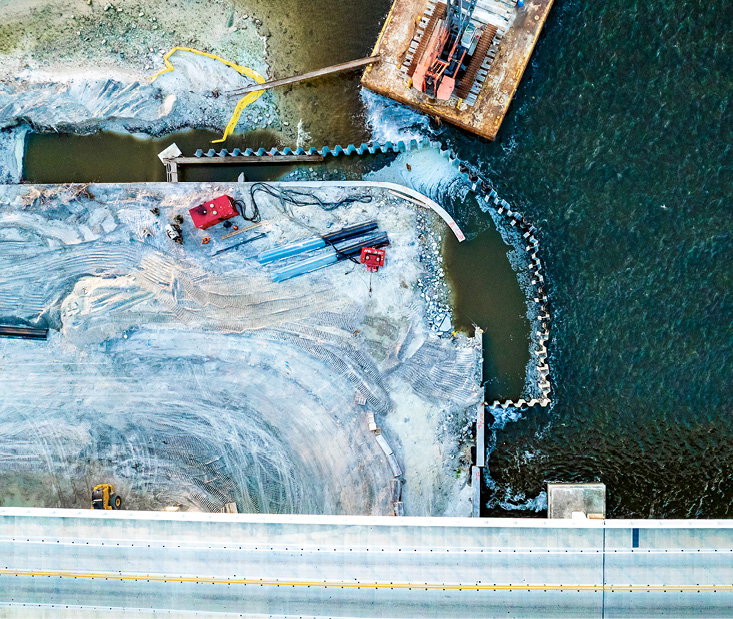
An overhead view shows marine construction as the joint-venture team deploys specialized equipment to rebuild the Sanibel Causeway. (Superior Construction)
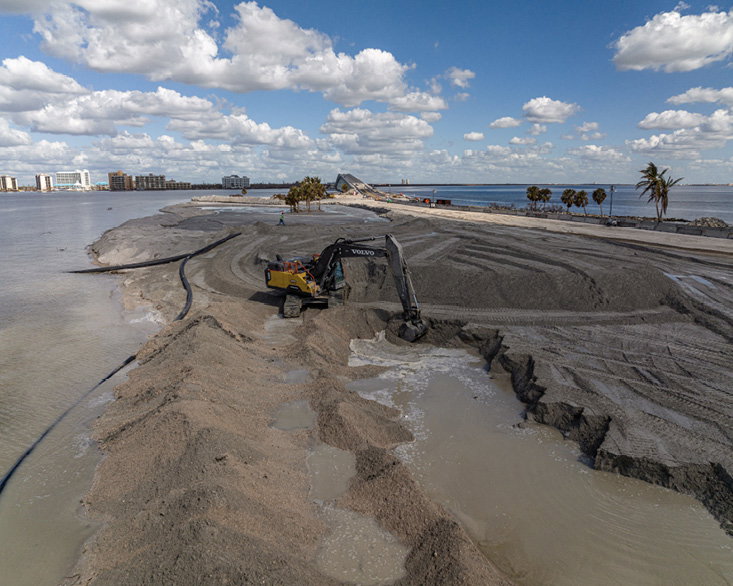
Heavy excavation transforms damaged causeway islands, creating a foundation for enhanced storm resilience. (Superior Construction)
Repair and Rebuild
According to Suellentrop, the first engineering challenge was removing failed and fallen old approach slabs. The team used a crane on the first slab, backfilled the void, then took an excavator with a jackhammer across the bridge to remove the second approach slab. That work—accomplished within 24 hours—allowed teams to start backfilling the first island at sunrise the next day.
Advanced ADCIRC and SWAN hindcast modeling was used to analyze Hurricane Ian’s impacts and develop resilience strategies for future Category 5 hurricanes. Modeling informed critical decisions such as raising the roadway by 2 feet and changing the seawalls from 5- to 8-foot elevation.
“To ensure long-term durability in this highly corrosive environment, we designed the steel sheet-pile walls to account for expected corrosion over the 75-year design life,” notes LaBarbera. “We calculated the structural capacity assuming a reduced thickness, accepting that saltwater would corrode away a ‘sacrificial’ layer of steel over time. We also applied coal-tar epoxy coating or concrete facing for additional corrosion protection.”
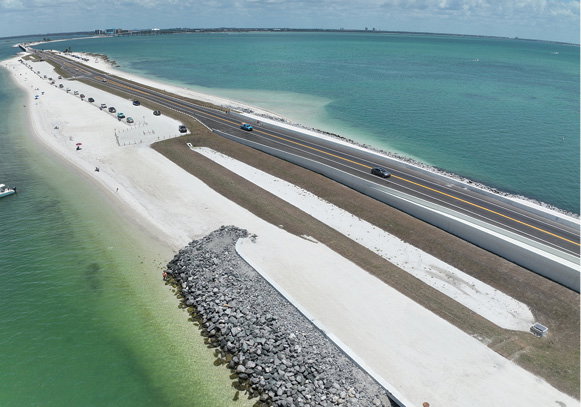
The reconstructed causeway road is elevated 2 feet and contains integrated stormwater management systems. (Superior Construction)
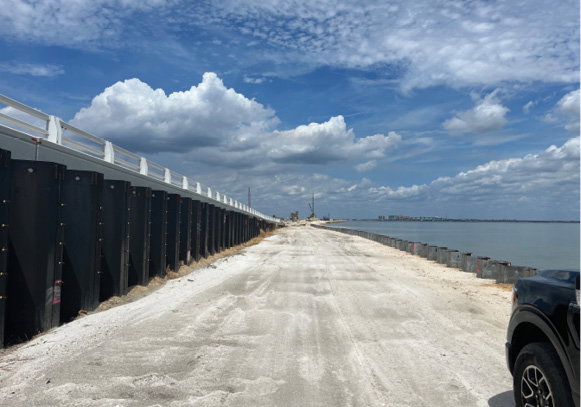
Cantilever steel sheet-pile walls were used in most locations, while fabricated steel king pile walls were utilized when the calculated deflection was too large for the available sheet pile wall sections. (Superior Construction)
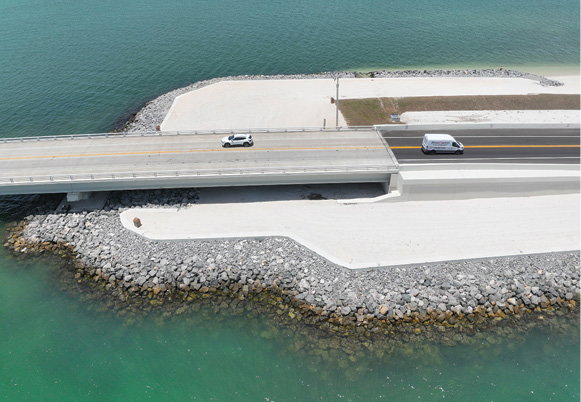
GPS guided granite armor stone placement for shoreline protection. (Superior Construction)
The team specified concrete classes from 3,400 to 5,500 psi based on environmental exposure, all with highly reactive pozzolan additives for enhanced saltwater resistance. Fiber-reinforced polymer (FRP) reinforcement was utilized in seawall bulkhead caps where saltwater exposure is most severe. Traditional steel reinforcement was used in less-exposed areas.
Kisinger Campo & Associates replaced washed-out MSE walls with steel temporary-critical sheet-pile walls at bridge approaches, where tides kept eroding the embankment fill needed to access the island. Starlink satellite systems were used to maintain connectivity as communication infrastructure was destroyed. Until limited passage was restored, workers took up temporary residence in mobile trailers at a nearby airport, using generators to cook meals for more than 100 people.
“A local mine had sand screenings in stockpile from their wash process that supplied the project with critical sand, allowing us to dump at a faster pace,” notes Suellentrop.
Superior Construction used asphalt base instead of the typical stone base since a smaller quantity was needed to achieve the required structural requirements and water-table height. Also, water mixed with stone created pumping and compaction issues.
“The key was using materials and techniques that could be incorporated into the permanent design,” says Mazzoni, adding that his company purchased sheet-pile during the emergency phase for the permanent phase, receiving it within a few weeks. Vendors’ prioritization allowed crews to begin permanent reconstruction sooner than would typically be possible.
The 750,000 square feet of steel sheet-pile walls—driven 40 to 70 feet deep without tie-backs—provide the structural support while 127,996 tons of granite armor stone and 79,000 tons of coastal riprap dissipate wave energy. The marine mattress geosynthetic system for scour prevention was another advanced material choice.
“The closed-loop underdrain system integrated into stormwater management was specifically designed to prevent hydrostatic pressure buildup that could compromise wall integrity during future storm inundations,” says LaBarbera.
“All the bridge abutments were affected by up to 20 feet of scour,” Suellentrop notes, adding the crews used 2- to 4-foot granite stone from Georgia to encase all the seawalls to protect them from scour.
Crews took care to preserve surviving seagrass and mangroves during construction, with large scour areas restored to allow for future seagrass growth. Design features enabled protected species to prosper. All existing roadway left in place was checked for voids using radar.
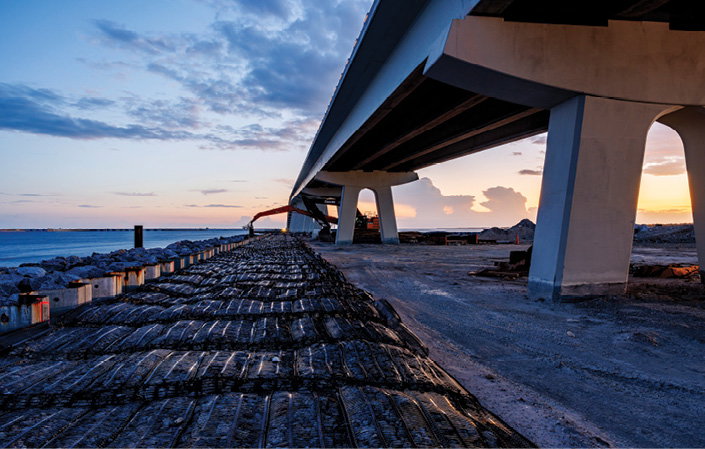
Gabion marine mattresses (25,225 square yards total) were installed below grade along each retaining wall to protect the walls from future toe erosion.
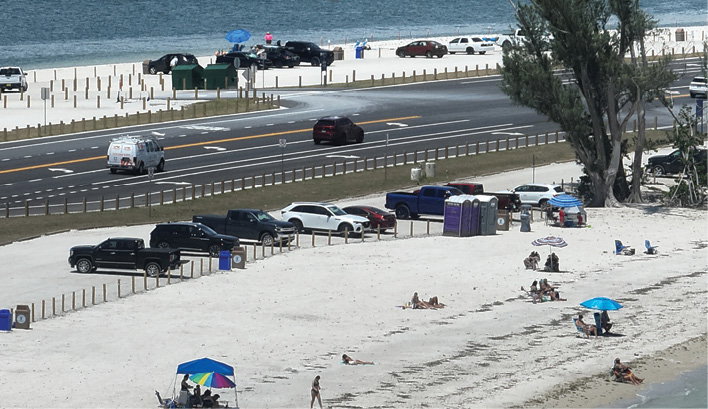
Locals and visitors return to restored Sanibel Causeway island beaches rebuilt with new sand after Hurricane Ian. (Superior Construction)
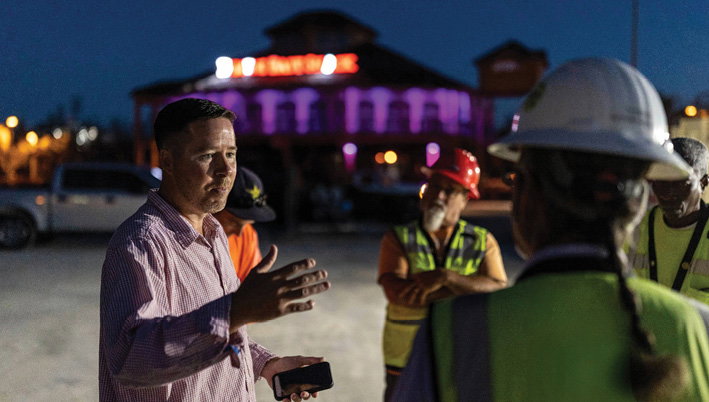
Superior Construction Area Manager Toby Mazzoni coordinates with field team members during a planning meeting. (Superior Construction)
Benefits of Design Build
As this was FDOT’s first phased design-build contract in response to a catastrophic emergency, the delivery method allowed for smaller pieces of the project to be designed and constructed as it advanced and for flexibility to adapt to emerging changes and challenges.
“When our emergency permits for water work expired, we shifted our construction sequence from outside-in (water to land) to inside-out (land to water) while new permits were obtained,” says Mazzoni, noting it also enabled crews to make emergency repairs that became the foundation for permanent solutions.
Operations ran 24/7 in multiple parts of the site throughout the entire project. “Having three pile-driving teams, multiple concrete crews and asphalt teams working in different sections required sophisticated sequencing but dramatically compressed the schedule,” adds Mazzoni.
“Temporary walls and side slopes were constructed adjacent to traffic before island access was reopened,” says LaBarbera. “Geotechnical testing was required to validate the wall and slope stability prior to allowing adjacent traffic loading, and bathymetric surveys verified proper placement of coastal protection elements.”
“Coordinating that volume of specialized material required extensive planning and logistics coordination,” adds Mazzoni. “Long-range delivery was conducted mostly by rail to a nearby location. Maintaining causeway traffic during construction added complexity. Once the temporary road was open for the people, we couldn’t take that away.”
The project’s rapid pace transcended the emergency phase to complete the roadway by the Christmas 2023 deadline against the threat of the approaching hurricane season. The toughest test came during the 2024 hurricane season when completed sections successfully withstood three major hurricanes with minimal damage, while unfinished sections experienced washouts.
Mazzoni is proud of his company’s role in building infrastructure the Sanibel-Captiva communities can depend on for generations. “The people who use this causeway are our neighbors,” he notes. “We were thinking of them every step of the way.”

Carol Brzozowski
Carol Brzozowski is a freelance journalist specializing in technology, resource management and construction topics; email: [email protected].
Video: New Roundabout Under Construction at McIver and Old Florence Roads in Darlington County
Promenade at The Point

June Issue 2026
.jpg?width=225)