Final Thoughts: Millennials Are ‘Engineering: The Next Generation’
Many members of my generation think we Baby Boomers are the greatest generation. After all, we protested against wars, fought for civil rights, and invented rock and roll. But we also produced this next generation of people. I am a Baby Boomer, and our generation currently is handing over the workplace to the Millennials. I recently heard that 1/3 of my generation already has retired, and the rest of us are not far behind. And because there are so many of us, there are going to be a lot of jo...

Future Forward: Can Cross-Laminated Timber Replace Concrete and Steel?
This page profiles innovative and impactful applied research in civil and structural engineering. With a background as a builder and developer in construction for 35 years, Casey Malmquist is CEO and president of SmartLam, the first commercial manufacturers of cross-laminated timber (CLT) in the United States. He has a bachelor of science degree in environmental studies from Gustavus Adolphus College in Minnesota. What Is CLT? Cross-laminated timber (CLT) is part of what’s colle...

Change Leader: Overcoming Budget Constraints at State DOTs
J.D. D’Arville (top) is the GIS/LRS data management administrator for the Alabama Department of Transportation (DOT), and John Russell (bottom), a licensed surveyor, is the surveying and mapping administrator for the Alabama DOT. John Russell Change D’Arville and Russell have worked together at the Alabama DOT for 25 years, and both have seen a lot of organizational and technological change in that time. “We know what each other is up against and how we can help each other,” note...

Executive Corner: Is the Future of Your Firm in the Hands of Millennials?
One of the largest ownership transition issues A/E firm owners currently face is the same one they faced years ago: finding a way to influence younger employees and warm them to the idea of equity ownership. Luckily, there’s now much more robust qualitative (and quantitative) data available from which we can draw stronger inferences as to what many Millennials’ thoughts are on long-term employment with a single employer. And we’re increasingly seeing that this piece of the equation, once underst...

Structural Solutions: Nuggets of Wisdom for Engineers Young and Old, Part 2: Communication Is Key
In my previous column, I mentioned the Direct Connect session for students that happens each year at the NASCC conference. My company has attended the session for several years now; not for recruiting necessarily, but to share our small-firm perspective. In this issue, I’ll continue my list of sage advice for students with hopes of providing a useful nugget or two that helps with readers’ careers. The No. 1 Quality to Master Although I didn’t start with this topic last issue, communication...

Future Forward: Use a PERMIT System to Promote Safety on the Job Site
This page profiles innovative and impactful applied research in civil and structural engineering. Patrick Tarrant is the founder and CEO of Crane Management, a consulting agency for construction companies in New York City. A well-known industry professional with more than 40 years of experience, Tarrant is frequently hired as an expert witness in construction and safety cases. Trained in all areas of crane operations, he is a certified hoist operator, master rigger, American Welding S...

Change Leader: Technology Is Changing Construction More Than Ever Before
Viet T.P. Pham Blake Potts Virtual Design and Construction (VDC) Consultant Viet T.P. Pham of MT Højgaard in Denmark and Regional VDC Manager Blake Potts of Rogers-O’Brien Construction in the United States are experts in digital construction who use Pix4D’s drone mapping technology for site surveying. Change The greatest challenge in the construction industry is productivity—or, to be more specific, lack of productivity. Investing in the most advanced technologies for su...

Code Update: How Changes to AISC 360-16 Affect HSS Connection Design
If you’re reading this column, you probably downloaded the new specification (www.aisc.org/publications/steel-standards), looked at Chapter K and wondered, “What the heck?!?!” Relax, and take a deep breath; it’s not as bad as it may seem at first glance. Reason for Change It wasn’t too long ago that a Hollow Structural Section (HSS) spec didn’t even exist. AISC 360-05 was the first time HSS connection provisions were brought into the main body of the specification and were introduced as Ch...
Civil Spotlight: T.Y. Lin’s Heller Receives Special Award from Arizona DOT
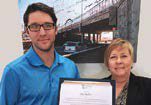
This column in Informed Infrastructure aims to highlight a particular civil engineer or civil engineering project that received deserving credit for improving the profession. Joseph (Joe) Heller, P.E., a T.Y. Lin International (TYLI) design engineer, received an Arizona Department of Transportation (ADOT) Partnering Spirit Award for the U.S. 60 and Bell Road Traffic Interchange Design-Build (D-B) project in Surprise, Ariz., which is near Phoenix and one of the fastest-growing suburbs...
Final Thoughts: Bridges: Overcoming Gaps Literally and Metaphorically
The main theme of this issue of Informed Infrastructure is “bridges,” which allow people to cross rivers that used to be barriers. They provide a way to span a gap or valley rather than travel long distances around them. Bridges allow different modes of transportation to operate in the same space; connect areas previously separated; and offer opportunities for innovation in design and construction. These structures—often taken for granted—also can be admired simply for their beautiful shape or f...
Video: New Roundabout Under Construction at McIver and Old Florence Roads in Darlington County
Promenade at The Point

June Issue 2026
.jpg?width=225)