
Responsible Adaptation: Navigating the Realities of Reuse on Campus
Macquarie University is building a dedicated multi-disciplinary building for engineering, astronomy and optics Universities are built to shape the future, but we can’t claim to be leaders if we act like nothing’s changed. In an era of climate urgency, how we use space says everything about who we are. In higher education, environmental responsibility isn’t a progressive stance: it’s the baseline. Institutions now measure carbon, set emissions targets, and embed sustainability into procu...

Unlocking Project Efficiency: Overcoming Industry Pain Points with PIM and BIM Integration
Disconnected data can be costly, but integrating BIM and PIM technologies helps eliminate errors and inefficiencies. You’ve probably felt it: the frustration of searching for a crucial RFI buried in an email thread or the anxiety that comes with not knowing if your team is working from the latest drawing. These aren’t just minor annoyances—they’re symptoms of a deeper problem in our industry: disconnected information. The solution isn’t just better software. It’s a smarter approach—one...
Concrete Research: Develops More-Sustainable Products and Working Conditions
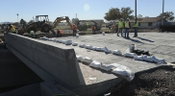
MCDOT workers apply UHPC between slabs on the Palo Verde Bridge over the Roosevelt Canal in Buckeye, Ariz. While Arizona’s infrastructure may be younger than its East Coast counterparts, the effects of aging in a desert climate have begun to take a toll on its roads, bridges and railways. Repairs and replacements come with the challenges of traffic disruption, neighborhood inconvenience and high costs. In addition, concrete sustainability has become a critical goal for federal, stat...
A Philadelphia Story: Decades of Regeneration Add Up in the City of Brotherly Love
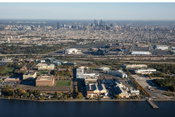
Located at the confluence of the Delaware and Schuylkill Rivers, the Philadelphia Navy Yard is now the largest LEED ND in the world. A maritime hub for more than a century, the 1,200-acre site today revels in lush green splendor nurtured by sustainable infrastructure. Founded in 1682 by William Penn, an English Quaker who advocated for religious freedom, the city of Philadelphia is a key cog in U.S. history and heritage. Known as the “City of Brotherly Love,” Philadelphia is home to 67 Nat...

From the Editor: Hoping Engineers Can Help Right the Ship
The (now 5th) annual Informed Infrastructure Sustainable Engineering Issue includes various articles and columns that highlight sustainable engineering through projects and commentary. As engineers, we continue to explore, conceptualize, develop and implement sustainability into standards, procedures and policies as well as our projects. Leading Universities A recent headline caught my attention: “Purdue University launches School of Sustainability Engineering and Environmental Engineering...

Transportation Troubleshooting: Optimizing Infrastructure Value Using Modern Asset-Management Tools
During my tenure as Washington State Department of Transportation (DOT) Secretary, we lacked advanced tools to maintain a precise inventory of our vast and diverse assets. It was a labor-intensive struggle to accurately account for assets we owned and managed—as well as their condition—right down to our guardrails, sign structures and culverts. We were not alone, as most DOTs experienced this pain in their daily operations. Fortunately, modern asset-management approaches are revolutionizin...

Thoughts From Engineers: Global Work Group Takes Aim at Flood Science
The disastrous flood events in several world regions within the last several weeks, from the Hill Country of Texas to northern China, underline the particularly damaging and deadly flood events we now encounter routinely. Communities worldwide are working to get ahead, fortify and redesign infrastructure, and adapt. From cities such as Copenhagen, Denmark, that have redesigned urban areas to accommodate flooding to countries such as Japan enabling vast IoT-enabled flood data reporting networks f...

Executive Corner: Strategizing for Potential Changes to DBE/MBE Programs
Recent legal challenges have placed Disadvantaged Business Enterprise (DBE) and Minority-owned Business Enterprise (MBE) programs under intense scrutiny. On May 28, 2025, the U.S. Department of Transportation filed a motion in the Mid-America Milling Company v. DOT case asking a judge to block race- and sex-based presumptions in its DBE program—a move that has made the future of set-aside contracting suddenly uncertain. While the legal process unfolds, owners and executives across the architectu...

Water Works: Modern Stormwater Management Requires Looking at All Tools
Green stormwater infrastructure (GSI) is increasingly recognized as a more-sustainable approach to stormwater management vs. traditional or even newer flow-through treatment practices. Definitions vary, but GSI practices often include vegetation and soil designed to infiltrate stormwater runoff onsite, preventing it from running off into receiving waters. Innovative practices—such as proprietary manufactured treatment devices (MTDs)—can be an effective alternative where space is constrained,...
Change Leader: ‘Maintenance Is the Vitality of Civilization’
This interview was recorded by Todd Danielson, the editorial director of Informed Infrastructure. You can watch a video of the full interview above or by visiting iimag.link/DuRZQ. Tristan Schwartzman, P.E., is principal and director of energy services at Goldman Copeland. My discussion with Tristan Schwartzman, P.E., concluded with him reciting the words on a plaque found on the wall of Charles Copeland, the founder of Goldman Copeland, an engineering consultancy in N...
Video: New Roundabout Under Construction at McIver and Old Florence Roads in Darlington County
Promenade at The Point

June Issue 2026
.jpg?width=225)