
ReEngineering the Engineer: What’s Ice Got to Do with It?
For some reason, I wasn’t much of a reader when I was young. Maybe it was the engineering gene; I don’t know many engineers I would consider voracious readers. However, through the years, I’ve come to enjoy reading a good book, mostly non-fiction. So when Christmas comes around, it’s not uncommon for one of our daughters to find me a good stocking-stuffer book. A much better choice than a tie ... One of the books I received this year particularly grabbed my attention: “How We Got to Now: Six...

Final Thoughts: Many Changes in Engineering, but the Main Priority Remains the Same
In previous “Final Thoughts” columns, I looked back at the work environment when I began my career some 40-plus years ago, which included calculations with slide rules, drafting on mylar and working in an open-space office. Today’s office and “tools of the trade” now are very different. Some things are better; some are not. The following are a few of my observations. Time Off and Workforce Diversity I believe that everyone benefits from significant time away from work. Since I began workin...
ReEngineering the Engineer: Reasonable Resolutions That Can Last All Year
Historically, I try to use the holiday break as a chance to regroup, reflect on the last year and get prepared to do it all over again for the next 12 months. This year, however, was an unrelenting race right to the bitter end. “Sleeping” projects came back to life at the last minute, and projects in design scrambled to get finished before everyone headed off for the holidays. Of course, as soon as the Christmas holiday is over, attention turns to the consummate generation of empty promises f...

From the Editor: Predicting the Present: Yesterday’s Future and Tomorrow’s Past
In the classic original The Terminator movie from 1984, an advanced artificial intelligence (AI) wages war against humanity. A fierce band of human resistance fighters battles back and eventually tips the scales in favor of the humans. In a last, desperate attempt to snatch victory from defeat, the AIs hatch a plan: they would alter the future by changing the past. To do so, they send a killer robot, a “Terminator” (played perfectly by Arnold Schwarzenegger), back in time to the present day to a...

Beyond a Book Depository: Commack Public Library Reopens Following $8.3 Million Renovation
The renovated and expanded library features a two-story-high aluminum-andglass storefront entrance vestibule with an aluminum sunshade. The beloved, 41-year-old Commack Public Library in Commack, N.Y., reopened following an $8.3 million renovation and expansion by general contractor Stalco Construction and Beatty Harvey Coco Architects (BHC). The renovation was financed through a voter-approved $7.8 million bond issue, with an additional $500,000 from the library’s capital im...

Thoughts From Engineers: Robot Engineers? You May Lose Your White-Collar Job to a Robot Sooner than You Think
According to the International Data Corp. (IDC), a global provider of market intelligence and analysis, big changes in the U.S. workforce will happen quickly and at a scale you never would have expected. The report, “IDC FutureScape: Worldwide Robotics 2017 Predictions,” outlines several jarring projections: By 2019, a hefty 35 percent of industries in health, commercial goods and utilities will use robotic automation in their operations. Nearly 40 percent of robots currently in use will be conn...

Are Your Construction Projects Under Control? Five Steps for Modernizing Cost and Schedule Management
“Incompetency at every level.” Definitely not the type of expression that should be associated with a $9 billion project. But that’s the case with the now cancelled construction of the two nuclear reactors in South Carolina of which the political, social and economic effects will be felt long after the last workers leave the now-defunct site. This situation led many to use the all-too-familiar phrases: “Haven’t we been here before?” closely followed by “Why haven’t we learnt from thes...

Change Leader: Modular Structures May Revolutionize Construction
These profiles are based on interviews, and the opinions and statements are those of the subject and are not necessarily shared or endorsed by this publication. GrowthPoint Structures hopes to transition building to a factory-based modular model, moving the construction process from onsite to a production line, similar to Henry Ford’s automotive revolution. The company recently completed a 140,000-square-foot facility in Carson, Calif., which aims to rapidly decrease the time and c...
Engineered Solutions: Precast Concrete Highway Slabs Expedite Caltrans Project
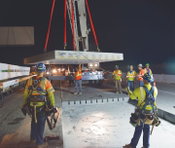
Precast concrete highway pavement slabs are increasing in popularity for rapid highway construction. This is, in part, the result of many state departments of transportation recognizing the efficiency of the precast slab method and selecting it for use on an increasing number of state projects. The California Department of Transportation (Caltrans), for example, has specified precast concrete pavement slabs for one of the largest projects of this type in North America: the Pavement and Slab R...

Code Update: Exploring New Concrete Connection Developments
Author’s Note: This is a highly condensed summary of a full paper, with many details and references, that can be read in its entirety on the Informed Infrastructure Web site at informedinfrastructure.com/36533/concrete-connections. Table 1. Approvals of Concrete Connections Table 2. Checklist for Cast-In Anchors Building codes in the United States have long acknowledged the need for regulators to allow for alternative materials. Yet the codes don’t provide much beyond...
Video: New Roundabout Under Construction at McIver and Old Florence Roads in Darlington County

Promenade at The Point

June Issue 2026
.jpg?width=225)