This article is based on an interview recorded by Todd Danielson, editorial director of Informed Infrastructure. The entire discussion can be viewed at iimag.link/LuZNm.

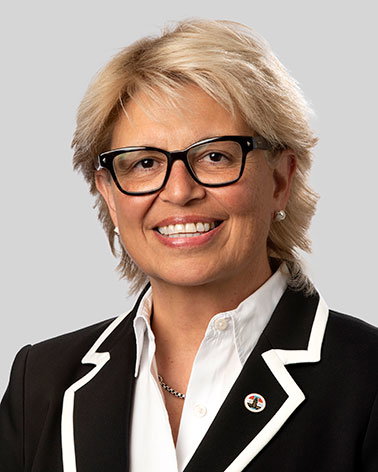
American Society of Civil Engineers (ASCE) members elected Rossana D’Antonio, P.E., GE, F.ASCE, as president of the society for the 2027-2028 term. When inducted as president-elect at ASCE’s annual business meeting in October 2026, she will be the first Latina female to serve the traditional three-year appointment as president-elect, president and then past-president.
“To be entrusted by our members to lead ASCE at this pivotal time is humbling and deeply meaningful,” says D’Antonio, a civil engineer and geotechnical engineer in California. “It’s the honor of a lifetime and one I don’t take lightly. I’ve committed to our members that I will work to represent our engineering community with their best interests in mind and to live up to the confidence they’ve placed in me.”
Coming a Long Way
As a child, although she loved the subjects, math and science were not D’Antonio’s strong traits. “What drew me into [civil engineering] was the problem-solving aspect,” adding that she views challenges as puzzles to solve.
“That led me to engineering as the right fit,” she notes. “Throughout history, we’ve literally created civilizations. It’s embedded in our name. Our work provides essential services people rely on daily to survive and thrive.”
D’Antonio earned a Bachelor of Science degree in civil engineering at California State University Fresno and a Master of Business Administration degree from Pepperdine University. While in college, she ran for ASCE student leadership.
After graduation, she worked for more than three decades at Los Angeles County Public Works. She then took a job as executive director for NV5, a global engineering and consulting firm helping governments and companies design, build and manage infrastructure and buildings through infrastructure engineering, utility services, power delivery and grid support.
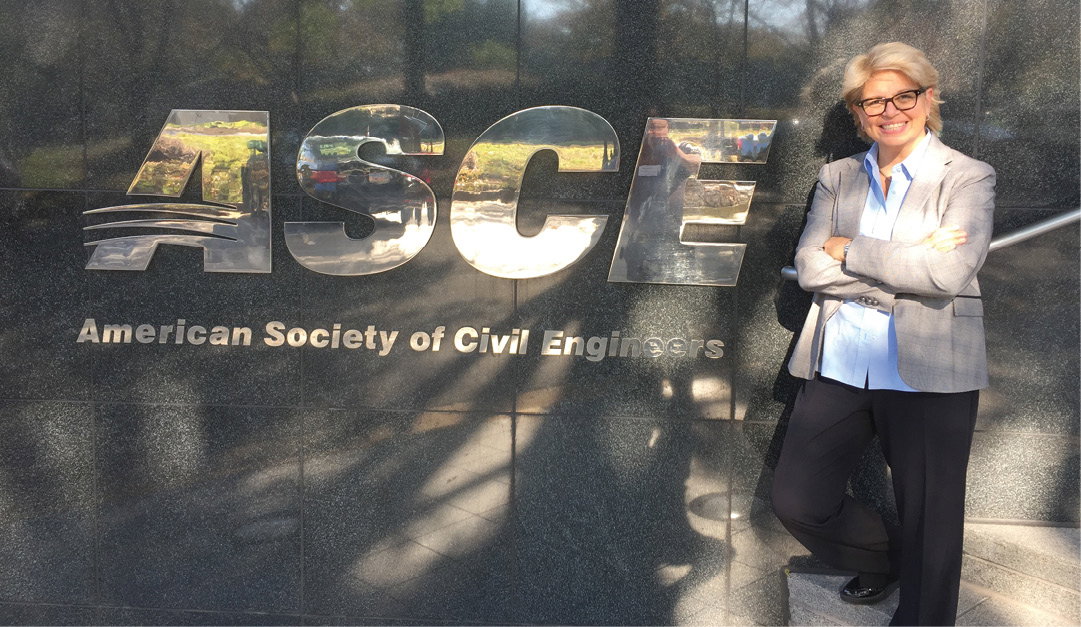
D’Antonio notes that one requirement to run for the presidential role is to have served in ASCE at different leadership levels, including on the Board of Direction, which she did from 2022 to 2025. She also served as Region 9 (California) Governor-At-Large for ASCE from 2017 to 2020 and held multiple ASCE leadership roles with the Los Angeles Section.
Taking the Next Step
Deciding she had reached a point in her professional career to dedicate time to the three-year presidential term, D’Antonio ran unopposed, yet still campaigned on social media and was ultimately elected. The president has a one-year term but will spend three years advancing society initiatives as president-elect (learning), president and past-president (training and advising). The president chairs the Board of Direction and the Executive Committee.
D’Antonio notes ASCE represents more than 165,000 members. She will work with ASCE Executive Director Peter O’Neill to help run the organization, develop priorities and plan strategically. Like always, funding for necessary infrastructure will be a primary concern.
“It’s hard for us to get anything done without the needed resources,” explains D’Antonio. “We need to ensure infrastructure investment remains a priority at the local, state and federal levels.”
D’Antonio believes funding from the Infrastructure Investment and Jobs Act (IIJA) resulted in a minor improvement reflected in the ASCE 2025 Infrastructure Report Card’s overall C grade, up slightly from the previous C-. She also notes that ASCE partnered with the National League of Cities and Bloomberg Philanthropies to produce webinars helping cities with populations less than 150,000 compete for IIJA money.
“The IIJA will be expiring in September [2026], so we need to be advocating for the next federal infrastructure investment bill,” she says.
Additional Concerns
Addressing artificial intelligence, D’Antonio notes “We have to learn to ride the wave or risk being engulfed by it. I’m excited about the potential and ways artificial intelligence can help civil engineering continue to evolve and innovate, but we’re operating in a largely unregulated environment.” A committee of experts is developing recommendations for the board to guide how artificial intelligence will shape ASCE policies.
Data centers, adds D’Antonio about another newsworthy topic, are a small part of a larger conversation on energy and increasing demands. The energy sector received a D+ on the ASCE report card due to rising demand, “so we’re facing real tension between the need and impact and how we go about solving that,” she notes. “History has shown us sometimes when challenges are so great, it spurs innovation. I’ve heard conversations about building data centers in the middle of the ocean or up in space.”
D’Antonio notes it’s critical to listen to community concerns about data centers’ footprints, water use, energy consumption and noise—valid concerns that deserve to be addressed in a thoughtful manner.
“We can use established sustainability frameworks such as the Envision rating system to evaluate projects holistically, considering the environmental, economic and societal impacts,” she says, adding that solutions can include more-efficient water and energy use, better siting or improved design features.
The issue calls for transparency and collaboration. “These facilities are essential to meet growing demand, but also need to be responsible, sustainable and compatible with the communities they’re ultimately going to serve,” she adds.
Driving Progress in Inclusion
“We need to elevate the perspectives of our younger members, leverage the expertise of our mid-career professionals and honor the wisdom of our life members,” says D’Antonio about another of her major priorities.
“We need to recruit and support more women and underrepresented groups, including Latino communities. I hope my journey inspires others from all backgrounds to step into leadership roles. This is especially meaningful at a time when conversations around immigration are so prominent.”
The child of immigrant parents, D’Antonio credits them for instilling values that frame the foundation of who she is.
“They taught me how to dream boldly, live life with a purpose and to always pay it forward,” she says. “I’ve dedicated myself to public service. I’ve been leading with compassion and integrity, and with a clear purpose in trying to make a meaningful difference in people’s lives.”
D’Antonio notes that today’s challenges are too complex for one group to solve alone.
“We must embrace our global partners to collaborate on addressing these challenges as well as arriving at holistic solutions,” she says, adding that one lesson from COVID is “we can’t wait until the next global crisis to establish international relationships. We must do that now.”
D’Antonio has extensive volunteer experience as past president and board member of the California Board for Professional Engineers, Land Surveyors and Geologists. She served on the Disaster Response and Resilience Subcommittee of the President’s National Infrastructure Advisory Council in 2024.
D’Antonio says her tenure with the Los Angeles County Public Works taught her success begins with listening to community needs.
“It’s also about aligning ourselves with the vision of our elected leaders and incorporating the expertise of subject-matter professionals, who often were inhouse, but sometimes included the public sector and academia. Our policies were rooted in science, research and data-driven decision-making,” she says, which is how she views her work on the ASCE Public Policy and Practice Committee.
Re-Elevating Science
Another of her top concerns is the growing disconnect between science and decision-making, as civil engineering is built on evidence-based solutions.
“When that foundation is undermined—be it through sidelining of technical expertise or reduced investment in research and infrastructure—it puts projects and communities at risk,” she says. “ASCE has a strong presence at the federal level. We engage our policymakers. We advance priorities that matter to our profession and the public, but we really need to do a lot more than that.”
Leadership in this space will require courage and collaboration, “so we need to speak clearly about the importance of science-based decisions while also recognizing we have to work across perspectives to find common ground,” says D’Antonio.
“My focus will be on ensuring I represent the voice of our engineering community and that we remain a strong, credible and trustworthy organization that’s tapped into whatever resources or information is needed.”
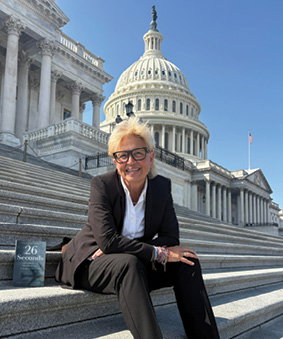
D’Antonio notes each year, the ASCE government relations group travels to Washington, D.C., to engage in advocacy of priorities and goals with legislators and trains those who’ve never done it through tools and talking points.
During her time with Los Angeles County, D’Antonio served as deputy director of municipal services and emergency management. The impacts from droughts, wildfires, hurricanes and earthquakes mean building engineering is taking a more significant role in addressing increasing challenges.
“Every disaster presents an opportunity to learn, improve and rebuild in a much better way,” she says, adding that can include strengthening zoning practices, updating building codes, hardening existing infrastructure, using appropriate materials and setbacks, and leveraging emerging technologies to help structures perform better under extreme conditions that are worsening.
The view of civil engineers by elected officials and the public needs to transcend someone in a hardhat and high-visibility vest working on construction sites to understanding that “our work literally saves lives, so whether it be with natural disasters or enforcing and upgrading our infrastructure, that is the key message we need to send,” explains D’Antonio.
A Personal Message
During visits to Washington, D.C., she shares how her brother, a commercial pilot, lost his life in a plane crash on a faulty runway at a Honduran airport with a well-documented history of accidents that had taken the life of more than 200 people over a span of 45 years. She chronicles the story in her book, 26 Seconds: Grief and Blame in the Aftermath of Losing My Brother in a Plane Crash.
“Nobody had ever done anything about it, regardless of the fact that all these folks had died,” she explains.
According to D’Antonio, it’s important to convey that message shortly after disasters strike because “as time goes by, people forget and move on. Washington has a million priorities. Infrastructure is not necessarily always at the top of their list, unless something catastrophic happens. Why not leverage those examples and move quickly?”
Advocating for Resiliency
Civil engineering’s greatest transformative shifts include the move toward designing and building more resilient infrastructure for a future shaped by changing climate and extreme weather events, D’Antonio says.
“I’ve been involved with developing and designing flood-adaptive urban spaces that provide multiple benefits: flood protection, water-quality improvements, recreational and green space, all in one project,” she says.
Civil engineers are building infrastructure that can withstand shocks and recover quickly, D’Antonio notes, adding other advancements include the integration of smart technology using sensors and artificial intelligence with real-time monitoring to predict failures before they happen, optimizing performance and extending asset life. Robots and drones on construction sites make projects more cost-effective during their lifecycle.
According to D’Antonio, significant challenges in civil engineering include the following:
• Lack of funding for aging infrastructure
• Weather events getting more extreme each year
• Embracing artificial intelligence with caution while developing policies for its implementation
• Protecting infrastructure from cyberattacks
Building the Workforce
Another major roadblock is a workforce shortage, which D’Antonio says can be addressed through storytelling as illustrated by ASCE’s movie productions such as “Cities of the Future” and “Dream Big.” In addition, presentations to school students can emphasize how civil engineers protect the environment and use advanced technology to solve real-world problems that improve people’s lives.
Highlighting the human impact of civil engineering makes the profession more visible, relatable and inspiring, D’Antonio says, adding “that’s how we begin to change perceptions, attract talent and strengthen our engineering profession.”
Many times, people take infrastructure for granted. “We assume we’re going to turn on the faucet and have clean water, and yet that’s not necessarily true throughout this country,” she adds. “Civil engineers need to tap into the consequences of not investing in our infrastructure and communicate that we’re responsible for protecting the health, safety and welfare of every community member.”
She advises civil engineers to get involved through advocacy, committee work or participating in webinars and professional forums.
“I’m extremely excited about the future, about rolling up my sleeves and working alongside our entire industry, ASCE members and beyond to help drive progress in tackling some of these challenges and driving the opportunities ahead.”
D’Antonio says she welcomes connection through social media or her website: https://rossanadantonio.com/.

Carol Brzozowski
Carol Brzozowski is a freelance journalist specializing in technology, resource management and construction topics; email: [email protected].
Video: New Roundabout Under Construction at McIver and Old Florence Roads in Darlington County
Promenade at The Point

June Issue 2026
.jpg?width=225)