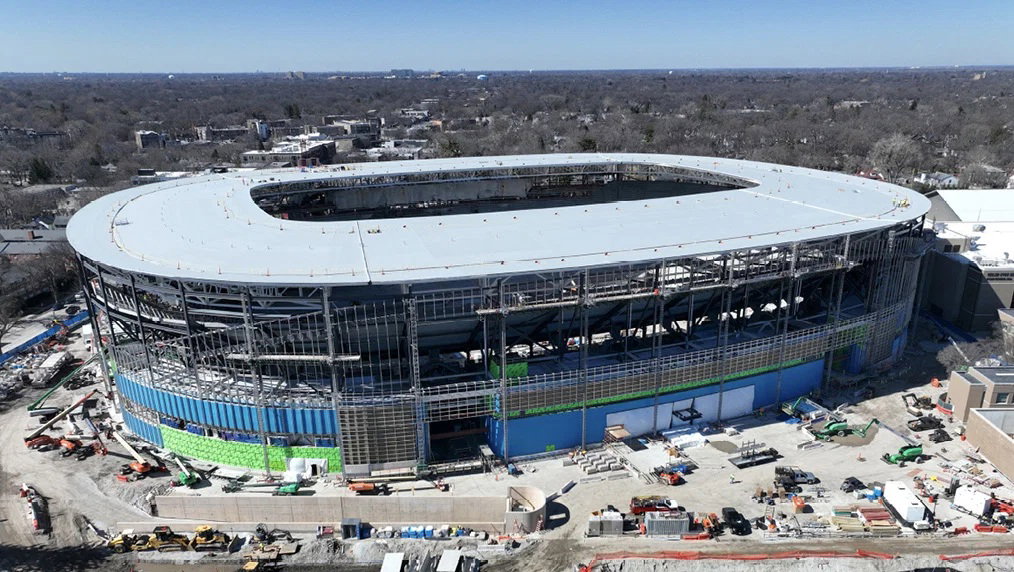
Northwestern University and the Ryan family didn’t simply tear down and rebuild Ryan Field for their beloved Wildcats; they sought to create one of the best stadium experiences anywhere in the country. Built on the previous stadium’s footprint, it has 320,000 more square feet but 12,500 fewer seats, an intentional choice to make the fan experience more intimate and memorable.
The design and engineering of this technically advanced steel structure was accomplished by Thornton Tomasetti, the multinational consulting firm that contributed to the design of six of the world’s 15 tallest buildings and many of the iconic sports venues, including Minneapolis’ U.S. Bank Stadium—an engineering marvel featuring the largest transparent ETFE roof in North America and the world’s largest glass-and-steel pivoting doors—and Miami’s Hard Rock Stadium, defined (from an engineering standpoint) by its massive open-air canopy, an independent structure designed to withstand Category 4 hurricane winds while providing shade to 92 percent of seats.
While the new Ryan Field in Evanston, Ill., is neither the largest nor tallest NCAA stadium, it’s certainly now on the shortlist for most iconic; the nearly completed stadium is highly concentrated, because Thornton Tomasetti’s design work, engineering and construction logistics all were tightly constrained by several intransigent site characteristics and design drivers.
“We were threading a pretty tight needle at Ryan Field,” says Structural Engineer Brad Toellner, a senior associate in Thornton Tomasetti’s sports group. “A compact urban site, a field surface 21 feet below grade in tricky Midwestern soils, a seating bowl designed to be the most intimate in college football, and all of it wrapped in a long-span canopy that concentrates crowd energy. In simple terms, every major constraint—space, soil, wind, access—pulled in a different direction, and the design challenge was to reconcile those forces in a stadium meant to feel inviting and exciting on game day and genuinely part of the surrounding Evanston neighborhoods.”
Bonus Content
Watch the full video interview with EOR Thornton Tomasetti Structural Engineers Karen Grossett, S.E., principal, and Brad Toellner, P.E., senior associate, sports group. It's above or visit iimag.link/wkxTD
Thornton Tomasetti’s Sweet Spot
Toellner frames the firm’s role succinctly: “Our job is to make the architect’s vision constructible and resilient, without ever losing sight of the gameday experience.” He notes that many of the firm’s recent stadium and arena projects demand exactly that balance: long-span steel structures pushed to their limits; rigorous performance criteria for wind and seismic loads; and an almost theatrical emphasis on how crowds move, see and feel the space. “We’ve been building toward projects like Ryan Field for decades—every complex roof, every hybrid stadium concept, every BIM-heavy collaboration has refined our skillset for this kind of work.”
Principal and Structural Engineer Karen Grossett emphasizes the firm’s longterm commitment to information-rich modeling. “We don’t treat BIM as a deliverable; we treat it as a key tool by which we do our work,” she explains. “By the time we reached construction, each discipline’s models were the shared language of the project—steel fabricators, precast vendors and contractors weren’t just looking at drawings, they were coordinating directly in the models with us.”
That mindset—paired with deep sports-venue experience—positioned Thornton Tomasetti to resolve unusually challenging site and structural demands. The Ryan Field redevelopment is happening on the site of the pre-existing stadium and is hemmed in by existing streets as well as a well-established campus and residential neighborhood.
“Everyone involved wanted this stadium to be no taller than its predecessor, as a conscious consideration of how it related to the surrounding neighborhood,” says Toellner. “The challenge was to expand the building’s functional footprint—clubs, plazas, concourses—while reducing nominal capacity and actually improving the way the stadium worked in context.”
The result is a stadium that’s physically larger in area than its predecessor yet friendlier to Wildcat fans, with corner plazas and terraces that open views to the community and distribute crowds instead of funneling them into a few narrow gates.
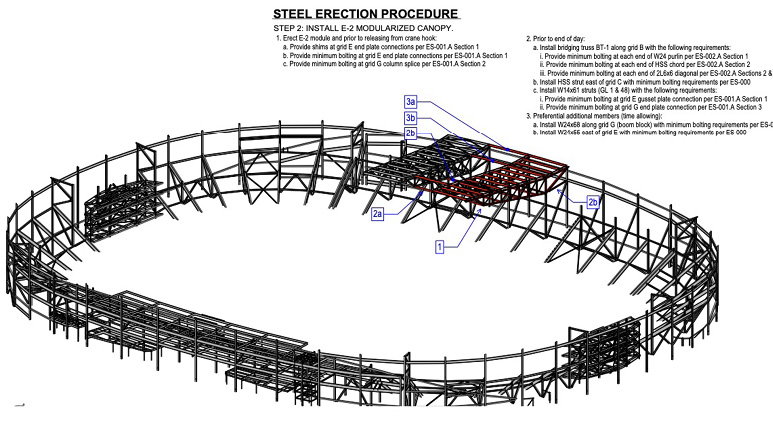
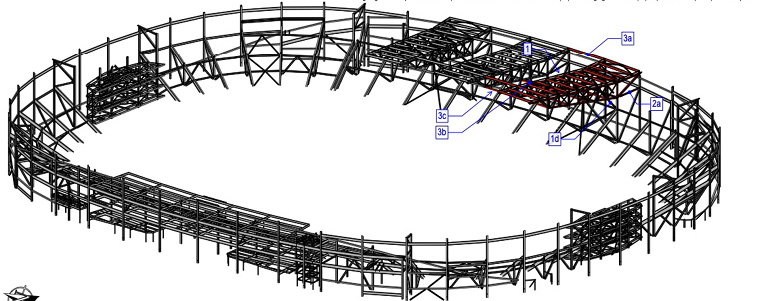
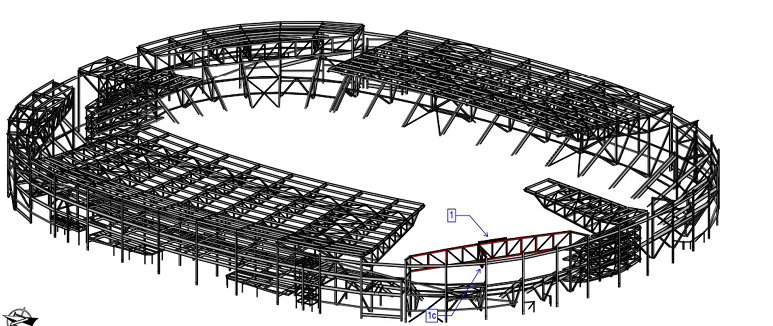
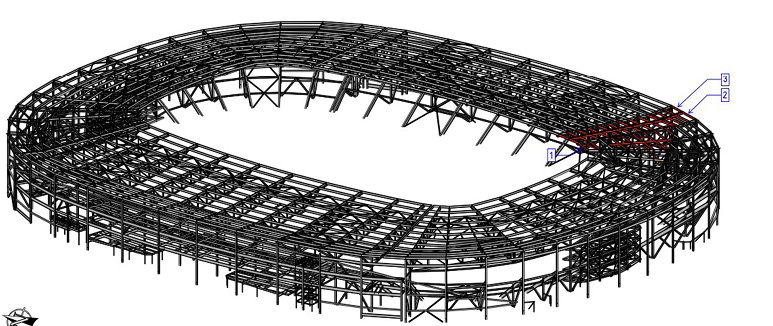
A sequence of drawings defines the proper order of erection of various canopy modules and loose pieces.
Key Stakeholders
• Owner: Northwestern University
• Developer: Ryan Sports Development
• Owner's Representative: CAA ICON
• Lead design architect/architect of record: HNTB (Kansas City office leading)
• Associate design architect: Perkins&Will
• Structural design and construction engineering: Thornton Tomasetti
• Construction manager/general contractor: Turner Construction and Walsh Construction, in a Turner-Walsh joint venture (also referenced as the Central Street Consortium)
• Project steel fabricator: LeJeune Steel Company
• Project steel erector: Complex Structures Group (CSG)
• Demolition contractor (legacy stadium removal): Alpine Demolition
Complex Characteristics
Setting the field 21 feet below grade improved Ryan Field’s performance as a sports venue as well as its neighborhood compatibility. Excavating more than 300,000 cubic yards of soil and installing hundreds of deep foundations and soil anchors on a previously developed, moisture-sensitive site would’ve been a major civil-engineering project even without a stadium on top.
“You’re effectively carving out a bowl in wet, Midwestern soils and then asking it to support a complex, asymmetrical steel structure,” notes Toellner. “That means we had to understand groundwater, temporary support, long-term settlement and construction sequencing as a single problem, not four separate ones.”
Adding to the complexity, the stadium is conceptually organized into four large discrete segments, rather than a continuous bowl, a response to both wind behavior and programmatic goals. To refine the massing and canopy geometry, the team used wind-tunnel testing, iterating shapes and openings to control gusts in concourse zones while managing uplift and vibration in the long-span elements.
“We rely on wind-tunnel modeling to inform us on the wind pressures and distributions that result from environmental wind scenarios interacting with the stadium’s complex geometry,” explains Grossett. “This stadium’s form—with its faceted facade, complex canopy and the abundance of open structure—was best evaluated in a scale-model wind-tunnel environment. The data collected from that testing enabled us to properly design for a complex distribution of wind pressures and the often counter-intuitive resulting snow drifts.”
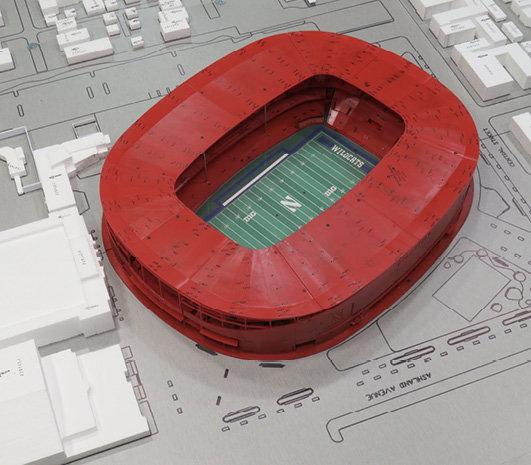
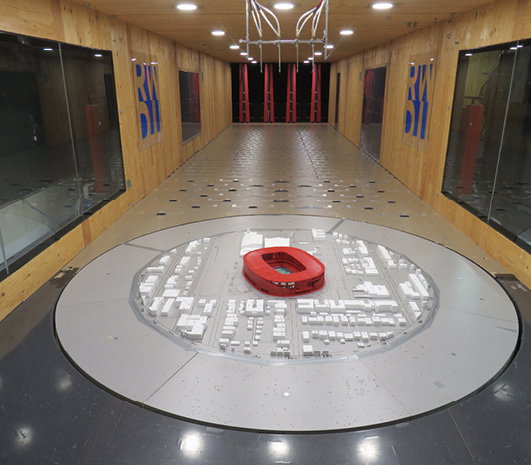
To analyze wind loads on the sophisticated stadium and canopy design, global consulting firm RWDI performed wind-tunnel testing on 3-D printed models of the stadium and surrounding campus buildings.
One Canopy to Rule Them All (All Four Stadium Segments, That Is)
The most immediately recognizable feature of the new Ryan Field is its continuous canopy, which covers all spectator seating while leaving the playing surface open to the sky. Structurally, the canopy is a study in precise, skillful steel specification and connection design: a carefully orchestrated hierarchy of long-span members, secondary framing and bracing elements that withstands gravity, wind and vibration loads while maintaining a slender, refined profile.
“This is where the firm’s arena and roof experience really came to the forefront,” notes Toellner. “We’re drawing on lessons from NBA arenas, international football stadiums and tensile canopy projects to get the stiffness, resonance and deflection behavior exactly where it needs to be.”
Steel specification depended on several critical early decisions, influencing everything from plate thicknesses to weld procedures to fabrication tolerances. “When you have long-span steel in a highly visible, architecturally expressive canopy, you can’t specify steel as if it were a commodity,” notes Grossett. Higher performance grades in select locations allowed the team to reduce member sizes and maintain the slender aesthetic the architects desired, while more-conventional steel was used strategically in back-of-house framing and less-critical spans. “You end up with a multifaceted approach—an intricate structural system that supports both constructability and the design narrative,” she adds.
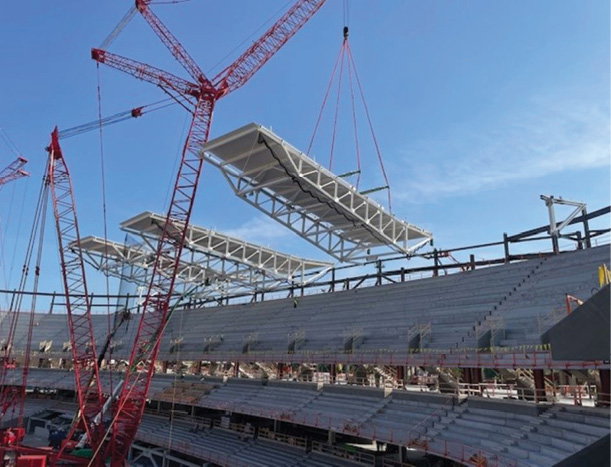
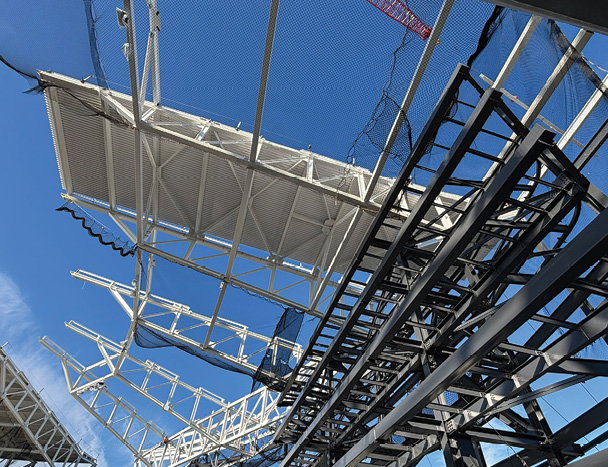
Prefabrication strategies contributed to constructability and safety. Large canopy segments were detailed with modular, shop-assembled truss and girder units that could be lifted into place with less “high work,” reducing schedule risk and ironworker exposure. The team developed a detailed construction sequencing document that functioned as both technical roadmap and communication tool, laying out when each panel would fly, how temporary bracing would be installed and removed, and how loads would shift as the canopy closed. “These documents walk the contractor through the process step by step so they can clearly understand the design intent,” says Grossett.
For Toellner, the canopy is where the balance between engineering and gameday experience is most apparent. “You want the overhead ‘ceiling’ to feel light—as if it’s hovering over the crowd—while it’s doing incredibly heavy lifting in terms of structure.”
The canopy shape and soffit geometry are tuned to reinforce a desirable “intimate cauldron” effect that funnels sound back toward the field and stands. “In arena and stadium work, aesthetics isn’t separate from engineering,” adds Toellner. “The way steel lines trace the sky, the way the roof edge meets the horizon—that’s part of how fans remember the place, and it has to be engineered deliberately.”
And when it comes to big stadium construction, this structural engineer is something of a romantic at heart. “It didn’t matter how many times I had looked at that canopy on screen in models and renderings; when I actually saw it being constructed, going up overhead … well, it was awesome.”
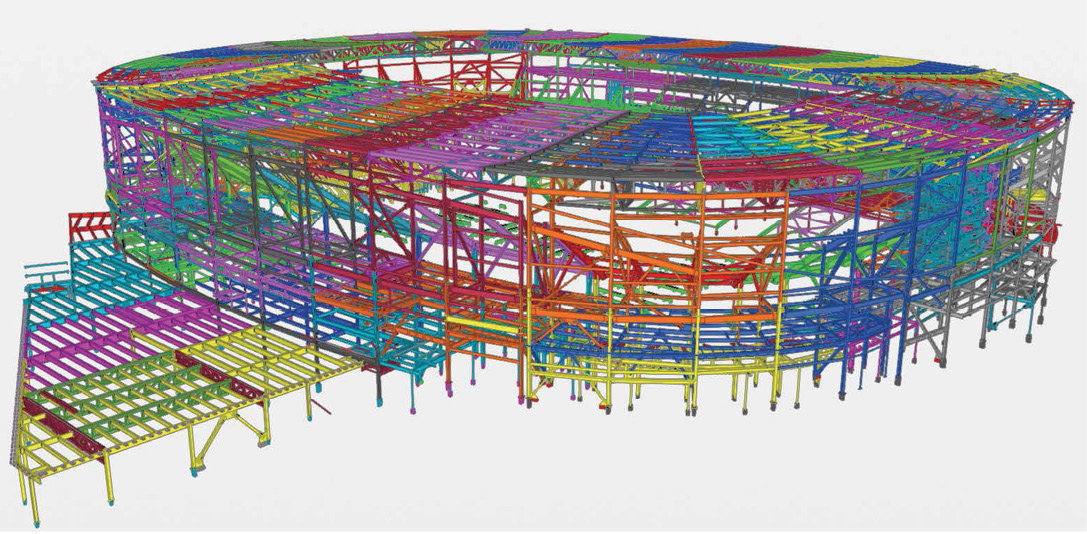
Steel fabricator LeJeune Steel Company took construction documents created by Thornton Tomasetti and developed a Tekla model that incorporates the full detailing of every piece of steel, including every bolt, cope, weld, etc.
The Digital Backbone
The “straw that stirs the drink” for all this cutting-edge stadium design and structural engineering is an aggressive digital solution and multiplatform BIM environment that Thornton Tomasetti has refined, and at times invented, while successfully delivering many high-profile sports projects. Ryan Field’s structural design and construction engineering relied on tightly integrated analysis models, detailed steel models and coordination models shared with architects, MEP engineers, precast suppliers and contractors. “On a job like this, you don’t just export a model at arbitrary milestones,” says Grossett. “Designers live in the model every day, resolving clashes, testing connection ideas and aligning everything from foundations to canopy steel to ADA ramp systems.”
The Thornton Tomasetti team created a workflow that depended on several large platforms. Autodesk Revit provided coordination, with each discipline maintaining its own live-linked model and syncing several times a day so structural, architectural and MEP changes propagated in near real time. Behind that hub, SAP2000 and RAM handled most of the heavy structural analysis, supported by targeted spreadsheets and smaller models, while Thornton Tomasetti’s proprietary KONSTRU interoperability platform replaced slow, error-prone remodeling by pushing Revit geometry directly into analysis tools and back again. The result was less time spent on rework and more time for engineer tasks that resist automation, such as understanding load paths, reconciling conflicts in crowded corners of the building, and applying judgment, precedent and collaboration to thousands of specific design decisions.
The overall design and analysis strategy combined global structural models for wind and gravity behavior with localized, high-resolution models for construction staging and sequencing. Wind-tunnel data flowed into these models to calibrate load scenarios and refine steel specification, particularly in the canopy and its supporting frames. Sequence-based construction engineering models, often created in parallel with BIM and analysis models, ensured that temporary conditions—lift states, partial framing, unbalanced loads—remained within allowable limits throughout the build.
“That’s where digital tools shine,” notes Toellner. “You can test the stadium at every step of its lifecycle, from the first caisson to the last roof panel, and make sure you’re never flirting with unacceptable risk.”
In the model, long-standing tools for finite-element analysis and steel detailing were augmented by more-recent capabilities: rule-based model checking, early generative studies of canopy geometry and data-rich exports for fabrication. “Through the years, we’ve developed tools that will support design, coordination and construction,” explains Grossett. “Ryan Field is a good example of that—every platform and solution we have assembled played an important role, and they all worked together.”
AI and the Near Future of Engineering
Asked about AI’s potential to be useful to structural engineers, Toellner is cautiously optimistic. “We’re already using machine learning-adjacent tools to sift through design options, flag unusual model conditions, and check for patterns in loads and connections,” he says. “But I don’t see AI replacing core engineering judgment anytime soon; what it does is give us better lenses to look at complex problems.”
Grossett adds that AI value lies in augmenting, not automating, engineering practice. “On a project like this one, we’re always balancing competing priorities: cost, constructability, performance, aesthetics, neighborhood impact,” she says. “AI can help us see trade-offs faster, but the hard part—deciding what type of place we’re making—remains a very human conversation among architects, engineers, contractors, owners and communities.”
It’s meaningful that the structural team’s emphasis kept returning to the individual engineer’s judgment. Automated layout of basic framing is likely in the near future; automated reconciliation of competing priorities such as “cost, constructability, performance, aesthetics, neighborhood impact” is not.
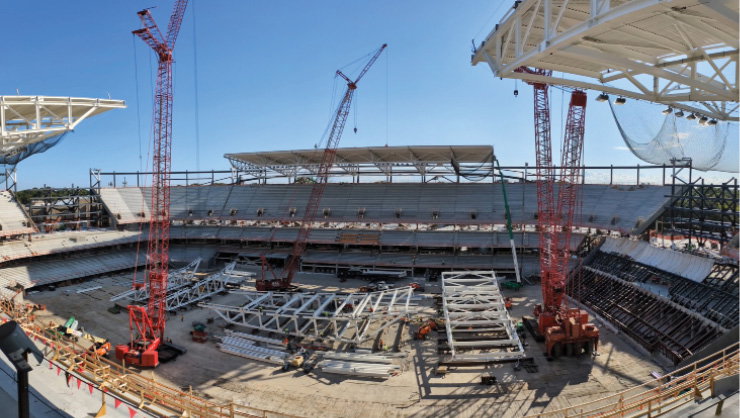
A New Benchmark for NCAA Stadiums
For Northwestern and the NCAA, Ryan Field is an $850-million generational investment and establishes a new standard for what a college football stadium can be. Seating capacity wasn’t reduced as a concession to circumstances, but rather as an intentional means to bring fans closer to the action and immerse them in amenities, terraces and club spaces that rival NFL venues.
Accessibility and inclusion have been treated as core performance criteria, not afterthoughts. The new Ryan Field doubles ADA requirements, with widened entries and ramps, expanded terrace seating options, and improved restroom layouts designed from the outset to serve visitors of all abilities. “We talk a lot about fan experience in sports design, and that should include every fan,” says Grossett. “At Ryan Field, gold-standard accessibility was baked in from the beginning of our design work, not tacked on to satisfy codes.”
From a community standpoint, the stadium is envisioned as a year-round hub, with outdoor plazas and green spaces designed to host festivals, markets and non-game events. An underground loading dock and carefully arranged service routes keep operations largely hidden, freeing the perimeter to function as a public realm rather than a back-of-house zone. The result is a building that fits more gracefully into Evanston’s fabric than its predecessor, while offering significantly upgraded experiences for students, alumni and residents.
By many measures, the “swapped out” Ryan Field may indeed be the nicest stadium in college football: technologically advanced, intimately scaled, accessible and deeply settled into its particular location. But what’s most impressive here is the alignment of vision and execution—Northwestern’s and Ryan Sports' commitment to a new standard, an architectural team (HNTB in collaboration with Perkins&Will) willing and able to rethink the meaning of a college sports venue, and an engineering partner in Thornton Tomasetti capable of turning ambitious ideas into a beautiful, buildable reality.
As Toellner puts it: “If, 10 years from now, people in Evanston and the Northwestern community just think of Ryan Field as a great place to gather—a place where the community and neighborhood feel at home—that will be the real measure of success for us as engineers.”

Angus Stocking
Angus Stocking is a former licensed land surveyor who has been writing about infrastructure since 2002 and is the producer and host of “Everything is Somewhere,” a podcast covering geospatial topics. Articles have appeared in most major industry trade journals, including CE News, The American Surveyor, Public Works, Roads & Bridges, US Water News, and several dozen more.
Video: New Roundabout Under Construction at McIver and Old Florence Roads in Darlington County
Bridge Replacement at Amsterdam Centraal Station
June Issue 2026
.jpg?width=225)