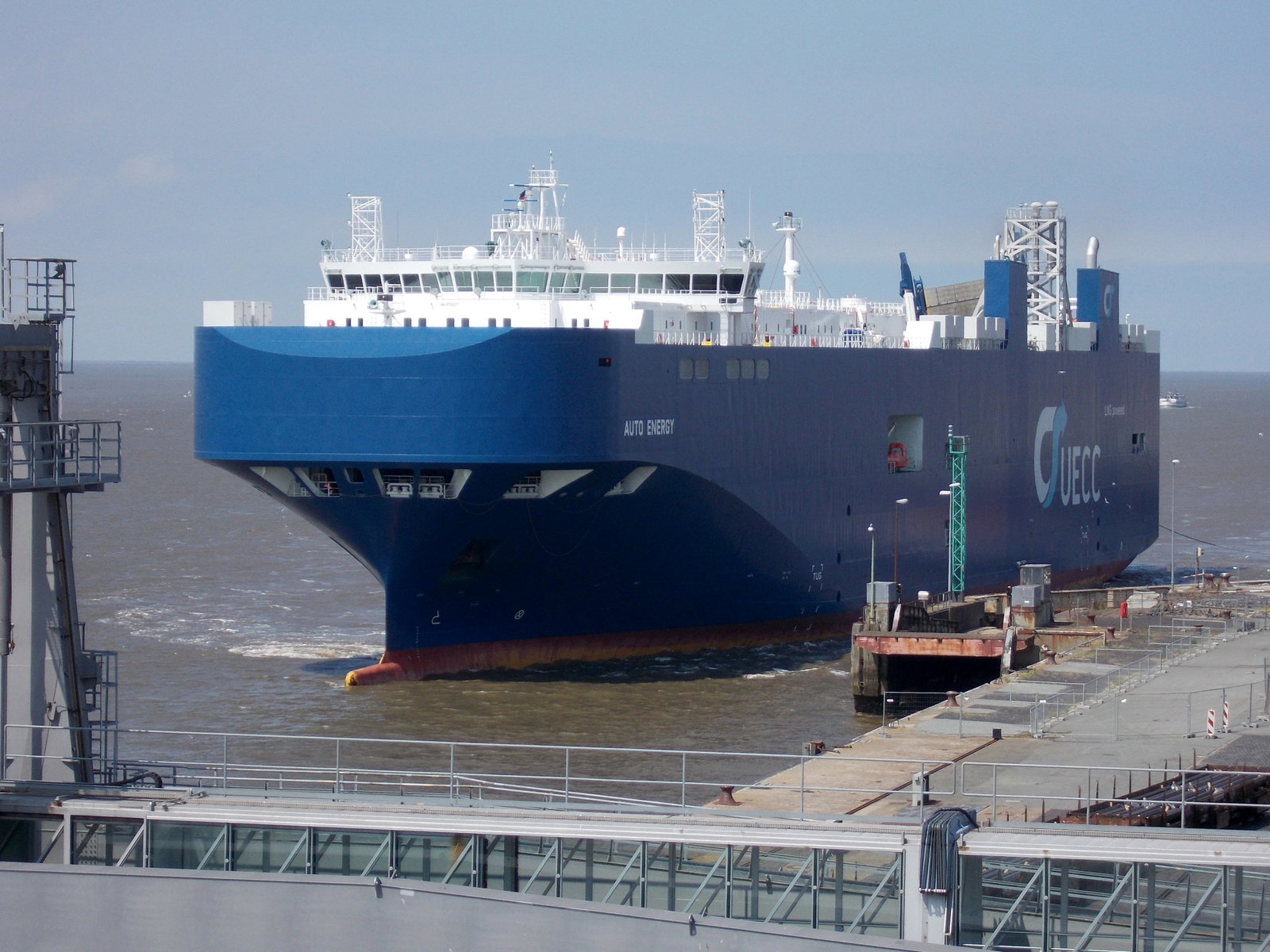
Photo credit: Tvabutzku1234/Wikimedia Commons, Creative Commons 1.0
[New York, NY – April 20, 2026] The maritime shipping industry runs on fossil fuels and is a major emitter of climate-warming greenhouse gases (GHG). Cutting those emissions is growing more urgent and more feasible day by day, according to a new report released today by the NGO Energy Vision, The Future of Shipping: Cleaner Fuel Options for the Maritime Sector. It offers one of the most comprehensive analyses to date of the costs, feasibility, and emissions profiles of alternative shipping fuels.
While low-carbon alternative fuels cost more than conventional carbon-intensive fuels, oil price volatility and mounting regulatory pressure on the maritime sector are narrowing that gap. Regulatory regimes are increasingly requiring shipping companies to pay for their greenhouse gas emissions. Conventional fuel prices rose more than 10% over the past month, driven by market disruptions from the Iran conflict.
Energy Vision’s report found the extra cost of using low-carbon fuel could be remarkably low when calculated on a per-product basis -- pennies or even less per shipped product.
Maritime Shipping Impacts
Maritime shipping is the backbone of global commerce, moving approximately 90% of all internationally traded goods across major trade routes connecting the US, China, the EU, and beyond. Yet nearly all of the world's 106,000-plus commercial vessels run on fossil fuels — primarily heavy fuel oil, marine diesel oil, and marine gas oil — consuming over 87 billion gallons of marine fuel annually. The sector is responsible for almost 3% of total global greenhouse gas (GHG) emissions. A single container ship can emit as much GHG in a day as 217 cars produce in an entire year.
The damage isn't only to the climate. Shipping poses serious public health risks, particularly in and around port cities, where elevated concentrations of nitrogen dioxide, sulfur dioxide, and fine particulate matter are linked to higher rates of respiratory and cardiovascular disease. In some urban ports, shipping accounts for as much as 40% of local sulfur dioxide concentrations, with the health burden falling disproportionately on nearby communities.
The Sector at a Crossroads
The maritime industry is under mounting pressure especially to decarbonize, from regulators, customers, and increasingly volatile fossil fuel markets. The European Union already imposes escalating financial penalties on high-carbon shipping through its Emissions Trading System, and a global carbon pricing framework proposed through the International Maritime Organization is on the table for a vote in late 2026, though the US and Saudi Arabia are resisting this.
Meanwhile, the global merchant fleet is projected to grow 40–115% by 2050, partly to support the clean energy transition itself: wind turbines, batteries, and rare earth minerals are bulky, and they travel by sea. That makes decarbonizing the sector doubly important.
"Fleet owners now face a fundamental choice," said Michael Lerner, Energy Vision's Director of Research and Publications and lead author of the report. "They can bear the escalating costs of non-compliance and the volatility of fossil fuel prices year after year. Or they can invest now in vessels that will have far less commodity price risk and GHG emissions over their 30-year lifespans, and will help usher in the clean energy future."
Findings on Specific Fuels
Energy Vision's analysis evaluates the full range of lower-carbon alternative fuels now available or emerging for long-distance shipping. It finds that:
The most readily deployable options are renewable diesel and biodiesel, produced from vegetable oils, used cooking oils, and animal fats, which can be used in existing diesel engines without modification.
Second-generation fuels include bio-liquefied natural gas (bioLNG) made from the methane biogases emitted by decomposing organic waste, and biomethanol, produced from agricultural residues, forestry waste, and municipal solid waste. They require new engines but are already proven at scale on some of the world's most demanding trade routes.
Next-generation alternatives like green ammonia and e-fuels remain years and billions of dollars away from commercial scale, though Energy Vision anticipates they will grow through the 2030s and beyond as policy, infrastructure, and markets mature.
The best candidates for near-term adoption are fuels made from organic waste — particularly bioLNG, which currently carries the lowest price premium of any alternative maritime fuel and, under EU regulations, is already cost-competitive with conventional heavy fuel oil on some routes.
Biodiesel and fuels made from wastewater- or landfill-derived renewable natural gas emit some GHG over their lifecycles, but only a third to half of what fossil shipping fuels emit.
Fuels derived from food waste and livestock manure go even further, achieving carbon-negative lifecycle emissions — meaning more greenhouse gas is captured during production than is released when the fuel is burned.
LNG is currently the most widely used alternative shipping fuel, though it is primarily fossil-derived. BioLNG is increasingly being produced and consumed, especially by EU- and Asia-based carriers. Newer high-pressure LNG engines greatly reduce "methane slip" (uncombusted fuel escaping into the atmosphere) while eliminating low-load engine operations could cut total methane slip in half.
Defraying the Costs
Low-carbon fuels currently come at a premium, and that cost has to be covered by someone. But Energy Vision found that the business case for investing in adopting alternative fuels is strong.
Major shipping companies including Maersk, Hapag-Lloyd, Fortescue, and United European Car Carriers are already investing in clean fuel programs. At the same time, the Zero Emission Maritime Buyers Alliance (ZEMBA) — whose members include Amazon, Patagonia, and Tchibo — is pooling demand to bring down costs and facilitate long-term fuel contracts.
“We point out in the report that the incremental cost of low-carbon fuel could be covered by a tiny increase in the price of consumer goods,” said Energy Vision President Matt Tomich, “For example, we calculated the extra cost of using a low-carbon fuel to ship a cargo container across the Pacific would translate to just 12 cents per pair of sneakers, less than a third of a cent per T-shirt, and less than a tenth of a cent per smartphone or tube of toothpaste.”
“Large customer-facing corporations moving high volumes of goods across oceans are best positioned to lead on defraying those costs,” Tomich said. “What's needed is a combination of stronger policy signals, longer-term fuel supply commitments, and financing mechanisms that reduce the risk for early movers. The EU is showing what's possible when regulations create real market incentives. Shippers, fuel producers, investors, and policymakers all have a role to play. Now’s the time to act and get ahead of regulation, future fossil fuel price shocks, and worsening climate change impacts."
# # #
NOTE TO EDITORS AND PRODUCERS: "The Future of Shipping: Cleaner Fuel Options for the Maritime Sector" was co-authored by Michael Lerner and Adelaide Wiener. It is available in html format here and as a downloadable pdf here. Michael Lerner, Matt Tomich and other experts are available for comment and interviews on request. For information contact: Stephen Kent, [email protected], 914-589-5988.

Parul Dubey
Video: Habitat for Humanity - Women Build Event in Sacramento

AdventHealth Weaverville Hospital

June Issue 2026
.jpg?width=225)