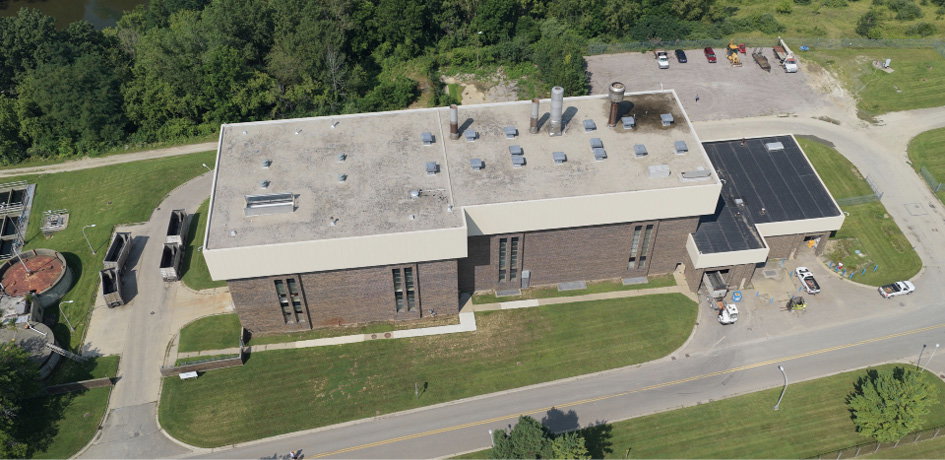
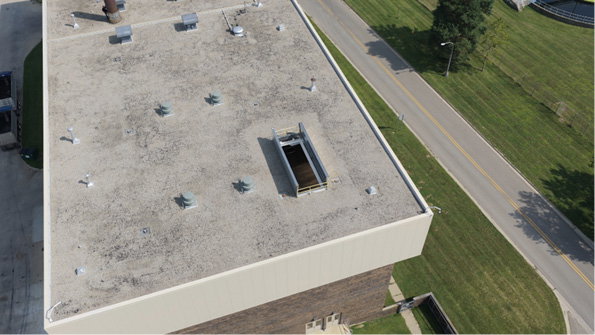
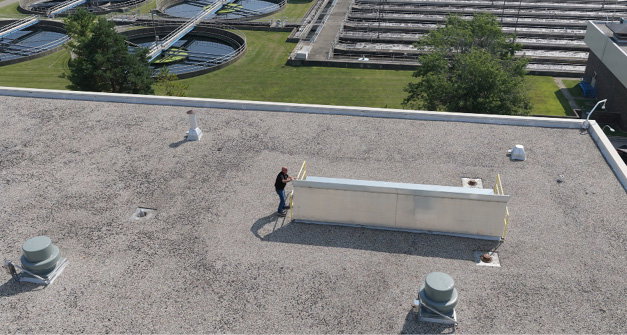
Genesee County in Michigan recently opened a Digestion and Dewatering Facility. The three-year, $9.5-million project included the installation of two dewatering centrifuges. (Photo credit: Freddy Ray Dugard)
In the 2025 Report Card for America’s Infrastructure, the American Society of Civil Engineers (ASCE) identified several solutions the country needs to take to improve the grade of the nation’s wastewater management systems.
One of the solutions proposed by the ASCE, which gave the country a D+ grade for its wastewater infrastructure, called for expanded collaboration among researchers, wastewater utilities and other groups to deploy regulations, systems and policies to address 21st century concerns such as forever chemicals, known in the industry as PFAS (per- and polyfluoroalkyl substances).
Earlier this year, one Michigan county took an important step to help address that concern and developed a unique solution with an extensive retrofit.
The Genesee County Drain Commissioner – Division of Water and Waste Services (GCDC-WWS) installed two dewatering centrifuges to process a combination of primary waste and digested sludge. The three-year, $9.5-million project to construct the Genesee County Digestion and Dewatering Facility included retrofitting a building by removing vacuum presses associated with obsolete incinerators and installing the centrifuges, which are capable of processing 250 GPM of sludge. Each centrifuge weighs a staggering 18,500 pounds.
The wastewater treatment agency transitioned from sludge disposal via liquid land application to landfill disposal. “The sludge dewatering improvements provide an efficient means of preparing the sludge for landfill disposal while also significantly reducing the volume of sludge requiring disposal. The need to install sludge dewatering equipment arose from a shift in sludge disposal practices,’’ according to the GCDC-WWS.
Acres of Farmland
Genesee County in mid-Michigan includes more than 400 farms, extending across 120,000 acres, according to the 2022 Agriculture Census. The farms produce a market value of more than $360 million in products, with more than half of that related to milk-related products.
Some of those farms used biosolids derived from sewage sludge treatment as a valuable organic fertilizer and soil conditioner on farms. The cost-effective practice has been widely accepted and utilized for decades, but in recent years, fears of contamination have forced many communities to dramatically reduce the use of biosolids.
Contamination from PFAS is found in many consumer products, such as food wraps, carpeting and clothing. Some of those chemicals are associated with health problems, including cancer, liver damage and decreased immune response to vaccines. One report claims nearly 70 million acres of U.S. farmland could be contaminated by forever chemicals, and that about 18 percent of all U.S. agricultural lands could be using biosolids as fertilizer.
Michigan adopted a plan to reduce PFAS in wastewater biosolids in 2018. The Michigan Department of Environment, Great Lakes and Energy said the initiative has resulted in a substantial reduction in PFAS concentrations since the program was implemented and added an interim plan in 2021 for land application of biosolids containing PFAS.
Project at a Glance
Where: Genesee County, Mich.
What: The Genesee County Drain Commissioner – Division of Water and Waste Services completed a three-year, $9.5-million retrofit of an existing building to support a change in sludge disposal practices from land application to landfill disposal.
Powerful centrifuges: Two centrifuges were installed in the building and are capable of processing 250 GPM of sludge. They were installed on the top floor of the building after the removal of vacuum presses associated with obsolete incinerators.
Through the roof: Installation of the centrifuges challenged the project team, which used heavy operating equipment to lower them through a 22-foot roof hatch manufactured by BILCO.
Did you know? Genesee County includes more than 400 farms, covering 120,000 acres. Some of those farms used biosolids from sludge treatment as fertilizer. With this change, farmers will need to find alternative fertilizer solutions.
Reducing Landfill Sludge
The dewatering process adopted by Genesee County will significantly reduce the amount of sludge transferred to landfills, thereby reducing exposure to forever chemicals.
Centrifuges have been used in dewatering since the 1930s, according to the Environmental Protection Agency. Dewatering removes more water and produces a drier material, referred to as a cake.
The process offers several advantages, primarily reducing volume and saving money on storage and transportation. It also eliminates free liquids before landfill disposal. Centrifuges offer lower overall operation and maintenance costs and require minimal operator attention. Operators also have lower exposure to pathogens, aerosols, hydrogen sulfide and other odors, according to the EPA.
The project scope also included installing a sludge feed pump, sludge screen, polymer feed system, a sludge cake pump with associated piping to discharge sludge cake to an existing loading area, piping to convey primary sludge to the feed well for the centrifuge, and piping associated with new equipment. It also involved modifications to the electrical equipment for the new process equipment and to consolidate the existing electrical equipment, modifications to the instrumentation and control system, modifications to the heating and ventilating equipment, and roof modifications.
While landfill disposal of dewatered sludge is common, retrofitting an existing building to accommodate the new dewatering equipment was creative and budget conscious. The process included the breakdown and removal of incinerators, which had been in use for decades. The dewatering equipment was installed in place of the incinerators on the top floor of a building at the Anthony Ragnone Wastewater Treatment Plant.
“The sludge dewatering improvements provide an efficient means of preparing the sludge for landfill disposal while also significantly reducing the volume of sludge requiring disposal. The need to install sludge dewatering equipment arose from a shift in sludge disposal practices.”
Statement from Genesee County Drain Commissioner – Division of Water and Waste Services
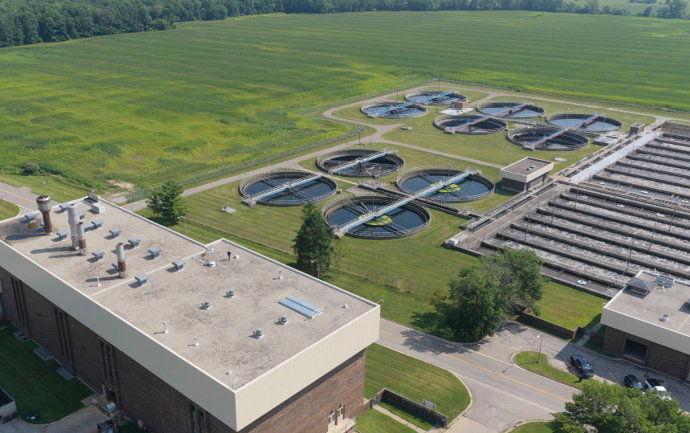
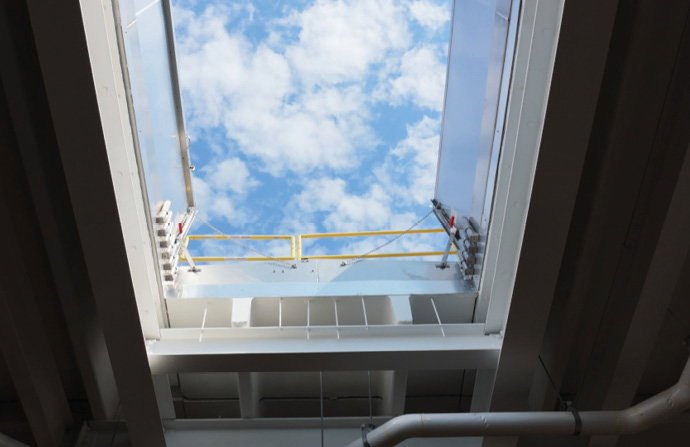
The centrifuges, which weigh 18,500 pounds and are capable of processing 250 GPM of sludge, were installed on the top floor of the building and replaced obsolete incinerators. (Photo credit: Freddy Ray Dugard)
Installation Challenges
One of the challenges facing Sorenson Gross, the general contractor for the project, involved the installation of the centrifuges that are 18.75 feet long and 4.66 feet wide, which made them unusually difficult to install, especially on the fourth floor of a 51-year-old building.
Workers used heavy operating equipment to lift and lower the centrifuges into the building through a 22-foot-long roof hatch manufactured by BILCO. The custom-made hatch includes heavy-duty arms and chains, modified with Type 316 stainless steel hardware.
“Every seven years or so, they will need to swap out the center portion of the drum,’’ explains Alex Summers, project manager for Sorenson. “It’s easier to access the centrifuges in the building through the hatch.
“It was nerve wracking watching them install the centrifuges,’’ he adds. “It’s about 20 to 25 feet up in the air. We had personnel on the roof to make sure they didn’t hit the hatch as they were placing them in the building.”
Next Step
As part of its evolving plan, Drain Commissioner Jeff Wright announced in June 2025 a $13 million waste-to-energy facility associated with the newly built digester plant. The new plant is designed to convert sewage gas to energy and will be completed in 2026.
The facility will capture methane gas extracted through the digestion and dewatering process and convert it to electricity at the Ragnone plant. That plant processes most of the county’s municipal sewage. According to Wright, the plant projects will improve reliability and efficiency, decrease the environmental footprint and create renewable energy that will contain future costs.
As the ASCE noted in its report, the nation’s wastewater infrastructure is in dire need of attention. Genesee County is one example of how groups can work together to develop plans and build models that will help solve the country’s ongoing wastewater infrastructure challenges.
Thomas Renner
Thomas Renner writes on building, construction and other trade-industry topics for publications throughout the United States; email: [email protected].
Video: New Roundabout Under Construction at McIver and Old Florence Roads in Darlington County
Bridge Replacement at Amsterdam Centraal Station
June Issue 2026
.jpg?width=225)