The Norwaldo neighborhood on the northeast side of Indianapolis was primarily developed in the early to middle 20th century as the city developed along early streetcar and automobile routes. There was very limited stormwater infrastructure installed as it wasn’t needed at the time; most water was able to get to the surrounding streams and rivers naturally.
But as impermeable development increased and storms became more frequent and released more water, water began to pond in low points on the streets and surrounding land, leading to erosion and freeze/thaw cycles that rutted the streets, cracked the sidewalks and could pool in yards for weeks at a time.
The Indianapolis Department of Public Works listened to neighborhood resident’s concerns and proactively moved to improve the situation through newer stormwater techniques known as low-impact development (LID) or “green infrastructure.” Indianapolis contracted HNTB in 2015 to design and implement the structural improvements for about five square blocks in the Norwaldo area that had the worst drainage problems.
Learn more details about LID techniques and the engineering project in the Norwaldo neighborhood by watching the author’s full interview of HNTB Vice President Bob Page, P.E., above or by visiting iimag.link/MKHqv.
Why LID?
“When you think of LID or green infrastructure, it’s trying to mimic what has naturally taken place,” explains Bob Page, P.E., a vice president at HNTB who leads the firm’s water resources practice. “Imagine a green field and trying to infiltrate water into the ground—we’re just trying to recreate that as best we can with engineering techniques to reduce runoff from the built environment and minimize the human impact on the natural water world as best we can.”
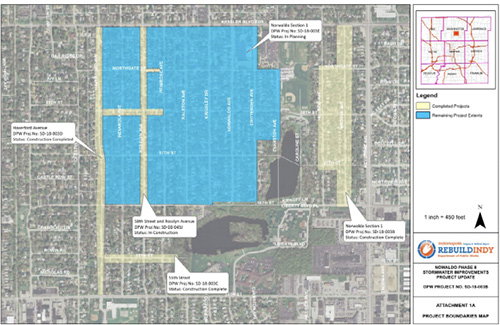
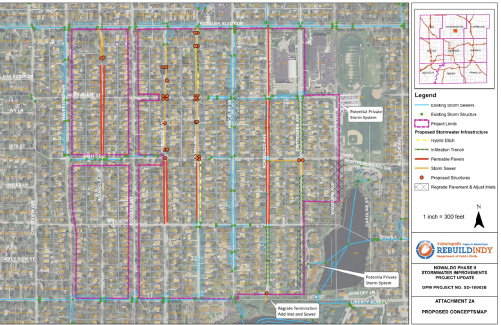
Maps of the Norwaldo neighborhood project site show street blocks, existing storm sewers and the proposed new LID-based stormwater infrastructure.
Before LID techniques became more commonplace in the 21st century, stormwater was historically removed through pipes to get it away from development as quickly as possible. According to Page, stormwater engineers tried to “beat the peak” and remove the maximum amount of water to the nearest stream or river, with little concern for water’s infiltration back into the natural groundwater system. LID techniques try to get as much water as possible back into the ground through slower infiltration, while retaining some piping to allow for direct water removal when larger storm events would overwhelm these greener techniques.
Page also notes that during major storm events, traditional stormwater systems “almost worked too well” and brought too much water into the streams and rivers, creating major flooding events along those waterways. “It’s better for the environment as a whole to just let the water stay where it falls as best we can,” he adds.
Pros and Cons of Neighborhood Age
The Norwaldo neighborhood’s age had positive and negative effects on the engineering at hand, according to Page. It was easier in that there was very little existing infrastructure to tear out and replace; HNTB could mostly start from scratch with new ideas, equipment and technology. On the other hand, some of the residents through the decades had made alterations to their land that went through the city’s “right of way.” Although the City could do whatever it wanted to in those areas, it hoped to be as respectful as possible to the time and money residents spent on their renovations, so the engineers sought to impact them as little as possible or return affected areas to a very similar state if they had to make alterations to improve the overall system.
“It just made it a little harder to coordinate and make sure we were replicating what they’d done,” he adds.
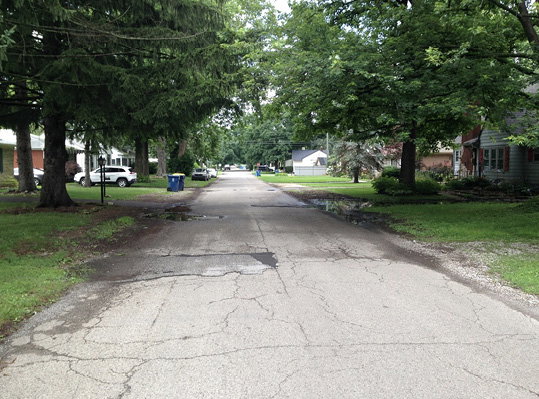
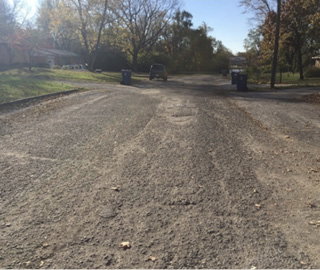
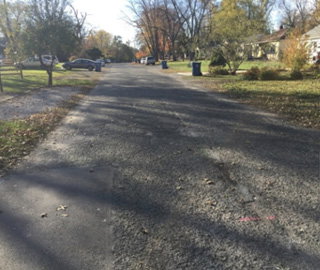
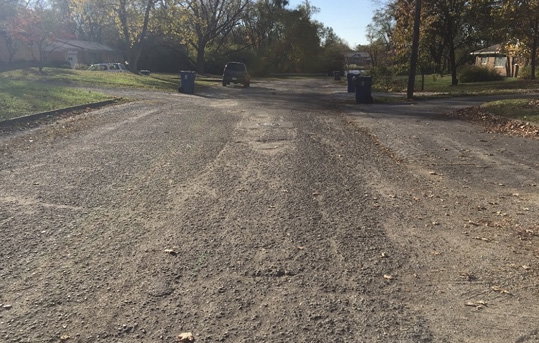
Decades of inadequate drainage led to ponding in the yards and streets as well as freeze/thaw cycles that tore up the neighborhood’s roads.
Porous Pavers and Hybrid Ditches
The two main techniques used to remedy the ponding water in Norwaldo were permeable pavers and hybrid ditches. Installation of both is nearly identical until the surface is topped.
“We designed a couple of strips on each side of the roadway and rebuilt the crown of the road to direct the water into that area and then design permeable pavers,” Page explains. “The permeable pavers sit on top near the street level; under that’s a permeable stone layer wrapped in geotextile to try and prevent clogging of that stone.”
In the stone and geotextile sandwich is 12-inch overflow pipe to take water away more directly during unusually strong stormwater events.
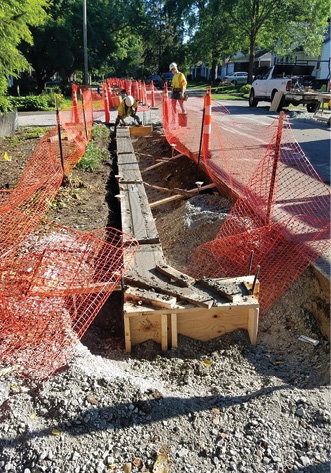
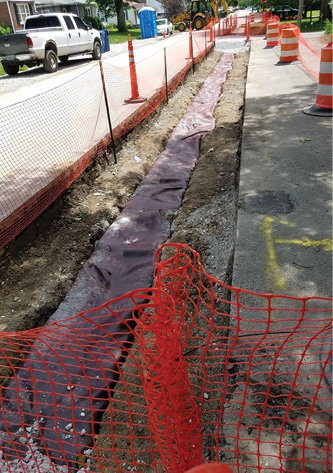
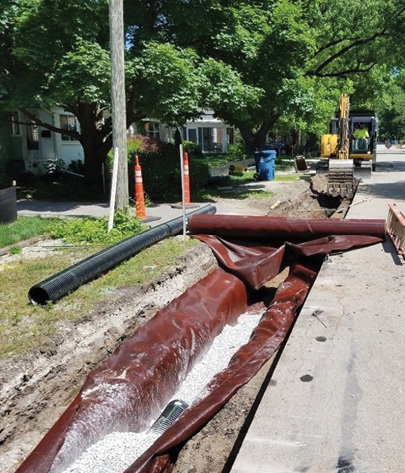
The early stages of the LID drainage system involve digging a 4- to 5-foot trench, casting a concrete berm to hold the materials in place (Top), laying an intial layer of geotextile-wrapped stone over which is placed 12-inch pipe for overflow drainage (Middle) that’s covered by another layer of stone, with a final layer of geotextile wrapping the system to prevent the stone from clogging from debris (bottom).
“There’s a pretty big stone bench underneath the pipe,” he adds. “Primarily, we’re draining down, storing the water in that stone layer, and then hopefully that’s infiltrating into the ground. But, if not, it has a pipe that it can go into.”
Instead of paving stones, a hybrid ditch has local sod placed on top of the same drainage system. The drainage is slightly inferior, but much better than the original “non-engineered” earth, especially if the soils have a lot of clay content. These hybrids were used where residents had renovations, trees or other obstacles that wouldn’t allow for the porous pavers on top. Maintenance was another key consideration when deciding to use a hybrid ditch.
“The nice thing about the hybrid ditch: it essentially looks like someone’s front yard,” notes Page. “So when they’re mowing their grass, they’re mowing over a low-impact development technique they don’t even know is there.”
In either case, geotextile is used to try and keep the stone layer as pure as possible, both from earth pushing up from the bottom and debris such as grass and leaves contaminating from above.
How Well Did It Work?
When the project was complete, the HNTB design team reassessed the site after a “pretty decent” storm passed over the area (about a quarter inch of rain). The pavement was wet, but there wasn’t any standing water anywhere to be seen.
“I was very pleased when I went up there and there was no ponding water,” adds Page. “A majority of the water had been taken into the improvements we’d made, and the system was working the way we planned.”
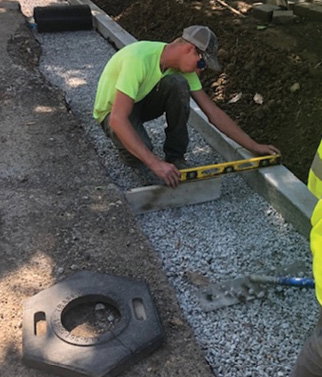
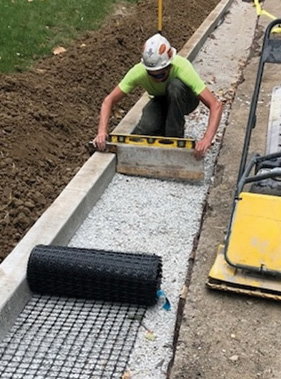
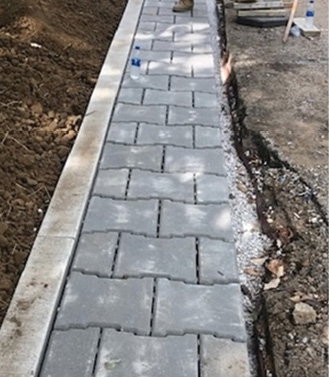
The next steps involve flattening the top layer of stone (Top) so more geotextile (middle) can be placed below the porous paving stones (bottom).
Engineering Advice for Using LID
According to Page, the cost of the LID installations is only a little more than for traditional piping. He does warn that maintenance requirements are greater, for the city and affected residents. Although not used on this project, rain gardens, another LID technique that uses vegetation to help absorb water more slowly, can quickly look like weeds if not properly monitored and maintained. Pavers and the stone beneath can become clogged if leaves and grass are allowed to collect on the surface and decay.
“The performance [of LID] is on par [with traditional techniques] as long as they’re maintained,” he explains. “If they’re not maintained, then there’s no performance.”
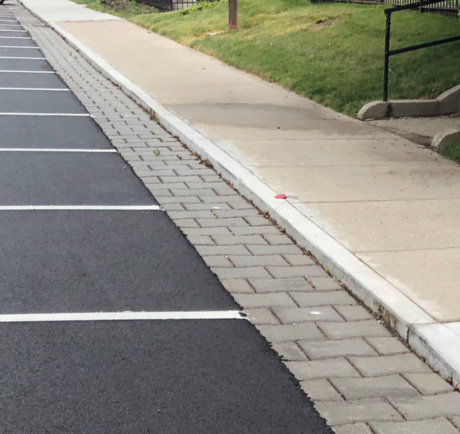

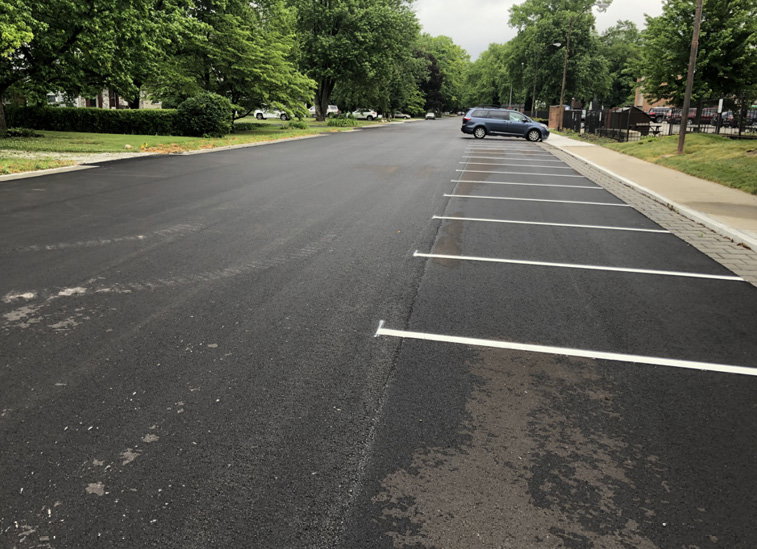
Photos show the final, transformed streets and drainage system that will provide better stormwater control while slowly recharging the local groundwater aquifers.
In terms of other advice he would pass along to water engineers looking into similar projects, reaching out to residents before the project starts is crucial. The HNTB team sent a mailer to about 5,000 people in the project area for details on how much flooding they were seeing and how often it occurred. It also allowed them to prepare the residents for the oncoming construction. They also held town-hall-type meetings at local libraries.
When the design was about 30-percent complete, they held an additional meeting so the public could see the preliminary plans and provide feedback. They held another meeting at about the 60-percent-complete mark to share updates.
“Keeping the public informed and involved and trying to implement as many of their thoughts as possible is always good,” notes Page. “Allow people to voice their concerns and be part of the process rather than somebody showing up with an excavator one day and just starting to build.”
The most vocal opposition came from residents who had mature and beloved trees that may be affected. Whenever possible, the engineers worked to find solutions that would leave the trees intact. In some cases, water drainage was diverted to the other side of a street without trees, and root zones were avoided where possible by using pipe-only systems.
“It makes life a lot easier when everybody’s getting along on a project, including the residents,” adds Page.

Todd Danielson
Todd Danielson has been in trade technology media for more than 20 years, now the editorial director for V1 Media and all of its publications: Informed Infrastructure, Earth Imaging Journal, Sensors & Systems and Asian Surveying & Mapping.
Video: New Roundabout Under Construction at McIver and Old Florence Roads in Darlington County
Bridge Replacement at Amsterdam Centraal Station
June Issue 2026
.jpg?width=225)