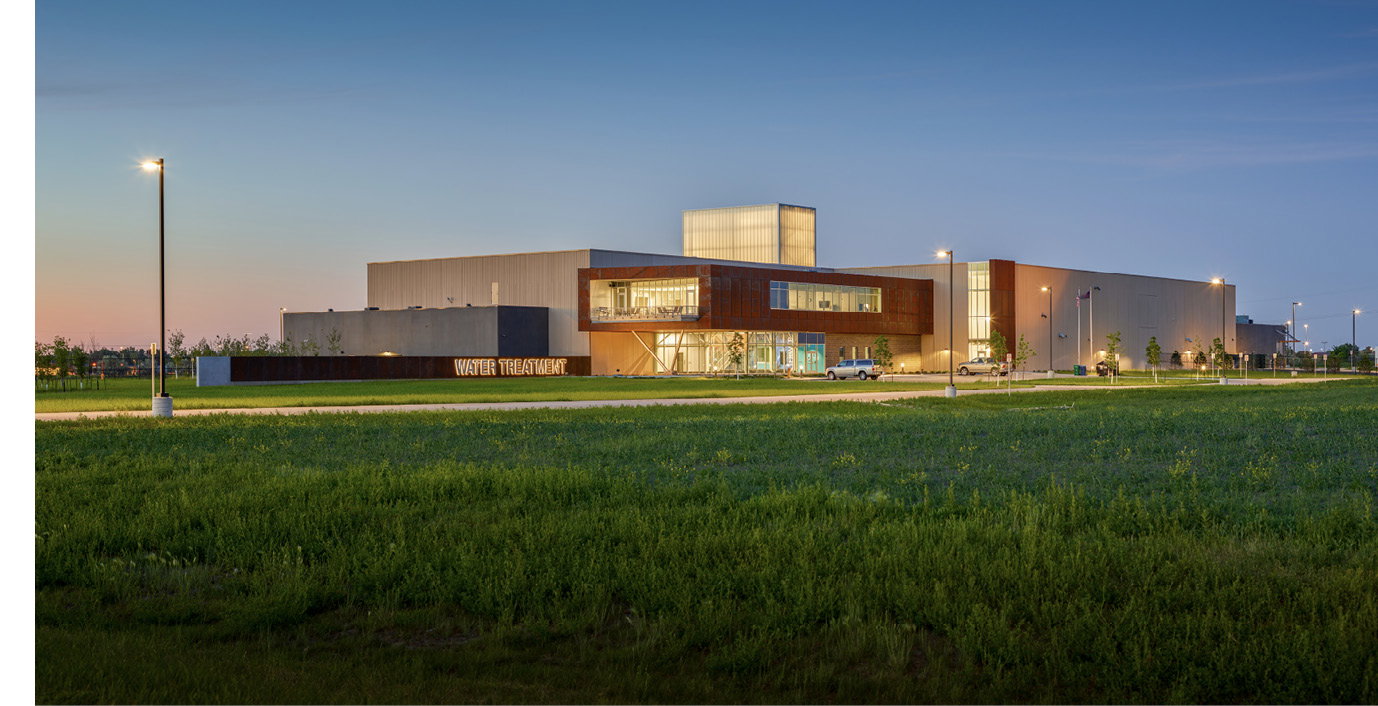
The 250,000-square-foot Grand Forks Regional Water Treatment Plant features an optimized control room and panoramic view of the major water-treatment areas. The unique design includes sustainable innovation, amenities to foster employee wellness within a 24/7/365 environment, resource stewardship and brighter standards in industrial park design.
After six years of planning and construction, Grand Forks, N.D., began operation of the Grand Forks Regional Water Treatment Plant (GFRWTP) in mid-2020. The $134 million, 250,000-square-foot complex is one of the most technologically advanced facilities of its kind. The project’s goal is to provide the city’s residents and industries with potable water. Additional key targets include reducing seasonal taste and odor issues as well as meeting water regulatory requirements.
Unique Design and Construction
This new plant replaces the city’s previous 60-year-old facility and is a culmination of a long history of water-supply planning and improvements. The city of Grand Forks implemented a new construction method and awarded a construction manager-at-risk (CMAR) contract to Ulliman Schutte. The CMAR provided construction phasing and scheduling recommendations to minimize interruption, advised on methods to gain efficiencies in project delivery, and developed potential construction cost savings scenarios with pre-procurement. The GFRWTP was the city’s first use of the CMAR project-delivery method. Through it all, AE2S served as the city’s advisor, prime engineering consultant and design partner with JLG Architects.
The GFRWTP was a bigger-picture project that could have been designed like any other windowless industrial or utility building. However, city administrators felt the parallel water-treatment process, using conventional technology as well as a new state-of-the-art membrane system, was an innovation that deserved to be highlighted. The facility’s bold exterior includes a cantilevered, weathering steel structure with expansive windows, which are unqiue for a treatment plant.
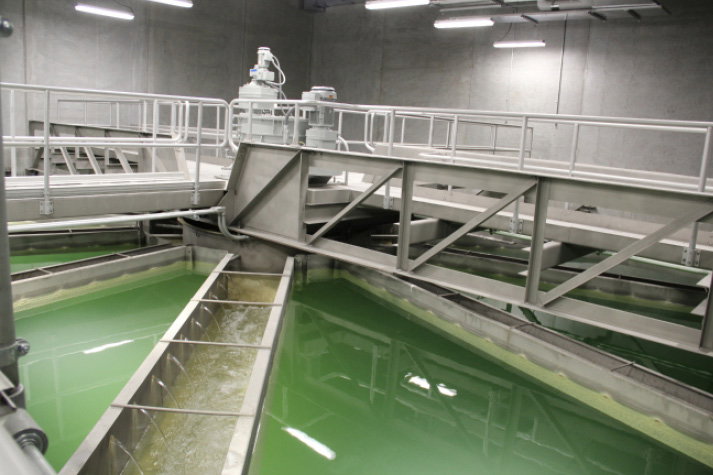
A photo of the Grand Forks contact basin shows where water is mixed with lime and chemicals for softening and settling out of solids. (JLG Architects)
“Although it’s an ultra-industrial architectural feature, it serves to bring a lot of natural light into those public spaces and offices,” explains JLG’s principal-in-charge, Scott Jordan-Denny. “We were also very intentional with our design, choosing inexpensive and durable materials that we knew could last a hundred years.”
To achieve their vision of designing a structure that could implement the new system while educating the public through tours, they needed a more vibrant internal environment to contrast the building’s three levels of tanks, labs and treatment equipment. Within the design, JLG mapped out a racetrack-style tour to take guests on an engineering journey from the lobby to the laboratory, past the control room, holding tanks and testing labs. To highlight specific areas, they created colorful “super graphics” that represent a microscopic view of the process that tourgoers are experiencing.
Much of the firm’s design is centered around enhancing the experience of viewing 30-foot-deep treatment and filtration tanks. Bright and airy office spaces capture natural light and outside views for a wellness-driven design that also includes a training room with a kitchen that doubles as a social gathering place.
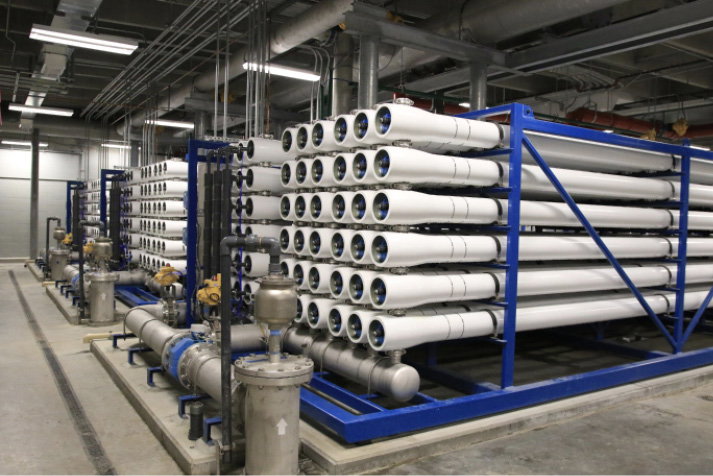
High-capacity reverse osmosis is a key part of the water treatment plant. (JLG Architects)
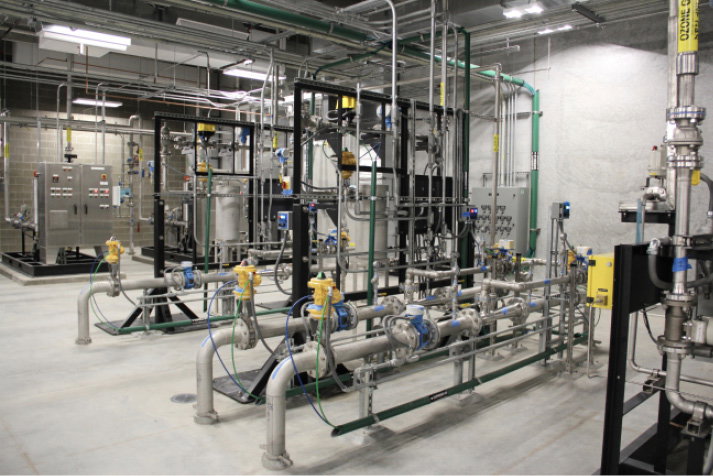
Ozone is mixed with sidestream water and injected into the basins for disinfection in these ozone gas manifolds. (JLG Architects)
The structure has a height of 75 feet above grade and houses a chemical storage silo. The design was accomplished using Revit 3D, allowing for virtual walkthroughs of the facility. Various framing systems used across the structure include cast-in-place concrete foundations, and walls and floors that framed the main treatment spaces. In addition, pre-stressed precast concrete wall panels and roof members provided the facility’s building shell. The administration space is framed from structural steel columns and beams, open webbed steel joists, light-gauge steel deck and cold-formed walls.
There were a number of structural design challenges that were addressed during planning, design and construction. These challenges included complex basin layout and configuration, foundation support requirements, a cantilevered administration space, and project sequencing. The foundation support was a critical item due to the soft and highly compressible soils that are common in the Red River valley.
To support the heavy three-story structure, the design included 794 driven-steel piling that extends to depths up to 100 feet below grade.
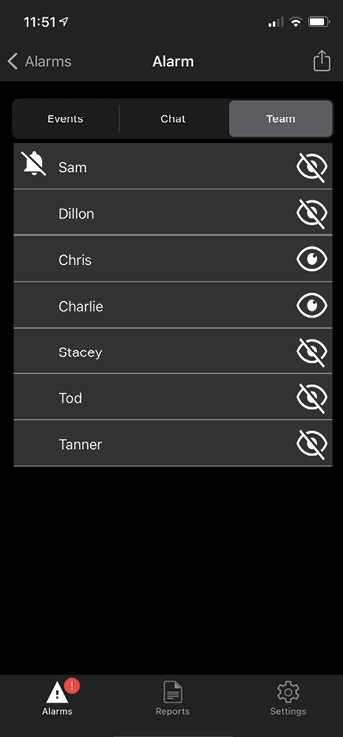
A WIN-911 mobile app call-out list displays operators who have seen the alarm and those who have not. (JLG Architects)
Hybrid Facility
GFRWTP operates as a hybrid facility utilizing both a conventional and membrane system for water treatment. From the general pretreatment area, the water is pushed through to a conventional system where the water is treated by a traditional lime softening, ozonation and biological filtration method or to the revolutionary membrane system. The membrane system starts with an ultra-filtration technique and then moves to three reverse-osmosis skids, each containing multiple membrane vessels that pull particulates from the water. The water is blended at the end of the two systems.
The new hybrid water-treatment plant also serves as the city’s monitoring hub for its 45 wastewater lift stations, 12 stormwater stations and 12 flood stations. To meet the project’s goals and oversee these stations to ensure there isn’t any unplanned downtime requires a lot of behind-the-scenes robust technology.
Technology Upgrade
Monitoring at the previous 60-year-old water-treatment plant depended on operators in a control room 24/7 to manually acknowledge alarms and notify the appropriate engineers via radio or phone calls. All storm, lift and flood stations received communications through the water-treatment plant because it was the only facility with staff onsite 24/7. Because of the new facility’s dramatically increased size, greater oversight responsibilities and the previous facility’s ongoing radio interference, Fred Goetz, manager of GFRWTP and the operations team, Tod Matelski, wastewater treatment (WWT) manager, and Pete Aamold, wastewater collections (WWC) supervisor, knew this was no longer a viable solution.
The city of Grand Forks contracted with AE2S, a specialized civil/environmental consulting engineering firm, as the project consultant and advisor. They worked together to select a software company whose SCADA system would manage the different utilities’ equipment. After a rigorous presentation process, the city and AE2S conducted a selection grading procedure among key stakeholders. The city then reviewed this matrix and ultimately chose AVEVA System Platform as the SCADA solution, which was presented by GS PlantOptics.
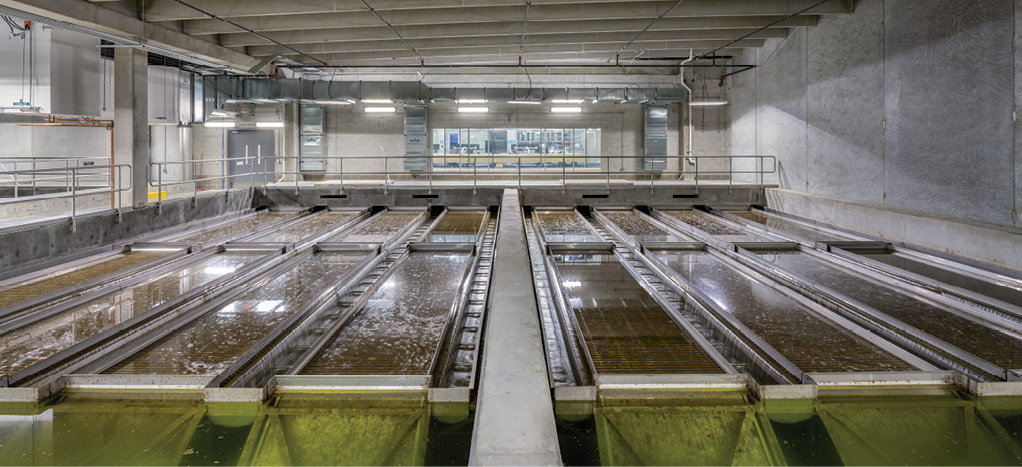
The water pretreatment process utilizes three 8 million gallons per day rapid mix/flocculation/sedimentation basins with inclined plate settlers to provide a large amount of solids-settling area in a small footprint, effectively reducing the up-flow velocity for improved floc settling and removal. (LG Architects)
AE2S configured the architecture so the servers are in one building and housed under one System Platform. While this provides congruent standardization, each department is now responsible for its own assets. Each of the three System Platform Operations Management Interface view applications has features that are unique for each department, incorporating the functionality needed by operational and information-technology teams to improve efficiencies.
Cohesive Departments
Together, GFRWTP, WWC and WWT make up the city of Grand Forks Water Department (water, wastewater and stormwater are separate public-works departments). While much of the work focused on the flagship treatment-plant project, WWT and WWC also received software system upgrades that allowed operators to have remote-control access. Along with the software upgrades, the 69 remote collections sites were converted from an antiquated radio system to a new cellular-based telemetry system.
Advanced Alarm Notification
Production levels at the new facility are as high as 16 million gallons per day in the water-treatment plant. Any aberration in the flow, water-quality issues or a chemical feed could be extremely detrimental.
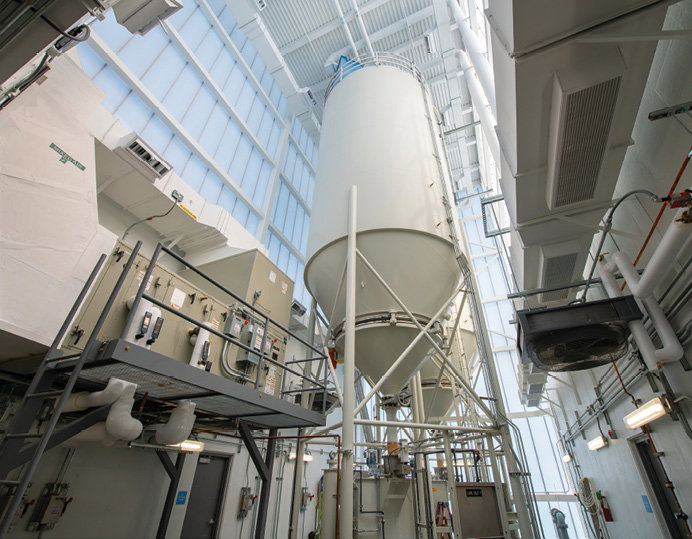
The plant has two lime storage silos holding 106,000 pounds of hydrated lime each. They’re located between the two softening basins. The lime is batched in slurry tanks and injected into the basins to soften the water. (JLG Architects)
To relieve the operators onsite in the control room at the water-treatment plant from the sole responsibility of receiving and dispatching alarms, AE2S recommended integrating the AVEVA System Platform with WIN-911 autonomous alarm notification software. This upgrade means that although this facility is still the only one staffed 24/7/365 and remains the monitoring hub, staff are no longer solely responsible for dispatching alarms.
WIN-911 alarm software provides constant remote monitoring and assurances to prevent any problems. Alarm notifications are dispatched via the software’s mobile app, which allows the team to respond and discuss—within the app—the state of the alarm and how to quickly resolve each issue.
Unique Equipment and Ongoing Monitoring
The WWT’s intricate system is continuously monitored by AVEVA System Platform and WIN-911 to ensure safe and effective processing of the wastewater brought in from the collections area. These include monitoring chemical levels such as sodium hydroxide and polymers as well as skimmers, air blowers and a state-of-the-art UV system.
Also being continuously monitored is a sophisticated microbubble flotation (MBF) system that extracts solids and other particles from the water before discharge. Although most water utilities also remove particles from the bottom, the MBF system uses high-pressure air blowers to aerate the basin and force the particles to the top where they’re skimmed off.
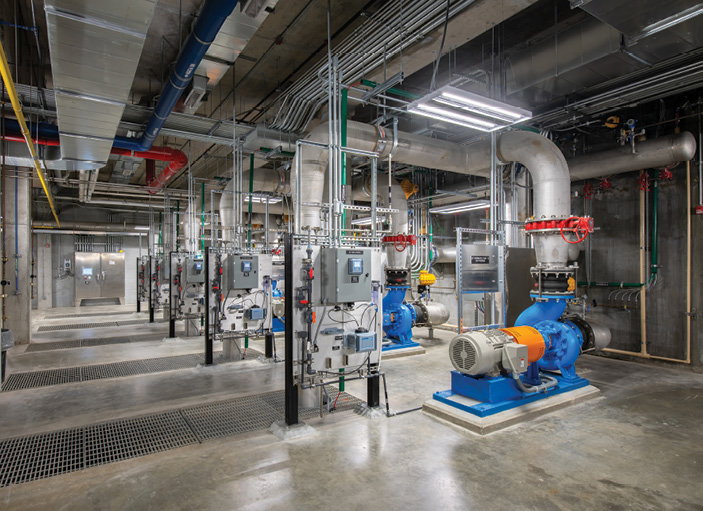
Ultrafiltration (UF) membranes pre-filter pretreated water before being processed through the reverse-osmosis skids. Five UF basins can produce 14.75 million gallons per day. Each skid has a permeate suction pump to create a vacuum and pull water through the membranes and send it to the filtrate storage reservoir. (JLG Architects)
In one instance, a WIN-911 mobile app alarm alerted the team that the high-pressure header system for the aeration blowers, which can only handle a specific PSI, was ramping up too high to accommodate the intake. When the team received the notification, it adjusted the levels to process the wastewater at a safer pace and avoid detrimental equipment damage.
“The mobile app not only lets the team know where the potential problem is located, but we also have it set up in the facility to report exactly what situation is occurring,” adds Matelski.
In addition to this being the largest building construction project in Grand Forks’ history, the plant, city administrators and design partners achieved their goal of implementing a cleaner and more-efficient hybrid water-treatment system.
The GFRWTP is making a positive impact on the Grand Forks’ community and sets the city up for future expansion. Upgrading the SCADA system and integrating it with autonomous alarm notification software ensures there isn’t any unplanned downtime, the three departments are working together cohesively and emergencies are avoided.
Cody P. Bann
Cody P. Bann is vice president of engineering at SmartSights; email: [email protected].
Video: New Roundabout Under Construction at McIver and Old Florence Roads in Darlington County
Froedtert Hospital Expansion
June Issue 2026
.jpg?width=225)