
The ACEC Research Institute recently released its “Engineering Business Sentiment” study for the first quarter of 2026. More than 600 executive-level ACEC member-firm leaders from firms of all sizes around the country were asked to weigh in on the current state of the industry and its direction. The survey uses a “net rating” methodology, which is calculated by subtracting the negative ratings from the positive ones. Therefore, a positive net rating indicates overall sentiment is optimistic, while a negative net rating indicates an overall pessimistic sentiment. The higher the number, the stronger the sentiment.
Mostly Good News
The study revealed continued widespread optimism for firms and the industry as a whole, with the former receiving a +82 net rating and the latter coming in at +76. That said, the headline here may be sentiment about the state of the U.S. economy overall, which garnered a +45 net rating. While that number is eclipsed by the bullishness for the state of the engineering industry, it’s worth noting that the +45 rating represents an 11-point quarter-over-quarter improvement.
Overall, what the data tell us is that firms are feeling good about their business. Balance sheets are solid, and leadership teams are sleeping better. Ask most engineering-firm executives about their own firm’s financial health and the answer, almost uniformly, is “confident.” Ask him or her about the broader economy and increasingly (albeit cautiously) the answer is the same. That’s a welcome and meaningful shift.
Thoughts on AI
Of course, no study of engineering business sentiment would be complete without an exploration of trends surrounding AI. Our research found that the proliferation of AI hasn’t sparked a wholesale transformation of our firms—not yet and not uniformly. What it has done is compelled more firms to get serious and plan for a future that will be increasingly driven by technology.
Nearly half of responding firms now have an AI strategy in place, up 18 points from last year. Conversely, the share of firms without an AI strategy (and without plans to put one in place) fell to 22 percent, down 10 points. Adoption may not be universal (yet), but preparation is becoming table stakes. It’s becoming clear that firms that aren’t at least thinking about integrating AI are falling behind in ways they may not fully appreciate until it’s too late. For those firms actively building strategies, 86 percent believe that adopting AI will yield positive impacts in the coming year. That’s up eight points from 2025, and up 23 points from when we first polled this question in 2024.
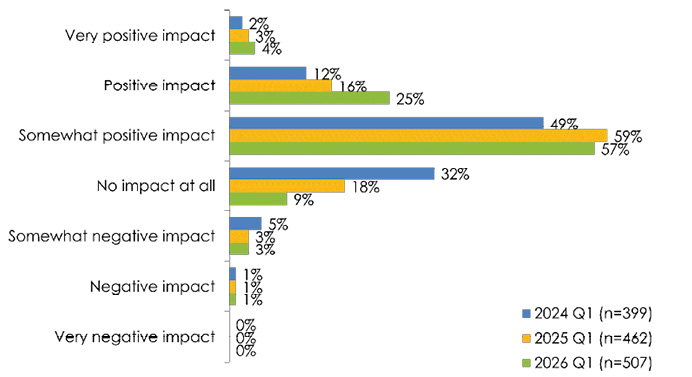
Although AI has become the dominant topic of discussion at industry conferences and happy hours, workforce challenges continue to loom large. The good news is that the engineering labor market is showing glimmers that may point to stabilization. Salary increases are cooling, which is welcome news for firms that have spent the last several years watching compensation budgets balloon in a seller’s market for talent.
Eighty-eight percent of firms currently have open positions, but the median number of openings has decreased from six to five. Still, unfilled positions are not an abstraction, they are a hard constraint on growth. We’re in a moment of unprecedented demand coupled with seemingly improving macroeconomic conditions. But none of that converts to bottom-line growth if seats are empty at our firms.
The throughline of the Institute report is clear: confidence in internal and external factors remains steady and improving, even as AI reshapes how firms think about technology. The firms that will lead this next era won’t be those that chose between talent and technology; they’ll be the ones that mastered both. The future belongs to firms that leverage technology to amplify human expertise, not replace it.

Daphne Bryant
Daphne Bryant is executive director of the ACEC Research Institute; email: [email protected].
Video: New Roundabout Under Construction at McIver and Old Florence Roads in Darlington County

Bridge Replacement at Amsterdam Centraal Station

June Issue 2026
.jpg?width=225)