
Anchor House staff and board members, former president Bill Clinton representing The Clinton Foundation and its Overdose Response Network, The United Methodist City Society (UMCS), The New York State Office of Addiction Support and Services (OASAS), Urbahn Architects, contractor The J. Pilla Group and project manager The Dormitory Authority of the State of New York (DASNY) celebrated the beginning of construction work for the critical $18 million renovation and expansion of the Anchor House Men’s Residential Treatment Facility at 1041 Bergen Street in the Crown Heights section of Brooklyn.
Left to right: District Director at Congresswoman Yvette Clark’s office Anita Taylor; Pastor Martha Epstein; Urbahn Architects Associate Daniel Zbarsky, AIA; OASAS Regional Coordinator Meghan Tansey; Urbahn Architects Principal Rafael Stein, AIA; OASAS Commissioner Dr. Chinazo Cunningham; Anchor House Executive Director Alison King; President Bill Clinton; Deputy Borough of Brooklyn President Kim Council; Anchor House Board of Directors President Rev. Margaret Schramm-Horn; Resident Bishop of the New York Episcopal Area Bishop Thomas J. Bickerton; NYC Council Member Chi Ossé; CEO of the United Methodist City Society Rev. Angela Redman, Esq.; OASAS Program Manager Desiree Aaron; Lance Carlile, Chair of the United methodist City Society Real Estate Committee; DASNY Project Manager Mehmet Aygun; The J. Pilla Group Project Manager Jesse Loverro; and Anchor House Compliance Officer Edgar Sanchez.
Photo by Ola Wilk
Former President Bill Clinton, Urbahn Architects, UMCS, DASNY, OASAS and The J. Pilla Group Break Ground for $18 Million Expansion and Renovation of Anchor House Men's Addiction Rehabilitation Facility in Brooklyn, NY
More than 6,300 New Yorkers died from drug overdoses in 2023, a nearly 70% increase since 2018; the numbers of deaths began to decline in 2024 and 2025, but efforts must be sustained to reduce the tragic toll of addiction
Brooklyn, NY– At a time when substance use disorder and co-occurring mental health needs and criminal justice involvement are reshaping communities across the United States and placing strain on New York’s and national behavioral health systems, Anchor House, Inc. has broken ground on an expansion of its men’s residential treatment facility.
Anchor House staff and board members, former president Bill Clinton representing The Clinton Foundation and its Overdose Response Network, The United Methodist City Society (UMCS), The New York State Office of Addiction Support and Services (OASAS), Urbahn Architects, contractor The J. Pilla Group, project manager The Dormitory Authority of the State of New York (DASNY) and celebrated the beginning of construction work for the critical $18 million renovation and expansion of the Anchor House Men’s Residential Treatment Facility at 1041 Bergen Street in the Crown Heights section of Brooklyn. Deputy Borough of Brooklyn President Kim Council attended the ceremony
DASNY and OASAS support the project through funding and oversight. This investment is designed to increase capacity while strengthening the delivery of structured, high-quality care within the Crown Heights community. The project responds to the growing demand for residential treatment among individuals presenting with higher clinical acuity, complex mental health needs, and significant system involvement. As more than 80% of those served rely on Medicaid and managed care, Anchor House continues to operate as a critical safety net provider within New York’s treatment continuum.
Anchor House is a faith-based, non-profit, intensive residential treatment facility provider of OASAS. governed by the UMCS and licensed by the OASAS. It currently operates a 50-bed men’s facility and 28-bed women's facility, both located in Brooklyn. The organization applies a trauma informed, integrated biopsychosocial and holistic treatment approach to substance use disorder. The goal is for men and women to return to their families as healthy, productive, and self-sufficient members of their communities.
Anchor House began in 1967 when Reverend Alfredo Cotto-Throner, then pastor at Third Street United Methodist Church, along with Rev. Richard Rice and their wives decided to create a place to stay for those facing drug addiction. The program was launched when the Brooklyn and Long Island Church Society purchased 976 Park Place from the United Methodist Church. In 1996, the men's facility grew from the Park Place location housing 20 men to the current 50-bed facility on Bergen Street. Nationally recognized among Newsweek’s America’s Best Addiction Treatment Centers – with its men’s program ranked #5 and women’s program #19 – Anchor House remains a leader in outcomes-driven care for New Yorkers with complex clinical and social needs.
Anchor House has maintained a longstanding relationship with the Clinton Foundation and its overdose response and recovery efforts, with an ongoing dialogue centered on faith-based engagement, community outreach and behavioral health initiatives in New York.
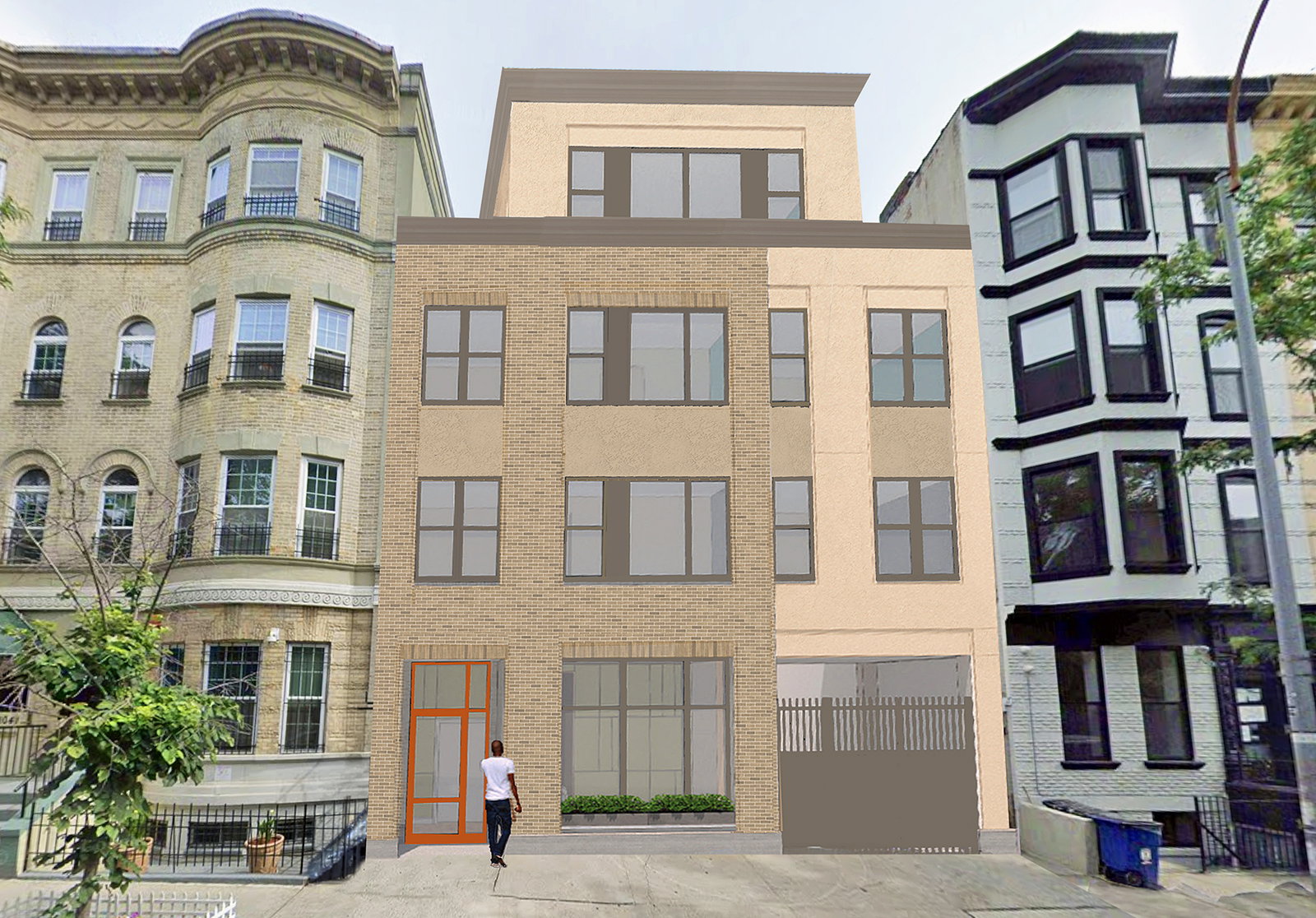
Urbahn Architects visually incorporated the new building into the local streetscape. The front façade will include a combination of brick face, stucco and metal panels and feature an asymmetrical design, with the brick section shifted to the left side to add visual interest and energy to the front elevation. The front of the structure will feature zoning-required setbacks on the top floor. Rendering by Urbahn Architects
For over 15 years, the Clinton Foundation has been fighting the overdose crisis by increasing access to lifesaving naloxone, reducing stigma and training community leaders to help people into recovery. The Foundation’s Overdose Response Network has helped distribute over a million doses of naloxone to community groups, sober living homes, and public health departments through a partnership with Direct Relief International; and has installed thousands of Overdose Aid Kits across the country. The Foundation has also convened hundreds of faith leaders for interfaith networks in 14 cities across the country, to help reduce the stigma of substance use disorders and better equip these leaders to address the overdose crisis in their communities.
“This is not simply an expansion–it is a direct response to the increasing clinical and operational demands we are seeing across the behavioral health system,” said Alison King, Executive Director of Anchor House. “Individuals are entering treatment with increasing complexity across trauma, mental health and justice involvement. Expanding capacity alone is no longer sufficient. This project strengthens both scale and structure—ensuring we remain a ‘House of Hope’—a safe harbor where hope is renewed, while delivering clinical excellence and measurable outcomes.”
“As Anchor House’s parent organization, The United Methodist City Society’s mission has always been to meet the most pressing needs of New Yorkers. This investment ensures that Anchor House has the modern infrastructure required to continue its 60-year legacy of healing and community reintegration.” said Rev. Angela Redman, Esq., CEO of the United Methodist City Society.
"There's really not much of a partisan difference when humans' lives break. The truth is that people don't have to die, but people don't know that the simplest thing is an orderly, caring, loving response,” said President Clinton. “Everybody counts and deserves a chance. Anchor House is a place of second chances."
“The goal of Anchor House’s expansion and renovation is to address the rapidly growing need for substance abuse treatment, particularly in response to mental health issues accelerating since the pandemic, cannabis legalization and opioids epidemic. Our hope is that at the ribbon cutting, we will have expanded our services to include an outpatient program,” explained King. “In a post-pandemic landscape where needs are more complex, these expanded services will position us as a critical resource to the Brooklyn community—addressing mental health and criminal justice-related needs through comprehensive substance use disorder treatment, strengthening continuity of care, and delivering integrated medical care on-site.”
“This expansion represents a major investment in compassionate, trauma-informed care that supports individuals on their path to long-term recovery,” OASAS Commissioner Dr. Chinazo Cunningham said. “By increasing residential treatment capacity in Brooklyn and creating a supportive environment focused on healing and stability, Anchor House will help more New Yorkers access the care and support they need to build healthier futures—building on Governor Hochul’s continued support for new affordable and supportive housing statewide.”
“The expansion of Anchor House is a powerful embodiment of our United Methodist commitment to social justice and the healing of the whole person,” said Bishop Thomas J. Bickerton, Resident Bishop of the New York Episcopal Area. “We are called not just to offer prayers, but to build tangible ‘Houses of Hope’ where the cycle of addiction is broken through grace and clinical excellence. By strengthening this facility, we are reaffirming our 60-year promise to the people of Brooklyn that no one is beyond the reach of transformation.”
Rev. Margaret Schramm-Horn, President of the Anchor House Board of Directors, added: “The Board’s priority is the dignity and long-term success of our residents. This $18 million project is a commitment to our clients that their recovery environment will finally match the world-class clinical care provided by our staff.”
According to Urbahn Architects Principal Rafael Stein, AIA, “This $18 million project will allow Anchor House to increase the men's treatment facility’s capacity to 70 beds and expand its critically needed addiction rehabilitation services in Brooklyn. The renovation of the existing center will upgrade bedrooms and create new shared facilities and outdoor spaces. Residential recovery lasts months, and the architecture should support that, not work against it. The new building takes design cues from the scale and materiality of the brownstones on Bergen Street, and inside, the courtyard and oversized windows bring daylight into the treatment floors.”
Over the five-year period ending in 2023, New York experienced a sharp escalation in overdose deaths driven by fentanyl and other synthetic opioids. In 2023, more than 6,300 New Yorkers died—one of the highest levels on record. Data shows overdose deaths began to decline in 2023, with a 30% decrease in 2024 and continued declines into 2025. This progress is significant, but must be sustained.
Urbahn’s project team includes principal Rafael Stein, AIA; Associates Dan Zbarsky, AIA and Bridgette Van Sloun, AIA, CPHC, WELL AP; and designers and project managers Joseph Zapulla,
Roshini Brahmaiah, Sahar Rahaman and Haley Evans.
Architecture
Anchor House currently operates out of an 8,100-square-foot former residential brownstone that includes four stories and a cellar. The expansion project calls for an 10,800-square-foot addition to be constructed on a 4,500-square-foot adjacent lot. Due to zoning regulations, Urbahn designed the addition as an independent structure rather than an expansion of the existing building, which allowed the team to maximize the addition's size and program. However, all floors of the new building will connect to the existing building to allow the center to operate as one facility.
“The Urbahn team undertook conscientious steps to visually incorporate the new building into the local streetscape,” shared Urbahn Associate Daniel Zbarsky, AIA. “The front façade will include a combination of brick face, stucco and metal panels and feature an asymmetrical design, with the brick section shifted to the left side to add visual interest and energy to the front elevation. The front of the structure will feature zoning-required setbacks on the top floor.”
While the existing building has a wood-joist structure, the new building will feature a steel-framed structure with concrete masonry unit (CMU) walls. The expansive and oversized windows will allow increased amounts of natural light to enter the bedrooms, shared spaces and therapy rooms, and serve as a design expression of Anchor House's spiritual and philosophical message of providing positivity, light and openness. These philosophies are also reflected in the warm and natural elements that are incorporated into the interiors.
The new building will feature an outdoor courtyard that includes an access gate on the right side and a U-shaped inner courtyard on the left side that allowed the design team to incorporate additional windows into the structure. The exterior courtyard will open upwards throughout the entire height of the building. The 20'x40', 800-square-foot site section at the back of the building will feature pavers, landscaping, seating areas and possibly exercise equipment.
According to The Pilla Group Project Manager Jesse Loverro, the building’s location has added logistical and technical challenges to the design and construction process. “The constricted, high-density nature of both the street and project site make careful planning and coordination between contractors and vendors paramount to executing the work on schedule, while ensuring the safety of the neighbors. In addition, the site’s rear border is adjacent to the Crown Heights North Historic District. This location required the design team to maintain a certain distance between the Anchor House complex and the neighboring properties and the construction team to carefully monitor the nearby buildings within the historic district with vibration sensors during construction,” he said.
Interior design
According to King, “Our leadership collaborated closely with Urbahn’s designers to maximize functionality and ensure all programmatic needs are met. The expanded and renovated facility will feature a new clinical and medical wing, alongside a central multipurpose environment for family engagement. The design emphasizes natural light and a residential, non-institutional setting aligned with best practices in recovery-oriented care.”
According to Zbarsky, “One of the main interior design challenges was fitting the extensive therapeutic and residential program into the small site. While at times the process felt like putting together a complex puzzle, we have achieved a well functioning interior layout that will comfortably serve both the personnel and residents.”
The new building will feature two entrance lobbies. A storefront-type entrance from the street that provides a connection to the small elevator lobby and then to the main lobby farther along the corridor, at the back of the building. The main lobby will house a reception desk and a short staircase, which visitors can travel up to a connected welcoming area that features comfortable seating, warm wood paneling and overlooks the double height multipurpose room. This introduction to the facility represents the theme of warmth, safety and community.
“The 850-square-foot multipurpose room, which extends from the cellar to the second floor, will be the most important public space in the expanded campus. It will be connected to the existing building and backyard and feature glazed roofing and a glazed wall facing the backyard,” shared Zbarsky. “Guided by the Anchor House leadership, the Urbahn team created this to be a space that is very open, happy, bright, full of natural light and easy to access. It will host various events, including family days, meetings, and movie showings and will open to the newly expanded dining room in the existing building. Access to the event room will be controlled with multiple doors to provide privacy when required,” he added.
The multipurpose room's finishes will include wood baffle ceilings and lightly colored tile in a vertical orientation, which will match other interior finish elements throughout both buildings to maintain consistency of the design. The flooring will consist of large square luxury vinyl tiles (LVT) matching the wood aesthetic. This material will provide the necessary durability, while echoing the residential warmth of the facility.
In addition to the multipurpose room, the cellar will also house a new kitchen to accommodate the additional residents, offices, bathrooms and storage rooms. The second floor of the addition, which will serve as the medical wing, will house group therapy and consultation rooms, exam rooms, nurses’ offices and a medical director's office. The third and fourth floors will have similar layouts and house a mix of one-bed to five-bed bedrooms. The fourth floor of the addition will feature a dormer that will also house a bedroom. The dormer will have setbacks on both sides of it to meet zoning requirements. As with the rest of the interior features, the bedrooms will include wood-look LVT flooring and colorful walls in yellows, blues and greens to create a space that feels residential and not institutional.
LVT flooring in several shapes and colors will be used throughout both buildings. The corridors throughout the campus will feature warm colors, crown moldings, wood paneling, elongated wood-look LVT flooring and bright, warm colors to evoke a feeling of a home rather than an institution. In both buildings, architects will incorporate multiple back-lit cloud ceilings and crown moldings with lights, as well as natural wood ceiling panels to achieve a residential, welcoming feeling. Providing a sense of warmth and connection to nature was important to Anchor House.
Due to budget constraints, the architectural team limited changing the layout and moving the walls within the existing building to reduce the renovation cost, while still providing a space that fulfilled Anchor House's functional and programmatic needs. However, some walls were modified to add ADA restrooms and a new client lounge, as well as to increase the size of selected bedrooms.
The newly constructed kitchen and dining room will be the most significant upgrade in the existing building. To make room for the expanded kitchen and dining area, the project team will open up the cellar in the back of the building to create a double-height space in a former multi-function room. This will require the removal of some walls to create more open space in the cellar. This space will also be clad in wood and will be visible internally from the second floor windows of the therapy room.
The project team includes structural engineer LERA; civil, landscape and MEP engineer O&S Associates; materials consultant Matrix New World Engineering; lighting designer Lumen Architecture; acoustical engineer Shen Milsom & Wilke; and elevator consultant CBA Elevator Consultants.
Urbahn Architects
Urbahn Architects is a full-service planning and design firm based in New York City, which recently celebrated its 80th anniversary. Since its founding in 1945, Urbahn has designed projects for organizations and institutions that operate in the healthcare, hospitality, multi-family residential, education, justice, science, transportation and infrastructure sectors. The firm also operates a regional office in Jakarta, Indonesia, focused on projects in the Far East. The value of Urbahn’s current domestic and international projects totals approximately $4 billion. Building Design & Construction magazine ranks Urbahn as the 74th largest architectural firm in the U.S.
Urbahn served as the architect for some of the U.S.’ most iconic structures, including the Vehicle Assembly Building and Launch Control at Kennedy Space Center in Cape Canaveral, FL, and the Fermi National Accelerator Lab in Batavia, IL. Four principals lead the firm: Donald E. Henry, Jr., AIA, LEED AP; Natale V. Barranco, AIA, LEED AP; Rafael Stein, AIA; and Ranabir Sengupta, AIA, LEED AP. Associate principals include Bridgette Van Sloun, AIA, CPHC, WELL AP; Christopher Young, AIA; Daniel Kohn, AIA, LEED AP; Enrico Kurniawan, AIA, NOMA; Ijeoma D. Iheanacho, AIA, LEED AP, NOMA; Lawrence Gutterman, AIA, DBIA, LEED AP; Nandini Sengupta, Assoc. AIA, LEED AP, NOMA and Ryan Bieber, AIA, LEED AP.
Urbahn’s current and recent healthcare projects include the NYCH+H Woodhull Hospital Outposted Therapeutic Housing Unit (OTxHU) and Harborview Ambulatory Center at the VA Medical Center in Brooklyn, NY; NYCH+H Bellevue Hospital OTxHU and the New York City Hall Mayoral Offices and Emergency Situation Center and Public Health Lab Redevelopment Master Plan in Manhattan; CUNY Lehman College Nursing Education, Research and Practice Center and teaching laboratories in the Bronx, NY; Stony Brook Medical Center Comprehensive Psychiatric Emergency Program in Stony Brook, NY; Rockland Children’s Psychiatric Center in Orangeburg, NY; Western New York Children’s Psychiatric Center in West Seneca, NY; and Correctional Medical Center in Bayamon, Puerto Rico. Urbahn also designed the NYCH+H Lincoln Medical Center in the Bronx, which operates one of the busiest emergency departments in the U.S., serving over 180,000 patients annually.
The J. Pilla Group, Ltd.
The J. Pilla Group Ltd.’s Senior President John Pilla founded the firm in 2006. Today, he offers the company’s clients more than 55 years of construction experience and expertise. John Pilla also leads P&P Contracting Corporation.
The J. Pilla Group Ltd.’s Senior President John Pilla founded the firm in 2006. Today, John Pilla manages the company alongside with his brothers and partners Paul and Tony Pilla.
Based in Hartsdale, NY, The J. Pilla Group provides general contracting, construction management, pre-construction and lean construction services throughout the greater New York area. The firm focuses on multi-family and institutional ground-up projects, mainly in the affordable housing market.
J. Pilla’s recent projects include the 11-story Webster Apartments at 3095-3101 Webster Avenue, mixed-use residential/commercial/medical property at 2721 Colden Avenue and 47-unit El Rio II affordable housing building at 2064 Boston Road in the Bronx, NY; and rehabilitation of the 85-unit 1840 Anthony Avenue affordable housing complex and 94-unit Rheingold Senior Housing at 15 Monteith Street in Brooklyn, NY; and seven-story Carlos Pagan Men’s Residence at South 2nd Street in Brooklyn, NY.

Parul Dubey
Video: New Roundabout Under Construction at McIver and Old Florence Roads in Darlington County

Bridge Replacement at Amsterdam Centraal Station

June Issue 2026
.jpg?width=225)