.jpg)
At Kimley-Horn, Nick Otto’s team is using AI to improve early phase data-intensive activities such as mapping the multi-partner inputs involved in maximizing solar exposure on an undulating slope. Eliminating hours of “picking and clicking” allows Kimley-Horn to concentrate human intelligence on consequential decision making that improves infrastructure ranging from runways, railways and roadways to sanitation, streetscapes and skyscrapers. (Kimley-Horn)
Big or small, near or far, engineering professionals around the world are on the edge of their seats as the AI revolution unfolds. Wonder what’s next? We do, too.
Following the mid-2025 report by the ACEC Research Institute on “The Role of Artificial Intelligence in the Engineering Industry,” Informed Infrastructure checks in with three technology leaders on the front lines of integrating AI in engineering. Each offers a thoughtful perspective on how AI is already changing business as usual for the AEC industry and what you should know about it.
From the considerable computational power required as well as the democratization of access to the layers of security and technology necessary for data certainty, transitioning to AI may seem exponentially more complicated than the transition to BIM. However, with the right decision-making, it could be far easier.
If you’d like to learn more about AI while receiving PDH credit for your professional certifications, you can watch a webcast about the ACEC AI report and take a written course, “How AI Solutions Benefit AECO Professionals.” Both can be accessed at edu.informedinfrastructure.com.
Trust But Verify
J. Nick Otto, Chief Technology Officer (CTO), Kimley-Horn

As CTO for Kimley-Horn, one of the nation’s premier engineering, planning and design consultants, Nick Otto has a front-row seat on the AI in AEC rollercoaster. He recommends fastening your seat belt.
“I’ve been in IT for 30 years and AEC services for about 10 of them,” begins Otto, whose prior responsibilities included IT leadership roles with Circuit City, Red Hat and SAS. “In 2016, my first impression of the state of technology was not that Kimley-Horn was behind, but the AEC industry as a whole was behind.”
When Otto joined the firm, Kimley-Horn employed some 2,500 professionals across 70 offices. Today, that number has swelled to nearly 10,000 staff members across more than 150 North American offices.
Within the AEC industry, there are large powerhouse firms employing thousands, and small engineering firms employing just a few, contending for and collaborating on the same projects. Big or small, new or old, many firms struggle to keep up with the pace of change.
The arrival of AI will have implications on the work—from who does what and when to the technological capacities required to simply open the engineering datasets of the future, it seems everything is subject to change. “To trust AI, we must have a framework to understand when and how AI is used,” he adds. “We also need to address the ‘black-box problem.’ This means understanding how models were trained, the datasets involved and decision making, while also being able to explain it to clients.”
.jpg)
(Chip Henderson Photography)
Educated as an environmental planner rather than a computer scientist, Otto thinks in terms of the relationships among things within an ecosystem, rather than in rows and columns of data, as computers do.
“I spend a lot of my time thinking about governance, risk and compliance,” he says. “To integrate AI into AEC services, we need a framework for guidance, not a blanket approach.”
As one of the nation’s largest civil engineering firms, Kimley-Horn is heavily involved in earthwork, which often is the first physical task in delivering largescale infrastructure programs. “One thing we’re thinking about is efficiency,” explains Otto. “For civil engineering scopes, including site grading and pipe networks, the first 10 to 20 percent of the work involves repeated tasks. We are interested in using AI in that early phase to reduce all the ‘picking and clicking.’ If we can streamline the first part of the work, our engineers can focus on making consequential decisions. Likewise, relative to QA/QC, AI can expedite design reviews and flag potential conflicts.”
Asked about the challenges, Otto worries about the dataset. Certainly, checking a design against a standard building code is realistic, but what about all the other requirements? In civil engineering, absolute certainty is essential to any client’s measure of success. There may be tens of thousands of relevant datasets that aren’t online and can’t be queried by AI. If AI is doing some of the work, the client must have the same confidence in the AI involved as they do in the human intelligence they hired.
“The challenge is there aren’t good-enough models yet, explicitly trained for the world of civil engineering,” shares Otto. “I don’t believe any one firm holds enough data to train a model to interact well with the real-world requirements of civil engineering. I worry a lot about security, confidentiality and data ending up in unauthorized systems. The most important thing is that as a leader, you must understand the data in your AI environment and how that data is affecting the decisions being made with absolute certainty.”
Firm of the Future
Michael Giacco, Vice President,
AI Engineers

Michael Giacco is excited about the future of AEC services. “The sky is the limit,” he notes from AI Engineers’ headquarters in Middletown, Conn. Employing more than 400 people in 11 eastern-seaboard offices from Boston to South Carolina as well as two international offices, AI Engineers holds its own against national engineering powerhouses. Delivering forward-thinking engineering solutions across bridge, transportation, building systems and site development, AI Engineers has been using leading-edge technologies to deliver work since 1991. “AI Engineers was started by Abul and Rubina Islam, a husband-and-wife team working from the basement of their condo. Through hard work and a willingness to embrace technology, AI Engineers has grown by staying ahead of the curve.”
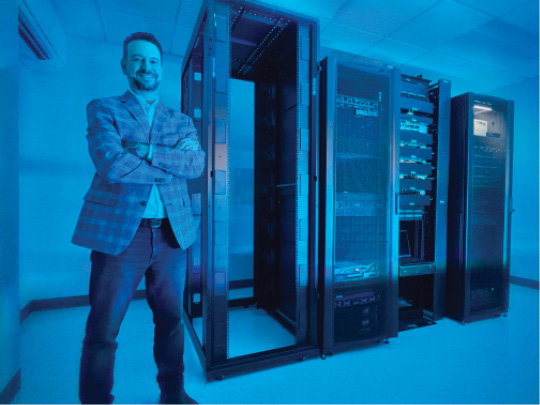
Michael Giacco is excited about the future at AI Engineers, where employee-owners have made a $2.5 million investment in an AI micro lab. Eliminating service costs, queuing times and other complications, AI Engineers is using the lab to develop new engineering tools, host client use and democratize access to the company’s supercomputing horsepower. (AI Engineers)
Abul Islam is the AI in AI Engineers. Specializing in bridge inspections in 1991, while his wife answered the phone, he attended client meetings by day and completed field measurements and engineering assessments at night. Starting with a single Tandy computer, AI Engineers has always been technology focused.
“Mr. Islam expanded from his home office to a space down the street. He hired some people who are still here today and expanded from bridge inspections to become a one-stop engineering shop,” continues Giacco. “Eventually, he built our headquarters office in Middletown. When I came onboard 10 years ago, AI Engineers was 120 people. Today, we employ 400 proud ESOP owners who share in profits. Mr. Islam still has the condo and the computer as mementos.”
.jpg)
Dedicated to the memory of a cherished colleague, The Mark Capaldo Data Center is now the headquarters and heartbeat of AI Engineers’ data-driven future. Rather than refreshing 400-plus company computers, a virtual desktop environment allows low-grade laptops access to virtually unlimited computing bandwidth by authorized allocation as needed. (AI Engineers)
A tech devotee, Giacco explains that the first steps any business can take in using AI begin with automation.
“When AI first came into the AEC industry, there were a lot of ‘wow-factor’ wins,” says Giacco. “Firms did scripting to automate data entry, material quantity take-offs and 3D visualization. Then we started automating structural analysis and later drone flights around bridges to gather data and photos, and develop point clouds to improve QA/QC. A lot of this was flashy, interesting stuff, with minimal impact, but it opened the AEC industry’s eyes to the possible time savings.”
Giacco points to the arrival of ChatGPT as the industry’s initial pivot point. Having a co-pilot to help craft RFP content, review documentation for conflicts or concerns, and eliminate many formerly painstaking processes involved in research and content distillation encouraged engineering leaders to push even further.
“Now, we’re seeing companies building inhouse teams of software engineers, coders and senior-level developers. These people are using AI to automate process improvements to things such as billing, hiring and other administrative functions,” shares Giacco. “At AI Engineers, we are diving in headfirst. Instead of buying into a third-party, cloud-hosted service, we’ve invested $2.5 million in creating our own AI environment on-premises. We won’t have to wait in line for processing power. We’ll have no recurring service costs. We can develop our own software tools and even provide clients with access to our AI lab to develop things they need.”
Asked what might be automated first, Giacco reminds all that getting paid faster never hurts. “We’re looking at automating the invoicing process,” he explains. “With certified payrolls and other procedural paperwork, sometimes invoices are more than a hundred pages long. If we can shorten that process from five days to one day, we can get paid four days sooner.”
With the horsepower needed to develop new engineering models, automate cumbersome processes, synchronize teams and resources globally, and cross-check designs against codes and requirements, the next step for the team at AI Engineers is to democratize access.
“Concurrent to the development of our AI lab, we recognized we were due for a computer refresh for the entire company,” continues Giacco. “As a baseline, we calculated about $3 million for everyone to get a new computer that meets the specs for their work. We decided instead to create a virtual desktop environment incorporating a centralized supercomputer and rather thin, inexpensive laptop computers for staff. When an employee needs computing power, we can allocate virtual bandwidth to their device just by turning a dial.”
The Future Is Bright
Dr. Mehdi Nourbakhsh, CEO, YegaTech

Dr. Mehdi Nourbakhsh started his AEC industry journey as a structural engineer with a strong background in computer science. Almost immediately, he began using his coding skills to automate his engineering tasks, greatly reducing his workload. He asked his employer if he could go into the construction sites to build what he designed. He soon found he loved construction management just as much as structural engineering and computing. A few years later, he started a dual-degree program at the Georgia Institute of Technology, pursuing a master’s in computer science and a PhD in building construction technology.
“I was introduced to AI in 2013 while earning my master’s degree,” he notes. “For my PhD, I developed an AI tool for building owners to make informed decisions on structural materials and grid layouts based on actual construction costs. The AI solution analyzes structural models for cost-effectiveness at a rate hundreds of times faster than actual architects practicing at top firms can. Then I started working with Autodesk, where I spent seven years developing AI-optimized algorithms for the design industry. This group developed AI technologies used by hundreds or thousands of people, securing eight U.S. patents in the field.”
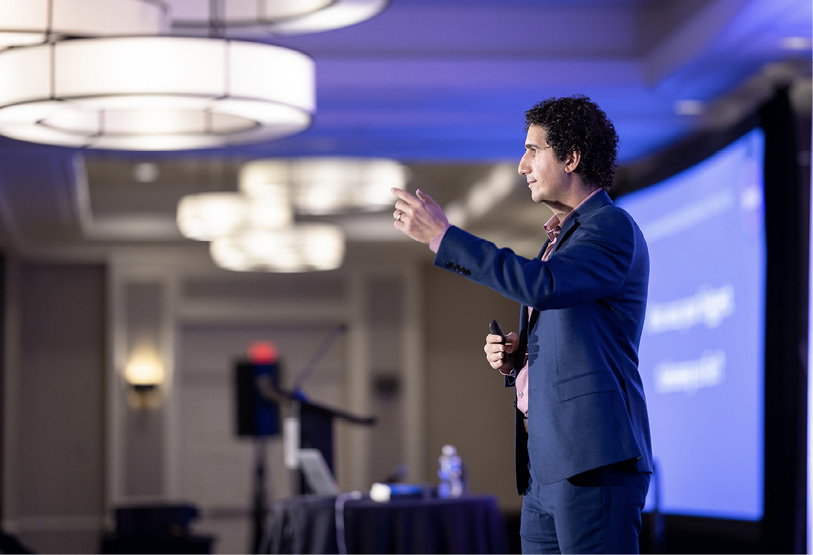
Dr. Mehdi Nourbakhsh has been integrating AI into AEC industry solutions for more than a decade. Yega Tech’s ‘teach them how to fish approach’ to AI consulting is hands-on, embedded and tailored to organizational objectives. (YegaTech)
YegaTech is an AEC industry consultancy that helps firms with AI strategy and execution, explains Dr. Nourbakhsh. “Yega means ‘unique or novel’ in Farsi. We have a unique way of looking at technology for the AEC industry. Rather than selling clients technology services, we take a ‘teach-them-how-to-fish’ approach. We embed with clients, understanding their organization, and building technology frameworks around their needs and capacities.”
Asked to assess the impact AI will have on the future of AEC services, he believes the answer lies in the question.
“Data is a number. When a number is accompanied by a value, such as Fahrenheit, it becomes information. When numerous pieces of information are coherently connected, we arrive at knowledge,” he explains. “CAD systems were based on dots and lines that required us to look at the design to interpret. Then, in the mid-2000s, the AEC industry transitioned to BIM, which models various information streams into a cohesive digital version of the design solution. In other words, we’ve been through the era of data-modeling (CAD), information modeling (BIM) and are now going to the era of knowledge modeling (AI-assisted design). What is different with AI is that now we have a technology that can think and design with us.”
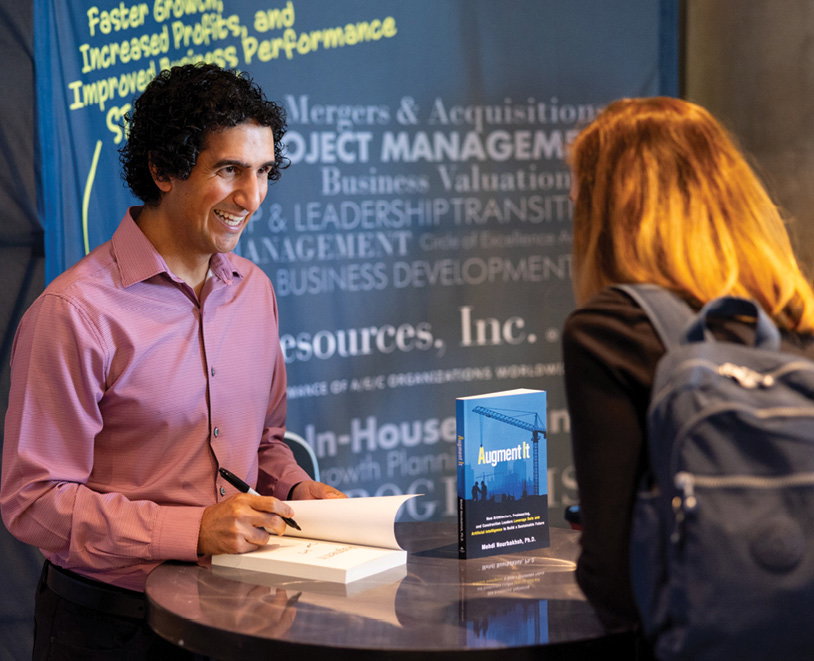
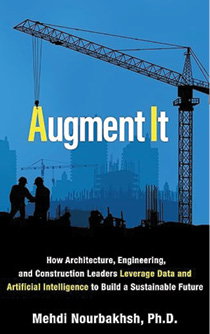
In addition to consultancy, Dr. Nourbakhsh regularly speaks to conferences, associations and business leaders on how AI is already impacting AEC. The author of two books on the topic, his goal is to educate 100,000 AEC professionals on how to respond to AI disruption and leverage data to build a sustainable future. (YegaTech)
As Dr. Nourbakhsh points out, until this point, programmers had to learn coding, complete extensive higher education and truly master the material to make computers do the things people ask of them. AI enables users to tell the computer what they want, and the computer writes the required code.
While the sky is the limit, Dr. Nourbakhsh reminds us that AI is far from the first cataclysmic technological change to overtake humanity. Indeed, there have been many. How organizations manage change determines how they weather the test of time.
“The challenge to AI integration is not the technology itself; it is the mindset of the leadership team and the company culture. Generally, leadership wants to run the organization as they always have,” says Dr. Nourbakhsh. “Imagine the arrival of electricity in the 1800s from the perspective of a business owner operating a significant amount of steam-powered machinery. Perhaps the costs of replacing machinery and wiring the factory didn’t pencil out. Some businesses invested in upgrading to electricity. Others dragged their feet. Some refused altogether. Business owners are accustomed to thinking about ROI. I believe the risks and cost of not investing in AI will be significant.”
As Dr. Nourbakhsh sees it, humanity has been through this before.
“A lot of people are fearful. There is a natural fear of the unknown, fear of a loss of control,” he concludes. “If you lean into change, fear becomes curiosity. Once people start using AI and understanding what it can do for them, a whole new world will open. The public needs to know that you will still have control over technology. However, control starts with moving past fear toward curiosity. YegaTech is on a mission to educate 100,000 AEC professionals on how to think intentionally about AI. The future
is bright.”
Learn More about AI in Engineering
To see how engineers in the field are integrating AI into their work, Todd Danielson, editorial director of Informed Infrastructure, interviewed Pusker Regmi, Stantec Vice President and Wastewater Sector Leader. They discussed the general role of AI in engineering and ways engineers can use the technology in their own practices safely and efficiently.
You can watch the full interview at iimag.link/iWKpc.

Sean Vincent O'Keefe
Sean Vincent O'Keefe is an architecture and construction writer who crafts stories and content based on 20 years of experience and a keen interest in the people who make projects happen; email: [email protected].
Video: New Roundabout Under Construction at McIver and Old Florence Roads in Darlington County

Bridge Replacement at Amsterdam Centraal Station

June Issue 2026
.jpg?width=225)