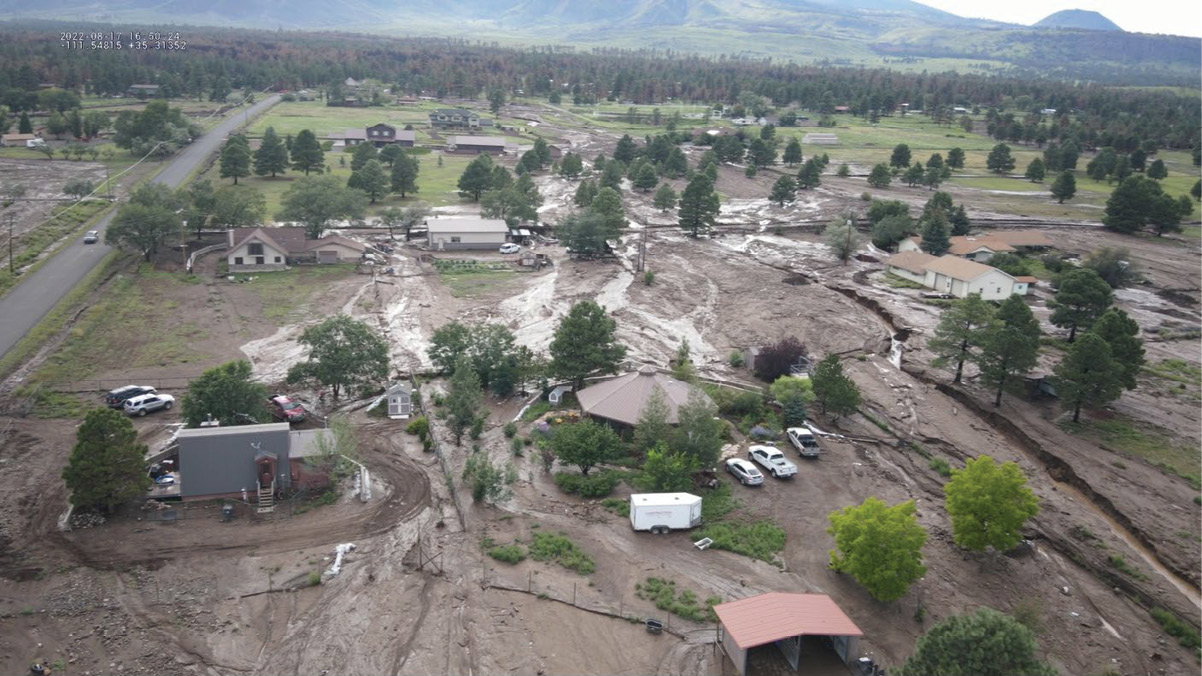
Post-wildfire flooding carrying ash, sediment, woody debris and boulders moves through a residential corridor after the 2022 Pipeline Fire. (Coconino County Emergency Management)
For wildfires in northern Arizona, the danger doesn’t end with the flames. When monsoon storms inevitably arrive, disaster can begin anew in the form of devastating flooding.
Rain that once soaked into forest soils can race downhill carrying ash, sediment, woody debris and even boulders toward neighborhoods below. Watersheds that had functioned safely for decades suddenly behave like entirely different systems, producing runoff many times greater than before the fire while threatening homes, roads and critical infrastructure.
Rick Shroads, P.E., founder of Civiltec Engineering, has watched such transformation firsthand. “The soils can get cooked, burnt, crystallized,” he explains. “They act almost like a sheet of glass when it rains. There’s no infiltration—the runoff just goes ...”
That was exactly the challenge facing Coconino County following the 2022 Pipeline Fire, which burned approximately 26,000 acres north of Flagstaff, Ariz., during summer 2022. Together with the nearby Tunnel Fire, the burn scar dramatically altered nine watersheds draining toward more than 1,500 homes, established neighborhoods and the U.S. Highway 89 corridor. Hydrologic modeling projected post-fire flood flows 10 to 31 times greater than historic conditions, leaving engineers only months to prepare before the next monsoon season.
Civiltec Engineering and Natural Channel Design Engineering were hardly entering unfamiliar territory. Following the Schultz Fire in 2010, the firms had worked with the Coconino County Flood Control District on post-fire flood mitigation and watershed restoration efforts. Additional fires across northern Arizona continued expanding that experience, giving engineers an unusual opportunity to study how burned watersheds respond under real conditions.
Experience alone, however, wasn’t enough. Although the County had constructed significant flood mitigation after the 2010 Schutlz Fire in some of this area, the existing measures were significantly strained, and some watersheds were burned to a far greater extent and much more severely burned.
The engineering team approached each of the nine watersheds individually while recognizing that every solution also had to function as part of a much larger regional system. Improvements in one drainage basin couldn’t simply transfer additional flood risk to another. Coconino County’s long-standing philosophy of creating no adverse downstream impacts remained one of the project’s guiding principles. That systems perspective influenced nearly every design decision.
Rather than relying on one large detention basin or oversized conveyance structure, engineers developed multiple layers of protection. Restoration work on National Forest land would reduce runoff velocities before flows reached developed areas. Restored alluvial fans and native rock structures would encourage sediment deposition and reduce erosion upstream. Large-diameter storm-drain systems would more safely convey remaining flows through neighborhoods before discharging into downstream detention facilities.
“The goal is to try to spread out and slow down the velocities of the flows on the forest within the alluvial fans,” notes Shroads. “The less debris and sedimentation that’s introduced into the storm-drain systems, the better.”
That philosophy represented an important shift in post-wildfire engineering. Instead of beginning where floodwaters entered neighborhoods, engineers began where runoff first formed.
Pipeline Fire Flood- Mitigation Program
.jpg)
• Owner: Coconino County Flood Control District
• Project Delivery Method: Construction Manager at Risk (CMAR)
• CMAR: Tiffany Construction Co. Inc.
• Lead Civil Engineers: Civiltec Engineering and Natural Channel Design Engineering
• Additional Design Consultants: JE Fuller Hydrology, Remal Consulting Engineers and Peak Engineering
• Pipeline Vendor: Contech Engineered Solutions LLC, a QUIKRETE Company
• Burn Area: Approximately 26,500 acres
• Watersheds Addressed: Nine
• Homes Protected: More than 1,500
• Major Transportation Corridor Affected: U.S. Highway 89
• Storm Drain Installed: More than 20,000 linear feet
• Largest Pipe: 120-inch spiral-rib metal pipe
• Total Cost to Date: $117 million
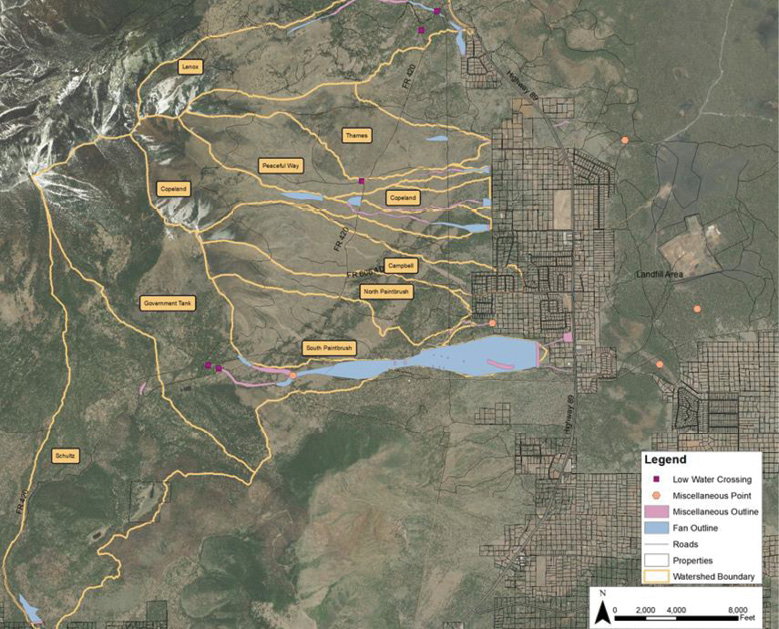
A map shows the nine affected watersheds (yellow outlines) and Highway 89 running north/south toward the right.
Looking Beyond Pipes
Large storm drains became one of the project’s most visible components, but they represented only one part of the overall solution.
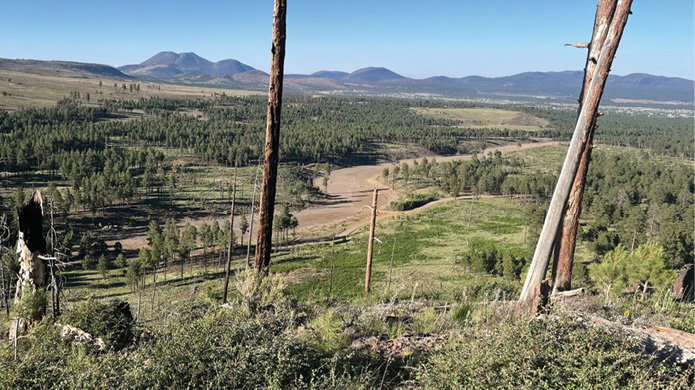
A photo shows a restored alluvial fan on National Forest land within the Government Tank Watershed. (Coconino County Emergency Management)
Before the fire, forest vegetation intercepted rainfall, surface litter slowed runoff and permeable soils absorbed much of the water before it reached drainage channels. Wildfire fundamentally altered that balance. Runoff arrived sooner, traveled faster and transported significantly more sediment, forcing engineers to reconsider not only the size of downstream infrastructure but where flood mitigation should begin.
By reducing flow velocities upstream and encouraging sediment to settle before entering conveyance systems, every downstream component could perform more effectively. This principle carried through every watershed addressed by the program.
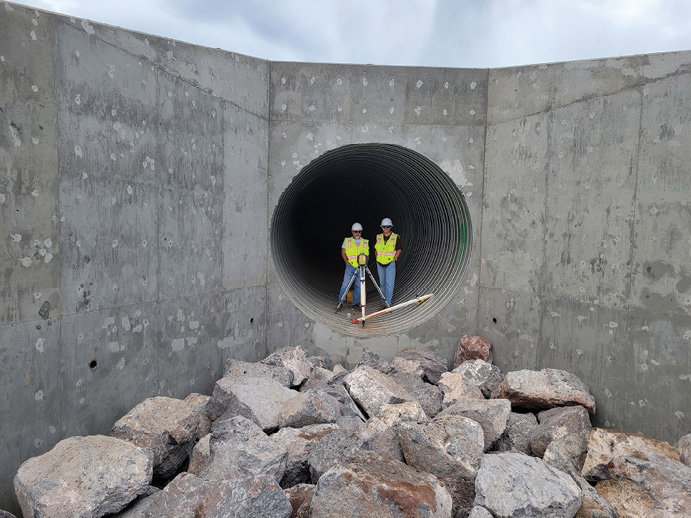
Standing inside a completed 120-inch-diameter pipe section illustrates the scale of the project’s stormwater conveyance system. Approximately 8,000 linear feet of 120-inch pipe—the largest size the mobile mill could fabricate—were installed throughout the mitigation program. (Coconino County Flood Control District)
Resident-Focused Engineering
Among the nine watersheds, South Copeland illustrates the practical challenges of turning watershed planning into constructed infrastructure. Runoff from the burned slopes ultimately flowed toward residential neighborhoods before reaching an existing regional detention basin west of Highway 89. Engineers evaluated several alternatives, including open channels, but quickly encountered a familiar obstacle.
Many of the affected neighborhoods had developed through Arizona’s lot-split process rather than as master-planned subdivisions. Continuous public rights-of-way were limited, leaving few obvious corridors for major drainage improvements.
Working with homeowners, the project team instead refined a solution centered on underground conveyance using 120-inch spiral-rib metal pipe. The approach minimized surface impacts while providing the hydraulic capacity necessary to safely move post-fire runoff toward expanded detention facilities.
“The team decided the best approach would be underground pipes,” adds Shroads.The primary storm drain carries approximately 1,500 to 1,800 cubic feet per second before discharging into the expanded Copeland Detention Facility. Engineers also incorporated an overflow channel paralleling portions of the pipeline to safely convey larger events should flows exceed the system’s design capacity. Downstream, the detention facilities temporarily store floodwaters before releasing them at controlled rates into drainage systems east of Highway 89, where highly permeable cinder deposits allow for some infiltration.
The hydraulic design solved only part of the problem, because every alignment crossed property owned by someone.
Rather than purchasing hundreds of easements through a very costly and lengthy acquisition process, the Flood Control District asked homeowners to voluntarily donate temporary and permanent easements. The engineering team then spent countless hours meeting individually with residents to explain proposed improvements, answer questions and adjust designs where feasible.
“They would say, ‘Come on in, show us your plans, roll them out on my kitchen table, and let’s talk about it,’” recalls Shroads. “‘Then let’s take the plans, tuck them underneath our arms, and go out and walk the site.’”
Those meetings became one of the project’s defining characteristics. Instead of limiting public involvement to formal presentations, engineers and property owners worked together in backyards, along fence lines and across proposed alignments, often resolving concerns before construction began.
“When people have faith in you and what you’re doing, and they know you’re on their side, I think it goes a long way,” adds Shroads.
Manufacturing the Solution Nearby
Designing for a 120-inch storm drain was one challenge; building more than 20,000 linear feet of large-diameter storm drain before the next monsoon season was another.
Transporting every pipe section from the Phoenix area would’ve required hundreds of trips through mountainous terrain while increasing costs and the potential for shipping damage. Instead, the project team established a temporary spiral-rib pipe-manufacturing facility less than five miles from most construction corridors. Another consideration was a massive project that was underway on the freeway between Phoenix and Flagstaff, which would have caused significant delays.
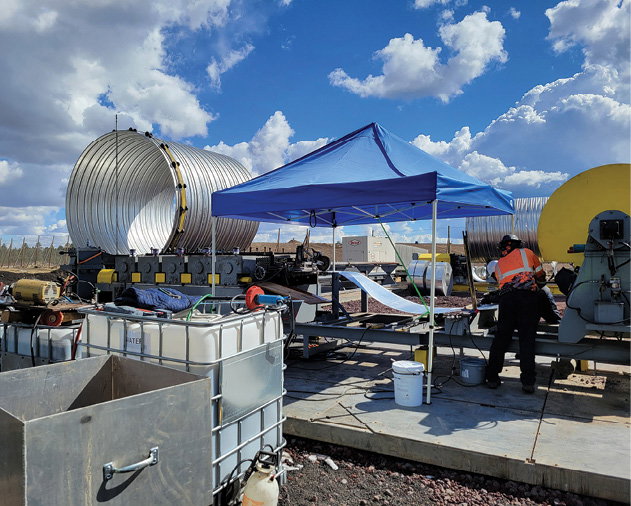
A temporary Contech mobile mill storm-drain pipe manufacturing facility produced spiral-rib metal pipe within five miles of the project corridors. Local production reduced transportation, improved construction scheduling and eliminated more than 1,000 truck trips that otherwise would have been required from the Phoenix area. (Coconino County Flood Control District)
“There was really no question that if we could manufacture the pipe onsite, it would be a cost saving,” states Shroads.
Steel coils arrived at the temporary facility brought in by pipe supplier Contech Engineered Solutions, where they were formed into spiral-rib metal pipe, cut into 20-foot sections and delivered directly to active construction sites. Producing pipe near the work simplified logistics, improved quality control and helped crews maintain an aggressive construction schedule despite winter weather and narrow seasonal construction windows.
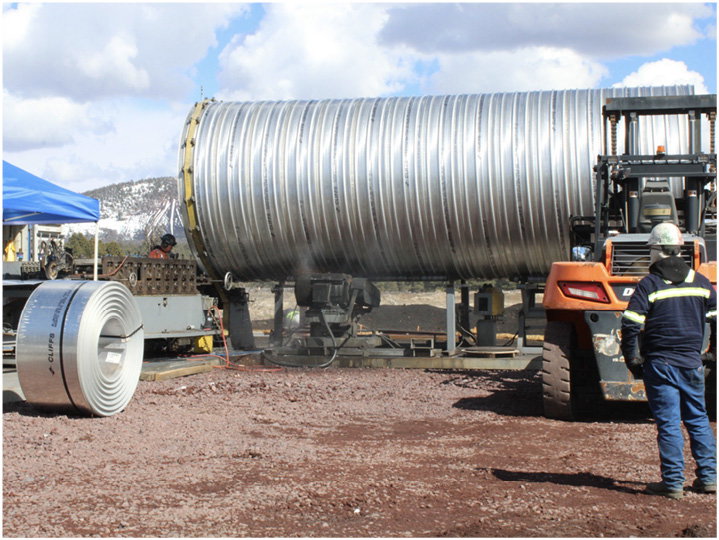
Pipe sections were fabricated near the project site and delivered as construction progressed, allowing crews to maintain an aggressive schedule despite winter weather, monsoon deadlines and the logistical challenges of constructing through established neighborhoods. (Coconino County Flood Control District)
Engineering Lessons from the Pipeline Fire
• Begin flood modeling immediately as the wildfire is progressing. Hydrologic conditions likely change before the first significant rainfall.
• Initiate long-term flood-mitigation planning and engineering while concurrently installing short-term flood-mitigation measures such as sandbag walls and concrete barriers.
• Treat sediment as part of the hydraulic design problem. Material captured upstream reduces downstream maintenance and improves system performance.
• Combine natural restoration with conventional infrastructure. Watershed restoration and engineered conveyance systems work best together.
• Engage property owners early. Walking alignments together often resolves issues more effectively than reviewing plans in a meeting room.
• Coordinate design, permitting and construction concurrently whenever possible. Overlapping activities helped compress delivery before seasonal weather windows closed.
Managing Water Before It Reaches the Pipe
One lesson appears throughout the project: Every downstream structure performs better when runoff is managed upstream.
Restored alluvial fans, native rock weirs and other watershed improvements reduce flow velocities while encouraging sediment deposition before debris reaches storm-drain systems. Cleaner water entering the conveyance system improves the long-term performance of culverts, inlets and detention basins while reducing maintenance demands after major storm events.
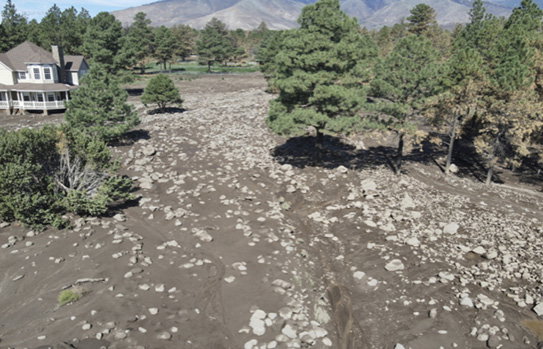
Large boulders were carried by massive floodwater after the Copeland Watershed unraveled. (Coconino County Emergency Management)
“If you can take flows and debulk them before they go downstream, then you’re one step ahead,” notes Shroads.
That approach reflects a broader change in post-wildfire flood mitigation. Instead of asking how quickly runoff can move through developed areas, engineers increasingly begin by asking how much runoff and sediment can be managed before either reaches downstream infrastructure.
On National Forest land, engineers restored alluvial fans using native rock and natural stabilization techniques rather than conventional concrete structures. The work slowed runoff, reduced erosion and encouraged sediment deposition before floodwaters reached downstream neighborhoods.
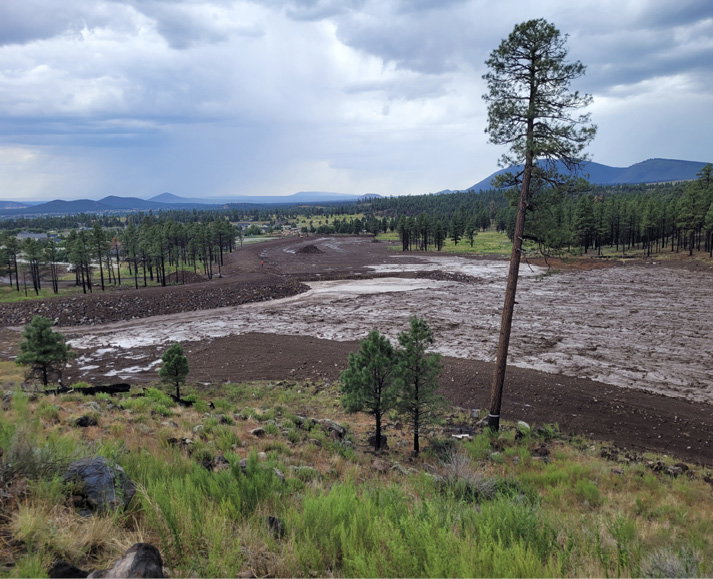
Three days after construction was completed, a monsoon storm approaching a 100-year recurrence interval tested one of several of the restored Wupatki Trails alluvial fans. The system successfully conveyed flood flows, providing an early demonstration of the project’s integrated watershed approach. (Allen Haden, Natural Channel Design Engineering)
Unfortunately, the Pipeline Fire mitigation program is unlikely to remain unique. Across the western United States, larger wildfires, changing precipitation patterns and continued development are forcing engineers to reconsider long-standing assumptions about stormwater design. While every watershed presents its own challenges, the underlying principles demonstrated in northern Arizona extend well beyond Flagstaff.
The project didn’t rely on one oversized pipe, one detention basin or one restoration technique. It succeeded because each component supported the next—from slowing runoff on burned forest slopes to conveying floodwaters through neighborhoods and temporarily storing flows before they continued downstream. The expertise and systems approach of the district’s team allowed them to engineer and construct about $100 million of flood mitigation in just more than two years.
When the first significant monsoon storms arrived after construction, the new infrastructure faced the test every engineer ultimately expects. For most residents, the storms passed with little notice. For the engineers who had spent months redesigning an altered watershed, that quiet outcome represented exactly what the project had been designed to achieve.

Todd Danielson
Todd Danielson has been in trade technology media for more than 20 years, now the editorial director for V1 Media and all of its publications: Informed Infrastructure, Earth Imaging Journal, Sensors & Systems and Asian Surveying & Mapping.
Video: New Roundabout Under Construction at McIver and Old Florence Roads in Darlington County
Promenade at The Point

June Issue 2026
.jpg?width=225)