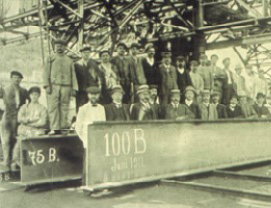
A photo from 1911 at the Differdange Mill in Luxembourg, celebrating the accomplishment of producing the first rolled beam in the world with a depth of 1 meter.
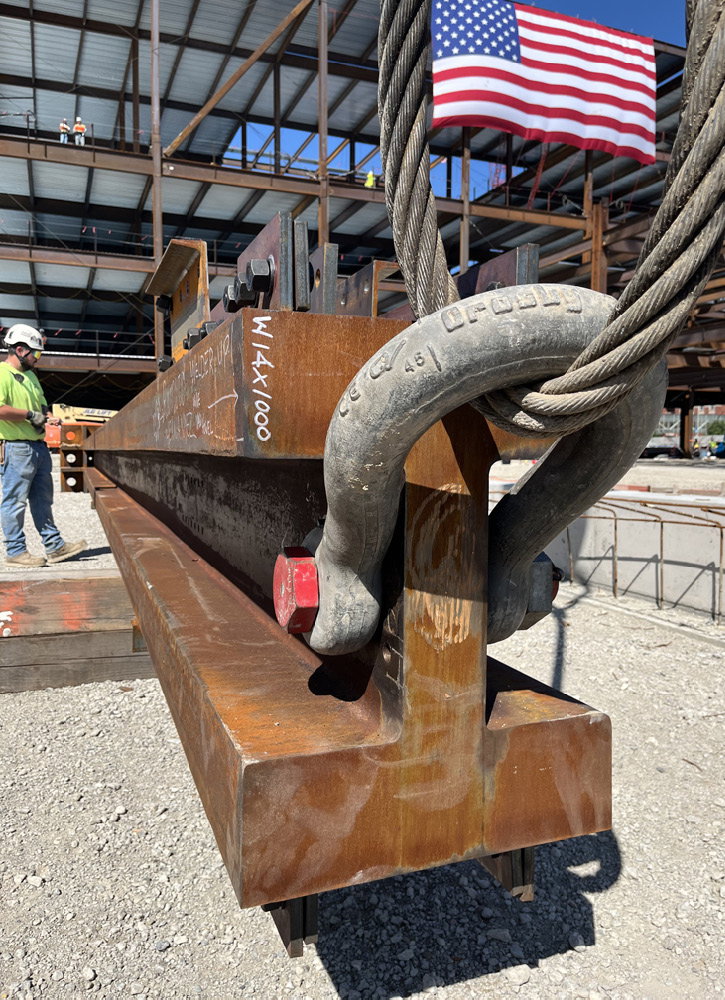
On July 1, 2025, a massive crane erected the world’s first W14x1000 steel column on the construction site of the Henry Ford Hospital in Detroit. As the heaviest rolled shape on earth, the column serves as a physical milestone in the evolution of the structural steel industry.
Since the turn of the 19th century, steel beams have evolved from relatively low strength and unreliable “I-beams” into the wide flange sections supporting the tallest, largest and most impressive structures in the world. Along these 100-plus years, several key technologies accelerated the evolution of wide flange beams, yet some of these achievements often are overlooked and undercelebrated (for instance, the inventor of the wide flange itself does not have a Wikipedia page). For this reason, it’s worth tracing the history of the steel beam and celebrating key milestones along the way.
I-Beams
In 1849, French inventor Alphonse Halbou developed the first I-shaped beam for use in structural applications. To accomplish this, he utilized a rolling process derived from the railroad industry, where wrought iron would pass through two symmetrical rollers as shown in Figure 1. These rollers squeezed the hot iron to form the web of the beam, and the excess liquid iron would fill in gaps left at the top and bottom of the rollers to create the flanges. The resulting beam had a strong web due to the compression of the rollers, but the flanges had inconsistent strength and thickness across the width of the section.
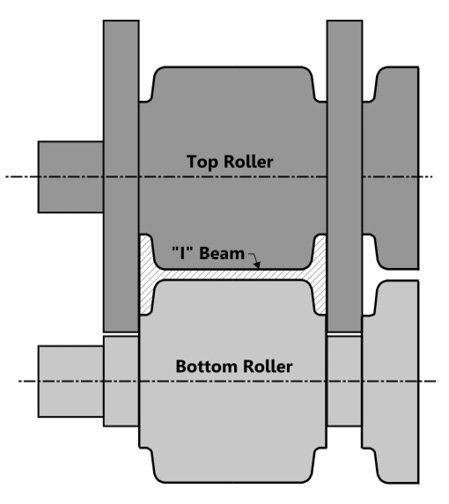
Figure 1. Typical Production Method for “I-Beams”
This didn’t pose a problem for producing railroad tracks, as the loads from trains directly pass through the web of the rail into the ground. However, a structural steel beam or column needs strong reliable flanges to resist flexural forces. For this reason, riveted built-up beams made from L shapes and plates were still preferable for most structural applications.
At the turn of the 20th century, many scientists and engineers in the steel industry searched for a solution to this problem. Several ideas were put forward, including a concept by E.M. Butz that would produce an extra tab at each flange tip that could be used to make simpler connections to other steel beams (Figure 2). Ultimately, these methods were too costly or impractical to implement in steel production, until Henry Grey developed the universal rolling method.
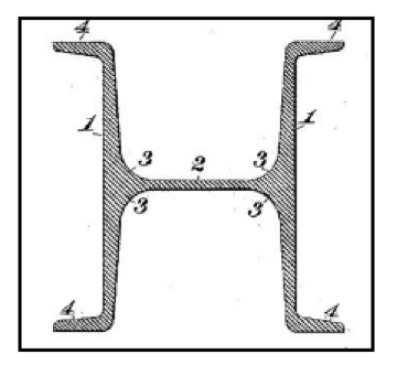
Figure 2. E.M. Butz’s Concept (Credit: Butz Patent No. 499,652, June 13, 1893; iimag.link/MNxCg)
Henry Grey
Born in England, Henry Grey emigrated to the United States at a young age and began a career in the steel industry. In 1896, a steel mill in Duluth, Minn., hired him to develop a method to roll wide flange beams in a commercially viable manner. During his time in Duluth, Grey invented and patented the universal rolling mill (Figure 3), which utilizes sets of both horizontal and vertical rollers to form the web and flange of the beam. A second set of “finishing” rollers then form the flange tips, completing the beam.
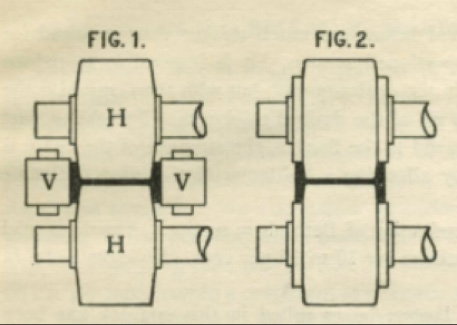
Figure 3. Henry Grey’s Universal Rolling Mill (Credit: Bethlehem Steel Company, 1907; iimag.link/bvWrn)
While Grey believed this technology would revolutionize the steel industry, engineers and mill owners in the United States were skeptical, so Grey couldn’t find an American mill willing to put this technology into full-scale production. Grey eventually found a mill in Luxembourg that was willing to take a chance on the invention, and, in 1902, Differdingen Iron and Steel Works became the first producer of the modern wide flange beam.
The invention became an immediate success, with the mill producing larger and more efficient shapes, including the world’s first 1-meter-deep beam in 1911. That same year the mill produced 15,000 tons of Grey’s beams per month, shifting focus exclusively to this single product.
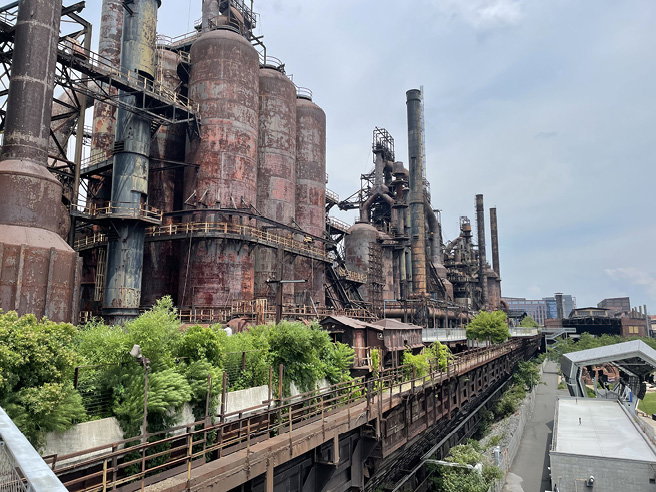
The remaining blast furnaces at the Bethlehem Steel mill. While the mill is now defunct, a portion of the facility is now a publicly accessible park. (Chris Urtz)
News of the success in Luxembourg quickly spread, and, in 1907, Bethlehem Steel became the first mill in the United States to begin production using the new rolling method. The Bethlehem Mill improved upon several of the technologies pioneered in Luxembourg, significantly increasing production volumes. The “Bethlehem Beams” produced at this mill also had a more consistent flange thickness than the beams originally produced in Luxembourg. Today, both mills are referred to as “Grey” mills in reference to Henry Grey’s accomplishments.
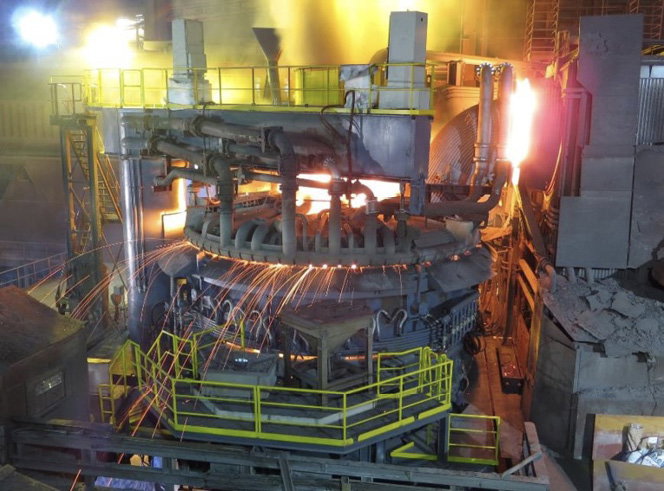
An example of an electric arc furnace melting down scrap metal to be reused as structural steel beams. (ArcelorMittal)
After other steel producers began selling their own versions of the “Bethlehem Beam,” the industry eventually settled on the standard wide flange shapes used today. The Bethlehem mill would eventually close in 1995, but the Luxembourg mill continued to modernize and upgrade its steelmaking practices. Today the Luxembourg mill (now ArcelorMittal Differdange) produces the strongest and largest wide flange shapes in the world, including the W36x925 and the aforementioned W14x1000. However, before the industry could get to this point, several more advances were needed to modernize the wide flange beam.
Steel Goes Electric
During the time when Henry Grey developed the wide flange beam, the excessive pollution associated with steelmaking made the prospect of living near a steel mill highly unpleasant. At this time, steel was produced exclusively from iron ore using a blast furnace and basic oxygen furnace.
In this steelmaking process, iron ore arrives at the mill as ferric oxide (Fe2O3). To make this ore suitable for steel making, the oxygen molecules must be detached from the iron molecules to make liquid iron (Fe). To accomplish this, steelmakers combine the iron ore with coke (CO) in a blast furnace under high temperatures. A chemical reaction occurs (Fe2O3 + 3CO → 2Fe + 3CO2), separating the oxygen from the iron and creating CO2 as a byproduct. This process leaves excess carbon intermixed with the liquid iron, which then is removed using an oxygen furnace. The oxygen furnace injects pure oxygen into the liquid iron, removing the carbon and creating additional CO2 as a byproduct. For this reason, blast furnace mills generate large quantities of carbon emissions (approximately 2,300 kg of CO2 per metric ton of crude steel).
During the mid-20th century, blast furnace mills began to see competition from mills utilizing a new steelmaking technology: the electric arc furnace (EAF). First developed in the late 1800s, EAFs were originally used to produce tool steels, but they eventually evolved into a commercially viable method for beam production. Unlike the coal-based blast furnace, the EAF uses large electrodes to melt solid iron into a liquified form. For this reason, an EAF can utilize scrap metal rather than iron ore as its primary feedstock, eliminating the need for the carbon-intensive process of separating oxygen from the iron.
This method is cleaner and safer and requires less capital than the traditional blast furnace mills. As World War II increased the demand for steel, construction of EAF mills greatly increased across the western hemisphere. Bethlehem Steel didn’t introduce EAFs into their beam mills, and this often is cited as one of the reasons for the mill’s eventual closure.
Today, all wide flange beams made in the United States are produced using this method. In 1994, the Differdange Mill replaced its blast furnace with twin EAFs. Since these EAFs are powered primarily by nuclear electricity generated in France, this mill now produces some of the lowest emissions for wide flange beams in the world.
Growing Stronger
As the steel industry evolved, new rolling methods and alloying practices allowed wide flange beams to gradually increase in strength from A7 steel (Fy = 33ksi) to A36 steel (Fy = 36ksi) and eventually to A992 steel (Fy = 50ksi). However, the most significant increase in strength came in the late 1980s with the introduction of the quenching and self-tempering (QST) process.
QST is an inline process that occurs directly after the rolling mill forms the beam into its final shape. While the beam is still hot from the rolling process (approximately 1,600°F), high-pressure water jets rapidly cool (quench) the exterior of the steel, while the interior remains warm (1,000°F to 1,300°F). After completion of this process, the warm interior of the steel reheats the exterior, self-tempering the beam.
The QST process refines the microstructure of the steel, increasing the strength without requiring additional energy for the tempering process. For this reason, utilizing these steels on a project doesn’t increase procurement lead times and only carries a marginal cost premium (approximately 1 to 3 percent industry wide). Since QST provides increased strength through mechanical methods rather than additional alloying elements, A913 steels have superior welding properties compared to conventional hot-rolled steels.
In 1990, the same mill in Luxembourg that produced the first wide flange beam also became the first mill to implement QST into its production line. The high-strength beams were originally sold as a proprietary product (HISTAR), but the steel grade soon was codified as a standard product (ASTM A913) in 1993. The original specification included three grades: Gr60, Gr65 and Gr70, with each grade number denoting the minimum yield strength. A913 Gr50 was introduced in 1995, providing a low-alloy alternative to A992 steel. Following an extensive upgrade to the QST process at the Luxembourg mill, A913 Gr80 was introduced in 2019 and is currently the strongest grade of wide flange steel in production today. Currently A913 Gr50, Gr65, Gr70 and Gr80 are commonly available and made by multiple producers.
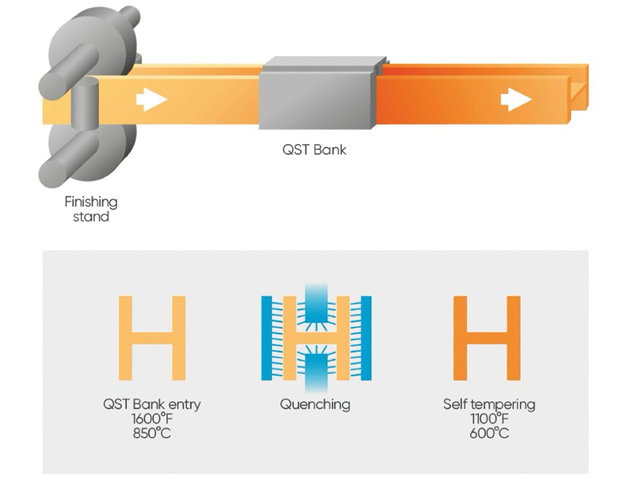
Figure 4. Diagram of Quenching and Self-Tempering Process (ArcelorMittal)
Unlike the previous evolutions to wide flange technology, A913 serves an effective but specific role, primarily used in strength-controlled members of large steel structures. Depending on the structural system, the size of a typical steel beam may be governed by stiffness or serviceability requirements rather than strength alone. The QST process also limits A913 steel to larger sizes (generally 100lb/ft or greater), as beams that are too thin can’t effectively self-temper.
For these reasons, the grade typically is used in large strength-controlled elements such as gravity columns, transfer trusses and short-span girders. The grade finds use in large concrete structures that require steel coupling beams (link beams) or composite columns. For these reasons, A913 doesn’t serve as a replacement for the more common grades of structural steel (A992 or A572) but works in harmony with these grades to provide the most efficient structure possible.
The Modern-Day Wide Flange
Throughout history, the steel beam has evolved in competition with built-up sections, from the riveted lattice structures of the early 1900s to the welded box columns found in modern skyscrapers. Wide flange beams always maintain the advantage of simplicity and lower fabrication cost, but as the demands on steel structures increase, it’s imperative that size and strength of these steels continue to grow.

Canada’s first supertall skyscraper (One Bloor West), set to be completed in 2028, utilizes four A913 Gr65 steel sections in each of the composite mega-columns supporting the building. (Chris Urtz)
The industry is eager to adopt these advancements, ensuring that engineers and fabricators can maximize the efficiency of their steel structures. The latest example came with the release of American Welding Society’s D1.1 2025 Structural Welding Code, which lists A913 Gr80 as the first base metal of 80-ksi yield strength permitted for prequalified welding.
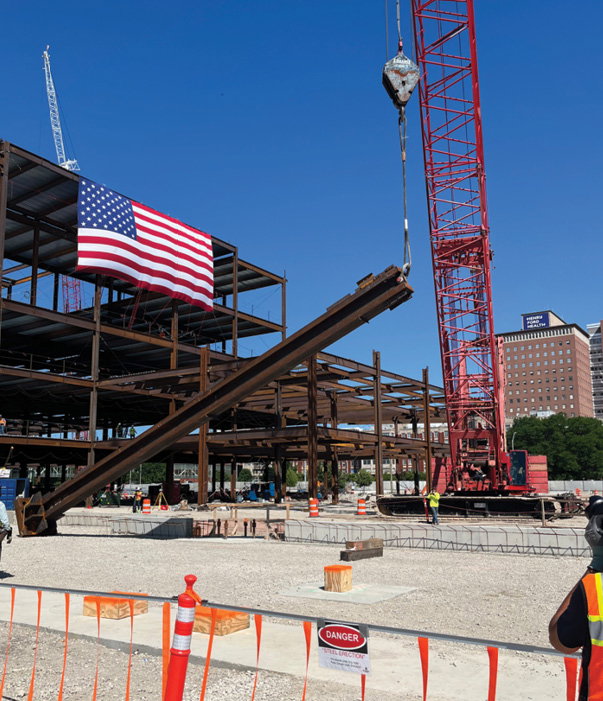
The world’s first W14x1000 steel column is ready for installation on the Henry Ford Hospital site. (Joe Dardis)
As we turn to the future, larger, stronger and more-sustainable steel beams are required to meet the demands of the ever-evolving construction industry. For this reason, it’s exceedingly important for architects, engineers, contractors and fabricators to collaborate with steelmakers so they can utilize the latest advancements in the industry.
Sources
The “Henry Grey” and “I-Beams” sections in the article are based on a thesis paper, “Henry Grey and the Bethlehem Beam,” by James W. Follweiler for Lehigh University in 2010. Lehigh will not allow distribution of the full paper, but the first 17 pages can be found at iimag.link/MNxCg.
Emissions Data in the “Steel Goes Electric” section is based on the following report: iimag.link/FlWqO.
The “Growing Stronger” and “Modern Day Wide Flange Sections” are mostly based on ArcelorMittal company resources, see iimag.link/KCZoH.
Chris Urtz
Chris Urtz, P.E., is a senior technical sales engineer for ArcelorMittal International North America; email: [email protected].
Video: New Roundabout Under Construction at McIver and Old Florence Roads in Darlington County

Bridge Replacement at Amsterdam Centraal Station
June Issue 2026
.jpg?width=225)